US5235632A - Mobile telephony system intended for indoor and outdoor subscriber use - Google Patents
Mobile telephony system intended for indoor and outdoor subscriber use Download PDFInfo
- Publication number
- US5235632A US5235632A US07/680,508 US68050891A US5235632A US 5235632 A US5235632 A US 5235632A US 68050891 A US68050891 A US 68050891A US 5235632 A US5235632 A US 5235632A
- Authority
- US
- United States
- Prior art keywords
- internal
- base stations
- external
- mobile
- mobile telephony
- Prior art date
- Legal status (The legal status is an assumption and is not a legal conclusion. Google has not performed a legal analysis and makes no representation as to the accuracy of the status listed.)
- Expired - Lifetime
Links
Images


Classifications
-
- H—ELECTRICITY
- H04—ELECTRIC COMMUNICATION TECHNIQUE
- H04W—WIRELESS COMMUNICATION NETWORKS
- H04W16/00—Network planning, e.g. coverage or traffic planning tools; Network deployment, e.g. resource partitioning or cells structures
- H04W16/14—Spectrum sharing arrangements between different networks
-
- H—ELECTRICITY
- H04—ELECTRIC COMMUNICATION TECHNIQUE
- H04W—WIRELESS COMMUNICATION NETWORKS
- H04W16/00—Network planning, e.g. coverage or traffic planning tools; Network deployment, e.g. resource partitioning or cells structures
- H04W16/02—Resource partitioning among network components, e.g. reuse partitioning
- H04W16/10—Dynamic resource partitioning
-
- H—ELECTRICITY
- H04—ELECTRIC COMMUNICATION TECHNIQUE
- H04W—WIRELESS COMMUNICATION NETWORKS
- H04W16/00—Network planning, e.g. coverage or traffic planning tools; Network deployment, e.g. resource partitioning or cells structures
- H04W16/02—Resource partitioning among network components, e.g. reuse partitioning
- H04W16/12—Fixed resource partitioning
-
- H—ELECTRICITY
- H04—ELECTRIC COMMUNICATION TECHNIQUE
- H04W—WIRELESS COMMUNICATION NETWORKS
- H04W84/00—Network topologies
- H04W84/02—Hierarchically pre-organised networks, e.g. paging networks, cellular networks, WLAN [Wireless Local Area Network] or WLL [Wireless Local Loop]
- H04W84/10—Small scale networks; Flat hierarchical networks
- H04W84/16—WPBX [Wireless Private Branch Exchange]
Definitions
- the present invention pertains to a mobile telephony system intended for indoor and outdoor subscriber use and comprising an external part-system for outdoor use which includes base stations of relatively high signal-strength and connected directly to a mobile switching centre, and an internal part-system for indoor use and having internal base stations of relatively low signal strength which are connected to the mobile switching centre.
- a known mobile telephony system includes geographic cells, each having a respective base station and being connected to a switching centre. Each base station has access to a given number of channels, which may be both frequency shared and time shared.
- the cells are collected in large cell groups, in which adjacent cells are assigned separate frequencies, so-called fixed channel assignment. All frequencies of the system are found within a cell group.
- Several cell groups are placed adjacent one another, in order to cover wide geographic regions and the frequency assignment in the cells is selected so that mutually separate groups will not disturb one another.
- CMS 88 Cellular Mobile Telephone System
- Ericsson Telecom AB 1988.
- Adaptive mobile telephony systems are also known, in which each base station has access to all system channels.
- a mobile subscriber is assigned a channel subsequent to measuring occurrent disturbances, so-called dynamic channel assignment.
- a system of this kind is intended for external use, normally by vehicular subscribers. Both the base station and the subscriber mobile station has a relatively high transmission power.
- Corresponding mobile telephony systems are known for indoor use, for instance in factories or offices, for instance as described in the 39th IEEE Vehicular Technology Conference, Volume 1, May 1-3, 1989, Dag ⁇ kerberg: "Properties of a TDMA Pico Cellular Office Communication System". This report describes an adaptive telephony system comprising cordless, portable subscriber apparatuses which can be connected to a subscriber exchange through base stations. One requirement is that such indoor systems shall have a large connection coupling capacity.
- the system has a relatively large number of small cells each with a respective base station, and both the base stations and the portable subscriber apparatuses have a relatively low signal strength. This enables the same channels to be utilized repeatedly within a building without the occurrence of troublesome disturbances.
- the aforesaid problems are solved in accordance with the invention by means of a combination of an outdoor system and an indoor system where both systems have access to substantially the whole of the assigned frequency range.
- the indoor system has adaptive channel assignment and relatively low signal strength.
- a subscriber mobile station is able to distinguish a base station in the outdoor system from a base station in the indoor system and to make a selection between these base stations. The mobile station can identify itself to the selected base station.
- the invention is characterized by the features set forth in the following Claims.
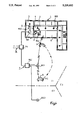
- FIG. 1 illustrates an internal mobile telephony system incorporated in a building which lies in the region of an external mobile telephony system
- FIG. 2 illustrates schematically signal sequences for the internal mobile telephony system
- FIG. 3 illustrates schematically signal sequences for the external mobile telephony system
- FIG. 4 illustrates an alternative embodiment of the building including the internal and the external mobile telephony system.
- FIG. 1 illustrates a building 1 which includes offices 2, laboratory locations 3, corridors 4 and an entrance hall 5.
- the building is equipped with a system 6 of cordless telephones which form an internal part-system of a mobile telephony system.
- This mobile telephony system includes an external part-system 7, which is a cell-divided mobile telephony system.
- the internal part-system includes in the corridors 4 internal base stations BSI which are connected to an internal switching centre MXI, by means of cables 8.
- This switching center is connected to an external mobile switching center MSC, which is connected to a subscriber exchange PX in the public telephone network.
- Each internal base station covers an area within the building 1, this area normally being referred to as a microcell.
- the external part-system 7 is divided into cells C1, C2 and C3, illustrated schematically in the Figure, and a base station, BS1 and BS2 is located in each cell. These base stations are connected to the external mobile switching center MSC and the external part-system has so-called fixed channel assignment.
- the whole of the external part-system has access to a mobile telephony frequency band, which is divided into a number of two-directional channels.
- Each cell has access to solely a part of these channels and the channels are distributed between the cells in a manner which will prevent adjacent cells from disturbing one another.
- One of the channels in each cell is a control channel which is used, for instance, to establish connections and to change channels, so-called handover.
- CMS 88 The external part-system is described in more detail in the aforesaid reference CMS 88.
- the internal part-system 6 also has access to a frequency band which is divided into a number of two-way channels.
- One of the channels in this system is also chosen as a control channel.
- An office normally requires a telephone system of large capacity. It must be possible for many users MSI within the limited area of the building 1 to obtain a connection simultaneously, without disturbing one another, and it must be possible for the consumers to move freely within the building while constantly being connected to one of the base stations BSI. Consequently, all of the base stations BSI of the internal part-system have access to all channels and the channel assignment is adaptive. In addition to the desired high capacity, this adaptive system also affords advantages from the aspect of installation. An adaptive cordless telephony system for indoor use is described in more detail in the aforesaid reference IEEE Vehicular Technology Conference.
- the assignment of a frequency band for mobile telephony, for instance, is given by the appropriate authority.
- the frequency range available is divided into frequency bands which are assigned to the users. It is important that the users do not encroach on one another frequency bands, so that a mobile radio system will not interfere with an aircraft landing system, for instance.
- the available frequency range is limited and the number of users is large and it is imperative that each user will utilize his limited frequency band effectively.
- both the internal part-system 6 and the external part-system 7 have access to the same frequency band.
- the mobile user MSI in the internal part-system is connected with one of his base stations BSI on a channel of determined frequency.
- a vehicular user MS located in a position 8 in the external part-system 7 establishes connection with his base station BS1 on the same channel.
- the transmission powers of the internal part-system are very small compared with the transmission powers of the external part-system and the risk of the connection to MS being disturbed by the internal part-system is small.
- the connection to the internal mobile station MSI can be disturbed by the established outdoor connection, and this risk is relatively high when the vehicular mobile station MS moves to a position 9 in the vicinity of the building 1.
- This disturbance is detected by the internal part-system and the disturbed channel in the internal part-system 6 is deactivated or disconnected and a non-disturbed channel is connected. Because the internal part-system is adaptive and all of the internal base stations BS1 have access to all channels, the probability of all channels being occupied or disturbed is very small, so that there is nothing to prevent the connection of this new channel.
- the mobile station MSI can determine whether it belongs to the internal part-system 6 or to the external part-system 7. It is necessary that a mobile station MSI is able to determine its status in this respect when a subscriber wishes to be able to call another subscriber or wishes to be called by some other subscriber.
- the signals of the external part-system 7 are so strong that said signals will often reach into the building 1, therewith enabling a conversation to be carried out indoors via the base station BS1 of the external part-system.
- the signals of the internal part-system are weak and it is often impossible to carry out an outdoor conversation via the internal base stations BSI. Consequently, when the subscriber is outdoors, it is necessary to establish a connection via the external base statiaon BSI.
- the control channels in the respective part-systems are used to determine whether the mobile stations MSI belong to the internal or the external part-system.
- the control channel is composed of a channel from the base station to the mobile station, often referred to as FOCC (Forward Control Channel) and a channel from the mobile to the base station, often referred to as RECC (Reverse Control Channel).
- FOCC Forward Control Channel
- RECC Reverse Control Channel
- the mobile station MSI listens constantly on FOCC, so as to be prepared to receive a call. When the mobile hears FOCC for the first time, the mobile transmits a signal with the intention of revealing its identity to the base station, so-called logging-in. This enables the mobile switching center MSC to connect the call to the correct base station.
- logging-in This enables the mobile switching center MSC to connect the call to the correct base station.
- the mobile station MSI is able to determine whether it belongs to the internal or to the external part-system in the following manner.
- the base stations BS1 of the internal part-system 6 transmit on the control channel FOCC signal sequences SSI which contain data words A and B intended for different purposes in a known manner, and an internal identification word IDI, as illustrated in FIG. 2.
- the reference sign T in FIG. 2 represents time.
- IDI is unique to the internal part-system.
- the base stations B1, B2 of the external part-system 7 transmit on the control channel FOCC signal sequences SSO which contain data words C and E intended for different purposes in a known manner, as shown in FIG. 3.
- the signal sequence SSO also includes an external identification word IDO which is unique to the external part-system.
- the mobile station MS constantly senses the control channels of the two part-systems. Immediately the signal strength of the identification word IDI in the internal part-system exceeds a threshhold value, the mobile station MSI will identify itself to the internal base stations BS1, i.e. the aforesaid logging-in process takes place. This is effected through a signal IDIR on the control channel RECC, as shown in FIG. 2.
- the mobile station registers the external identification word IDO and immediately the signal strength of the internal identification word IDI falls beneath the threshold value, the mobile station MSI will identify itself to one of the external base stations. This is effected through an external identification signal IDOR, as shown in FIG. 3.
- the mobile station MSI itself to request for a call to be connected or to be connected to a calling subscriber via one of the indoor base stations BS1, provided that the mobile station MSI is located within the building 1 and the signal strength of IDI exceeds said threshold value. If the mobile station MSI leaves the building 1, the signal strength of the identification word IDI will fall beneath the threshold value, whereupon the mobile station MSI identifies itself to the external base station BS1.
- the mobile station MSI can herewith ask to be connected to make a call or to be connected to a call via the external base station BS1, in a corresponding manner.
- the decision as to which of the two part-systems the mobile shall log into is decided on the signal strength of the identification word IDI in the control channel of the internal part-system. It is also possible to utilize the signal strength of the entire signal sequence SSI for the internal control channel or parts thereof, for instance the parts A and B. It is also possible to utilize, for instance, the bit error rate as a measurement of the signal quality on the channel, instead of a signal strength threshold value.
- the invention has been described in the aforegoing with reference to an exemplifying embodiment in which the internal base stations BSI and the external base stations BS1, BS2 are connected directly to the mobile switching center MSC.
- the advantage with this embodiment is that an ongoing call connection to the mobile station MSI can be maintained in a relatively simple fashion when the mobile station moves between the internal and the external part-systems.
- FIG. 4 illustrates an alternative embodiment of the invention which distinguishes from the embodiment illustrated in FIG. 1 insomuch as the two part-systems are mutually connected through a wire-bound public telephone network 10.
- the internal part-systems 6 is connected to a subscriber exchange AX which is connected by means of a wire to a public exchange PX in the public telephone network 10.
- the mobile switching center MSC is also connected to the public exchange PX by means of wires.
- Wire-bound telephone sets H may be connected to the subscriber exchange AX.
- the external part-system 7 has fixed channel assignment to the cells C1, C2 and C3.
- the external part-system may also be adaptive and the base stations BS1 and BS2 may have access to all channels of the system. It is also conceivable to permanently assign the majority of the traffic channels in the external part-system to the external base stations in accordance with a predetermined frequency plan, although a smaller number of the traffic channels will be assigned adaptively, for instance in accordance with Swedish Patent No. 8801555-7.
- the internal part-system 6 has access to all channels of the system. It lies within the scope of the invention to restrict this channel access.
Abstract
A mobile telephony system includes an internal part-system, which is installed in a building and an external part-system. The internal part-system has internal base stations which are connected to a mobile switching center, to which external base stations are also connected. The mobile telephony system is assigned a frequency band which comprises a plurality of channels. The external part-system is divided into cells and has fixed channel assignment with a few channels to each external base stations. The internal part-system is adaptive and the internal base stations have access to all channels of the system. In order to determine whether a mobile station belongs to the internal or to the external part-system, an internal identification word is transmitted from the internal base stations and an external identification word is transmitted from the external base stations. When the signal strength of the internal identification word exceeds a threshold value, the mobile station transmits an internal identification word to the internal base stations. If the signal strength falls beneath this threshold value, the mobile station identifies itself to the external part-system.
Description
The present invention pertains to a mobile telephony system intended for indoor and outdoor subscriber use and comprising an external part-system for outdoor use which includes base stations of relatively high signal-strength and connected directly to a mobile switching centre, and an internal part-system for indoor use and having internal base stations of relatively low signal strength which are connected to the mobile switching centre.
A known mobile telephony system includes geographic cells, each having a respective base station and being connected to a switching centre. Each base station has access to a given number of channels, which may be both frequency shared and time shared. The cells are collected in large cell groups, in which adjacent cells are assigned separate frequencies, so-called fixed channel assignment. All frequencies of the system are found within a cell group. Several cell groups are placed adjacent one another, in order to cover wide geographic regions and the frequency assignment in the cells is selected so that mutually separate groups will not disturb one another. A detailed description of the aforesaid system is found in CMS 88, Cellular Mobile Telephone System, Ericsson Telecom AB, 1988. Adaptive mobile telephony systems are also known, in which each base station has access to all system channels. A mobile subscriber is assigned a channel subsequent to measuring occurrent disturbances, so-called dynamic channel assignment. A system of this kind is intended for external use, normally by vehicular subscribers. Both the base station and the subscriber mobile station has a relatively high transmission power. Corresponding mobile telephony systems are known for indoor use, for instance in factories or offices, for instance as described in the 39th IEEE Vehicular Technology Conference, Volume 1, May 1-3, 1989, Dag Åkerberg: "Properties of a TDMA Pico Cellular Office Communication System". This report describes an adaptive telephony system comprising cordless, portable subscriber apparatuses which can be connected to a subscriber exchange through base stations. One requirement is that such indoor systems shall have a large connection coupling capacity. Accordingly, the system has a relatively large number of small cells each with a respective base station, and both the base stations and the portable subscriber apparatuses have a relatively low signal strength. This enables the same channels to be utilized repeatedly within a building without the occurrence of troublesome disturbances.
One problem encountered in mobile telephony is to offer the subscribers a sufficiently large number of channels within a limited frequency range. This frequency range is assigned by the authorities and may not be exceeded such that adjoining frequency ranges will be disturbed. Frequency time-sharing enables the number of channels within a frequency range to be increased considerably, although the number of channels remains restricted. Consequently, it is difficult to have an indoor system and an outdoor system for mobile telephony of large capacity within the same geographical region. Particular difficulties are found in introducing an indoor system in a region in which an outdoor system has already been established. It is also difficult for a subscriber to utilize both systems with one and the same mobile station.
The aforesaid problems are solved in accordance with the invention by means of a combination of an outdoor system and an indoor system where both systems have access to substantially the whole of the assigned frequency range. The indoor system has adaptive channel assignment and relatively low signal strength. A subscriber mobile station is able to distinguish a base station in the outdoor system from a base station in the indoor system and to make a selection between these base stations. The mobile station can identify itself to the selected base station.
The invention is characterized by the features set forth in the following Claims.
An exemplifying embodiment of the invention will now be described in more detail with reference to accompanying drawings, in which
FIG. 1 illustrates an internal mobile telephony system incorporated in a building which lies in the region of an external mobile telephony system;
FIG. 2 illustrates schematically signal sequences for the internal mobile telephony system;
FIG. 3 illustrates schematically signal sequences for the external mobile telephony system; and
FIG. 4 illustrates an alternative embodiment of the building including the internal and the external mobile telephony system.
FIG. 1 illustrates a building 1 which includes offices 2, laboratory locations 3, corridors 4 and an entrance hall 5. The building is equipped with a system 6 of cordless telephones which form an internal part-system of a mobile telephony system. This mobile telephony system includes an external part-system 7, which is a cell-divided mobile telephony system. The internal part-system includes in the corridors 4 internal base stations BSI which are connected to an internal switching centre MXI, by means of cables 8. This switching center is connected to an external mobile switching center MSC, which is connected to a subscriber exchange PX in the public telephone network. Each internal base station covers an area within the building 1, this area normally being referred to as a microcell. The external part-system 7 is divided into cells C1, C2 and C3, illustrated schematically in the Figure, and a base station, BS1 and BS2 is located in each cell. These base stations are connected to the external mobile switching center MSC and the external part-system has so-called fixed channel assignment. The whole of the external part-system has access to a mobile telephony frequency band, which is divided into a number of two-directional channels. Each cell has access to solely a part of these channels and the channels are distributed between the cells in a manner which will prevent adjacent cells from disturbing one another. One of the channels in each cell is a control channel which is used, for instance, to establish connections and to change channels, so-called handover. The external part-system is described in more detail in the aforesaid reference CMS 88.
The internal part-system 6 also has access to a frequency band which is divided into a number of two-way channels. One of the channels in this system is also chosen as a control channel. An office normally requires a telephone system of large capacity. It must be possible for many users MSI within the limited area of the building 1 to obtain a connection simultaneously, without disturbing one another, and it must be possible for the consumers to move freely within the building while constantly being connected to one of the base stations BSI. Consequently, all of the base stations BSI of the internal part-system have access to all channels and the channel assignment is adaptive. In addition to the desired high capacity, this adaptive system also affords advantages from the aspect of installation. An adaptive cordless telephony system for indoor use is described in more detail in the aforesaid reference IEEE Vehicular Technology Conference.
The assignment of a frequency band for mobile telephony, for instance, is given by the appropriate authority. The frequency range available is divided into frequency bands which are assigned to the users. It is important that the users do not encroach on one another frequency bands, so that a mobile radio system will not interfere with an aircraft landing system, for instance. The available frequency range is limited and the number of users is large and it is imperative that each user will utilize his limited frequency band effectively. In order to enable frequencies to be utilized effectively, both the internal part-system 6 and the external part-system 7 have access to the same frequency band.
Obviously, there is a risk that the internal part-system 6 and the external part-system 7 will interfere with one another. The mobile user MSI in the internal part-system is connected with one of his base stations BSI on a channel of determined frequency. A vehicular user MS located in a position 8 in the external part-system 7 establishes connection with his base station BS1 on the same channel. The transmission powers of the internal part-system are very small compared with the transmission powers of the external part-system and the risk of the connection to MS being disturbed by the internal part-system is small. On the other hand, the connection to the internal mobile station MSI can be disturbed by the established outdoor connection, and this risk is relatively high when the vehicular mobile station MS moves to a position 9 in the vicinity of the building 1. This disturbance is detected by the internal part-system and the disturbed channel in the internal part-system 6 is deactivated or disconnected and a non-disturbed channel is connected. Because the internal part-system is adaptive and all of the internal base stations BS1 have access to all channels, the probability of all channels being occupied or disturbed is very small, so that there is nothing to prevent the connection of this new channel.
It is important that the mobile station MSI can determine whether it belongs to the internal part-system 6 or to the external part-system 7. It is necessary that a mobile station MSI is able to determine its status in this respect when a subscriber wishes to be able to call another subscriber or wishes to be called by some other subscriber. The signals of the external part-system 7 are so strong that said signals will often reach into the building 1, therewith enabling a conversation to be carried out indoors via the base station BS1 of the external part-system. The signals of the internal part-system, on the other hand, are weak and it is often impossible to carry out an outdoor conversation via the internal base stations BSI. Consequently, when the subscriber is outdoors, it is necessary to establish a connection via the external base statiaon BSI. When the subscriber is indoors, it is often advantageous to establish a call via the internal base stations BSI, among other things because of channel availability and also for cost reasons. An advantage is therefore also afforded when each of the internal base stations BSI220 has access to all channels of the system, so that the risk of a call not being connected will be small.
The control channels in the respective part-systems are used to determine whether the mobile stations MSI belong to the internal or the external part-system. The control channel is composed of a channel from the base station to the mobile station, often referred to as FOCC (Forward Control Channel) and a channel from the mobile to the base station, often referred to as RECC (Reverse Control Channel). The mobile station MSI listens constantly on FOCC, so as to be prepared to receive a call. When the mobile hears FOCC for the first time, the mobile transmits a signal with the intention of revealing its identity to the base station, so-called logging-in. This enables the mobile switching center MSC to connect the call to the correct base station. A more detailed description of the control channel of a digital mobile telephony system is found, for instance, in the aforesaid reference CMS 88, Chapter 3.
The mobile station MSI is able to determine whether it belongs to the internal or to the external part-system in the following manner. The base stations BS1 of the internal part-system 6 transmit on the control channel FOCC signal sequences SSI which contain data words A and B intended for different purposes in a known manner, and an internal identification word IDI, as illustrated in FIG. 2. The reference sign T in FIG. 2 represents time. IDI is unique to the internal part-system. The base stations B1, B2 of the external part-system 7 transmit on the control channel FOCC signal sequences SSO which contain data words C and E intended for different purposes in a known manner, as shown in FIG. 3. The signal sequence SSO also includes an external identification word IDO which is unique to the external part-system. The mobile station MS constantly senses the control channels of the two part-systems. Immediately the signal strength of the identification word IDI in the internal part-system exceeds a threshhold value, the mobile station MSI will identify itself to the internal base stations BS1, i.e. the aforesaid logging-in process takes place. This is effected through a signal IDIR on the control channel RECC, as shown in FIG. 2. The mobile station registers the external identification word IDO and immediately the signal strength of the internal identification word IDI falls beneath the threshold value, the mobile station MSI will identify itself to one of the external base stations. This is effected through an external identification signal IDOR, as shown in FIG. 3. This enables the mobile station MSI itself to request for a call to be connected or to be connected to a calling subscriber via one of the indoor base stations BS1, provided that the mobile station MSI is located within the building 1 and the signal strength of IDI exceeds said threshold value. If the mobile station MSI leaves the building 1, the signal strength of the identification word IDI will fall beneath the threshold value, whereupon the mobile station MSI identifies itself to the external base station BS1. The mobile station MSI can herewith ask to be connected to make a call or to be connected to a call via the external base station BS1, in a corresponding manner.
In the case of the illustrated embodiment, the decision as to which of the two part-systems the mobile shall log into is decided on the signal strength of the identification word IDI in the control channel of the internal part-system. It is also possible to utilize the signal strength of the entire signal sequence SSI for the internal control channel or parts thereof, for instance the parts A and B. It is also possible to utilize, for instance, the bit error rate as a measurement of the signal quality on the channel, instead of a signal strength threshold value.
The invention has been described in the aforegoing with reference to an exemplifying embodiment in which the internal base stations BSI and the external base stations BS1, BS2 are connected directly to the mobile switching center MSC. The advantage with this embodiment is that an ongoing call connection to the mobile station MSI can be maintained in a relatively simple fashion when the mobile station moves between the internal and the external part-systems.
FIG. 4 illustrates an alternative embodiment of the invention which distinguishes from the embodiment illustrated in FIG. 1 insomuch as the two part-systems are mutually connected through a wire-bound public telephone network 10. The internal part-systems 6 is connected to a subscriber exchange AX which is connected by means of a wire to a public exchange PX in the public telephone network 10. The mobile switching center MSC is also connected to the public exchange PX by means of wires. Wire-bound telephone sets H may be connected to the subscriber exchange AX.
In the case of the described embodiment, the external part-system 7 has fixed channel assignment to the cells C1, C2 and C3. In accordance with the invention, however, the external part-system may also be adaptive and the base stations BS1 and BS2 may have access to all channels of the system. It is also conceivable to permanently assign the majority of the traffic channels in the external part-system to the external base stations in accordance with a predetermined frequency plan, although a smaller number of the traffic channels will be assigned adaptively, for instance in accordance with Swedish Patent No. 8801555-7. In the illustrated embodiment, the internal part-system 6 has access to all channels of the system. It lies within the scope of the invention to restrict this channel access.
Claims (8)
1. A mobile telephony system with a plurality of cells intended for indoor and outdoor subscriber use, and comprising an external part-system for outdoor use which includes external base stations of relatively high signal strength and connected directly to a mobile switching centre, and an internal part-system for indoor use and having internal base stations of relatively low signal strength which are connected to the mobile switching centre, wherein
the two part-systems have traffic channels essentially for call transmissions and control channels essentially for assignment and change of the traffic channels;
at least one of the traffic channels of the internal part-system has the same frequency as the traffic channels assigned to the base station of the external part-system cell in which the internal part-system is located;
the inner part-system has adaptive channel assignment;
an internal identification word which is unique to the internal part-system is transmitted from the internal base stations on the control channels in the internal part-system;
an outer identification word which is unique to the external part-system is transmitted from the external base stations on the control channels in the external part-system;
a mobile station detects a signal quality for the control channel of the internal part-system on which the internal identification word is transmitted;
the mobile station transmits an internal identification signal to the internal base stations when the detected signal quality exceeds a desired quality measurement; and
wherein the mobile station transmits an external identification signal to the external base stations when the detected signal quality is beneath the desired quality measurement.
2. A mobile telephony system according to claim 1, wherein the internal base stations are connected directly to the mobile switching centre MSC.
3. A mobile telephony system according to claim 1, wherein the internal base stations are connected to the mobile switching centre via a wire-bound telephone network.
4. A mobile telephony system according to claim 1, wherein the signal quality detected is a measurement of the signal strength of the control channel of said internal part-system.
5. A mobile telephony system according to claim 1, wherein the external part-system has fixed channel assignment.
6. A mobile telephony system according to claim 1, wherein the internal base stations are connected to a mobile switching centre via a subscriber exchange.
7. A mobile telephony system according to claim 1, wherein the frequency range of the traffic channels of the internal base stations are the same as the frequency range of traffic channels of the mobile telephony system.
8. A mobile telephony system according to claim 1, wherein the frequency range of the traffic and control channels of the internal base stations are the same as the frequency range of the traffic and control channels of the mobile telephony system.
Applications Claiming Priority (2)
| Application Number | Priority Date | Filing Date | Title |
|---|---|---|---|
| SE9001312A SE465992B (en) | 1990-04-10 | 1990-04-10 | MOBILE PHONE SYSTEM PROVIDED TO USE BY SUBSCRIBERS INDOOR AND OUTDOOR |
| SE9001312 | 1990-04-10 |
Publications (1)
| Publication Number | Publication Date |
|---|---|
| US5235632A true US5235632A (en) | 1993-08-10 |
Family
ID=20379150
Family Applications (1)
| Application Number | Title | Priority Date | Filing Date |
|---|---|---|---|
| US07/680,508 Expired - Lifetime US5235632A (en) | 1990-04-10 | 1991-04-04 | Mobile telephony system intended for indoor and outdoor subscriber use |
Country Status (11)
| Country | Link |
|---|---|
| US (1) | US5235632A (en) |
| EP (1) | EP0452290B1 (en) |
| JP (1) | JP3244182B2 (en) |
| CN (1) | CN1025906C (en) |
| AU (1) | AU635406B2 (en) |
| BR (1) | BR9101376A (en) |
| CA (1) | CA2040042C (en) |
| DE (1) | DE69113501T2 (en) |
| ES (1) | ES2080285T3 (en) |
| HK (1) | HK18896A (en) |
| SE (1) | SE465992B (en) |
Cited By (83)
| Publication number | Priority date | Publication date | Assignee | Title |
|---|---|---|---|---|
| US5400327A (en) * | 1993-09-30 | 1995-03-21 | Rockwell International Corporation | Automatic call distributor with wireless connection with remote unit and method |
| WO1995023490A1 (en) * | 1994-02-25 | 1995-08-31 | Celcore, Inc. | Mobility management method for delivering calls in a microcellular network |
| US5452471A (en) * | 1992-11-12 | 1995-09-19 | Motorola, Inc. | Network of hierarchical communication systems and method therefor |
| US5487101A (en) * | 1993-03-26 | 1996-01-23 | Celcore, Inc. | Off-load cellular system for off-loading cellular service from a main cellular system to increase cellular service capacity |
| US5535424A (en) * | 1993-09-10 | 1996-07-09 | Alcatel Mobile Communication France | Method enabling a mobile station of a cellular mobile radio system with more than one type of cell to determine the type of cell it is accessing, and mobile station and base transceiver station for implementing this method |
| US5555260A (en) * | 1994-02-25 | 1996-09-10 | Telefonaktiebolaget Lm Ericsson | Decentralized base station for reducing bandwidth requirements for communications to and from radio transmitter-receivers in a telecommunications network |
| US5564121A (en) * | 1994-08-18 | 1996-10-08 | Northern Telecom Limited | Microcell layout having directional and omnidirectional antennas defining a rectilinear layout in a building |
| US5594782A (en) * | 1994-02-24 | 1997-01-14 | Gte Mobile Communications Service Corporation | Multiple mode personal wireless communications system |
| US5604789A (en) * | 1994-07-01 | 1997-02-18 | U S West Technologies, Inc. | Method and system for providing a digital wireless local loop |
| US5634193A (en) * | 1992-03-24 | 1997-05-27 | Telefonaktiebolaget Lm Ericsson | Method of locating a mobile station in a mobile telephone system having indoor and outdoor base stations |
| WO1998001001A1 (en) * | 1996-06-28 | 1998-01-08 | At & T Corp. | Method and apparatus for maintaining channel priority in a multiple wireless communication system environment |
| US5850604A (en) * | 1995-04-28 | 1998-12-15 | Telefonaktiebologet Lm Ericsson (Publ) | System and method for restricting call setup to a fixed subscription area in a cellular telecommunications network |
| WO1999003290A1 (en) * | 1997-07-11 | 1999-01-21 | Nortel Networks Corporation | Method and apparatus for switching between public macrocellular telephone system and private microcellular telephone system |
| US5890064A (en) * | 1996-03-13 | 1999-03-30 | Telefonaktiebolaget L M Ericsson (Publ) | Mobile telecommunications network having integrated wireless office system |
| US5913169A (en) * | 1994-12-15 | 1999-06-15 | Nokia Telecommunications Oy | Cellular mobile station system |
| US5930726A (en) * | 1996-01-19 | 1999-07-27 | Nec Corporation | Mobile communication without call interruption during transition between outdoor and indoor modes |
| US5936572A (en) * | 1994-02-04 | 1999-08-10 | Trimble Navigation Limited | Portable hybrid location determination system |
| US5946622A (en) * | 1996-11-19 | 1999-08-31 | Ericsson Inc. | Method and apparatus for providing cellular telephone service to a macro-cell and pico-cell within a building using shared equipment |
| US6005884A (en) * | 1995-11-06 | 1999-12-21 | Ems Technologies, Inc. | Distributed architecture for a wireless data communications system |
| US6047195A (en) * | 1995-08-25 | 2000-04-04 | Kyocera Corporation | Sound volume setting device for a portable telephone |
| US6078812A (en) * | 1997-12-15 | 2000-06-20 | Ericsson Inc. | System and method for adaptive channel allocation |
| CN1065404C (en) * | 1993-12-22 | 2001-05-02 | 诺基亚流动电话有限公司 | Multi-mode radio telephone |
| US6263211B1 (en) * | 1998-09-24 | 2001-07-17 | Telefonaktiebolaget L M Ericsson (Publ) | System and method of automatically conveying a Wireless Office System (WOS) frequency set to mobile stations |
| US6374102B1 (en) | 1998-12-31 | 2002-04-16 | At+T Corp. | User proactive call handling |
| US20020136173A1 (en) * | 2001-03-22 | 2002-09-26 | Monroe Robert L. | System and method for user notification in a communication system |
| US6535730B1 (en) | 1998-12-31 | 2003-03-18 | At&T Corp. | Wireless centrex conference call adding a party |
| US6574470B1 (en) | 1998-12-31 | 2003-06-03 | At&T Corp. | Programmable ring-call forwarding in a wireless centrex services system |
| US20030119548A1 (en) * | 2001-02-26 | 2003-06-26 | Jahangir Mohammed | Method for extending the coverage area of a licensed wireless communications system using an unlicensed wireless communications system |
| US6587683B1 (en) | 1998-12-31 | 2003-07-01 | At&T Corp. | Unconditional call forwarding in a wireless centrex services system |
| US6591115B1 (en) | 1998-12-31 | 2003-07-08 | At&T Corp. | Wireless centrex call hold |
| US6606493B1 (en) | 1998-12-31 | 2003-08-12 | At&T Corp. | Wireless centrex conference call deleting a party |
| US6618600B1 (en) | 1998-12-31 | 2003-09-09 | At&T Corp. | Distinctive ringing in a wireless centrex system |
| US6631258B1 (en) | 1998-12-31 | 2003-10-07 | At&T Corp. | Busy call forwarding in a wireless centrex services system |
| US6643507B1 (en) | 1998-12-31 | 2003-11-04 | At&T Corp. | Wireless centrex automatic callback |
| US6654615B1 (en) | 1998-12-31 | 2003-11-25 | Albert Chow | Wireless centrex services |
| US6654603B1 (en) | 1998-12-31 | 2003-11-25 | At&T Corp. | Call waiting in a wireless centrex system |
| US6708028B1 (en) * | 1993-12-22 | 2004-03-16 | Nokia Mobile Phones, Ltd. | Multi-mode radio telephone |
| US6711401B1 (en) | 1998-12-31 | 2004-03-23 | At&T Corp. | Wireless centrex call return |
| US6738615B1 (en) | 1998-12-31 | 2004-05-18 | At&T Corp. | Wireless centrex caller ID |
| US6745025B1 (en) | 1998-12-31 | 2004-06-01 | At&T Corp. | Time-of-day call forwarding in a wireless centrex services system |
| US6762992B1 (en) | 2000-05-17 | 2004-07-13 | Telefonaktiebolaget Lm Ericsson (Publ) | Ring topology wireless local loop system and fallback method to conventional cellular system |
| US6771953B1 (en) | 1998-12-31 | 2004-08-03 | At&T Corp. | Wireless centrex call transfer |
| US6819945B1 (en) | 1998-12-31 | 2004-11-16 | At&T Corp. | Wireless centrex feature activation/deactivation |
| EP0808549B1 (en) * | 1995-02-06 | 2005-02-09 | Telia Ab | Arrangement for handover in a mobile telecommunications network |
| US20050181805A1 (en) * | 2003-10-17 | 2005-08-18 | Gallagher Michael D. | Method and system for determining the location of an unlicensed mobile access subscriber |
| US6961559B1 (en) | 1998-12-31 | 2005-11-01 | At&T Corp. | Distributed network voice messaging for wireless centrex telephony |
| US20050265279A1 (en) * | 2002-10-18 | 2005-12-01 | Milan Markovic | Apparatus and messages for interworking between unlicensed access network and GPRS network for data services |
| US20060025145A1 (en) * | 2002-10-18 | 2006-02-02 | Gallagher Michael D | Mobile station GPRS implementation for switching between licensed and unlicensed wireless systems |
| US7003287B2 (en) | 2001-02-12 | 2006-02-21 | Siemens Ag | System and method for call forwarding in a communication system |
| US7039025B1 (en) | 2000-09-29 | 2006-05-02 | Siemens Communications, Inc. | System and method for providing general packet radio services in a private wireless network |
| US7260078B1 (en) | 2000-02-08 | 2007-08-21 | Siemens Aktiengesellschaft | Method and system for providing management protocol mediation in wireless communications networks |
| US7272397B2 (en) | 2003-10-17 | 2007-09-18 | Kineto Wireless, Inc. | Service access control interface for an unlicensed wireless communication system |
| US7283822B2 (en) | 2003-10-17 | 2007-10-16 | Kineto Wireless, Inc. | Service access control interface for an unlicensed wireless communication system |
| US7308263B2 (en) | 2001-02-26 | 2007-12-11 | Kineto Wireless, Inc. | Apparatus for supporting the handover of a telecommunication session between a licensed wireless system and an unlicensed wireless system |
| US20080058005A1 (en) * | 1994-02-24 | 2008-03-06 | Gte Wireless Incorporated | System and method of telephonic dialing simulation |
| US7349698B2 (en) | 2002-10-18 | 2008-03-25 | Kineto Wireless, Inc. | Registration messaging in an unlicensed mobile access telecommunications system |
| US20080305793A1 (en) * | 2006-07-14 | 2008-12-11 | Gallagher Michael D | Method and Apparatus for Exchanging User Equipment and Network Controller Capabilities in a Communication System |
| US7471655B2 (en) | 2003-10-17 | 2008-12-30 | Kineto Wireless, Inc. | Channel activation messaging in an unlicensed mobile access telecommunications system |
| US7515575B1 (en) | 2005-08-26 | 2009-04-07 | Kineto Wireless, Inc. | Intelligent access point scanning with self-learning capability |
| US7565145B2 (en) | 2002-10-18 | 2009-07-21 | Kineto Wireless, Inc. | Handover messaging in an unlicensed mobile access telecommunications system |
| US7634269B2 (en) | 2002-10-18 | 2009-12-15 | Kineto Wireless, Inc. | Apparatus and method for extending the coverage area of a licensed wireless communication system using an unlicensed wireless communication system |
| US7640008B2 (en) | 2002-10-18 | 2009-12-29 | Kineto Wireless, Inc. | Apparatus and method for extending the coverage area of a licensed wireless communication system using an unlicensed wireless communication system |
| US20100041402A1 (en) * | 2008-08-15 | 2010-02-18 | Gallagher Michael D | Method and Apparatus for Distributing Temporary ID/Permanent ID Relationships in Enterprise Home Node B System |
| US7756546B1 (en) | 2005-03-30 | 2010-07-13 | Kineto Wireless, Inc. | Methods and apparatuses to indicate fixed terminal capabilities |
| US7843900B2 (en) | 2005-08-10 | 2010-11-30 | Kineto Wireless, Inc. | Mechanisms to extend UMA or GAN to inter-work with UMTS core network |
| US7852817B2 (en) | 2006-07-14 | 2010-12-14 | Kineto Wireless, Inc. | Generic access to the Iu interface |
| US7873015B2 (en) | 2002-10-18 | 2011-01-18 | Kineto Wireless, Inc. | Method and system for registering an unlicensed mobile access subscriber with a network controller |
| US7885644B2 (en) | 2002-10-18 | 2011-02-08 | Kineto Wireless, Inc. | Method and system of providing landline equivalent location information over an integrated communication system |
| US7912004B2 (en) | 2006-07-14 | 2011-03-22 | Kineto Wireless, Inc. | Generic access to the Iu interface |
| US7933598B1 (en) | 2005-03-14 | 2011-04-26 | Kineto Wireless, Inc. | Methods and apparatuses for effecting handover in integrated wireless systems |
| US7953423B2 (en) | 2002-10-18 | 2011-05-31 | Kineto Wireless, Inc. | Messaging in an unlicensed mobile access telecommunications system |
| US7957348B1 (en) | 2004-04-21 | 2011-06-07 | Kineto Wireless, Inc. | Method and system for signaling traffic and media types within a communications network switching system |
| US7995994B2 (en) | 2006-09-22 | 2011-08-09 | Kineto Wireless, Inc. | Method and apparatus for preventing theft of service in a communication system |
| US8019331B2 (en) | 2007-02-26 | 2011-09-13 | Kineto Wireless, Inc. | Femtocell integration into the macro network |
| US8036664B2 (en) | 2006-09-22 | 2011-10-11 | Kineto Wireless, Inc. | Method and apparatus for determining rove-out |
| US8041335B2 (en) | 2008-04-18 | 2011-10-18 | Kineto Wireless, Inc. | Method and apparatus for routing of emergency services for unauthorized user equipment in a home Node B system |
| US8041385B2 (en) | 2004-05-14 | 2011-10-18 | Kineto Wireless, Inc. | Power management mechanism for unlicensed wireless communication systems |
| US8073428B2 (en) | 2006-09-22 | 2011-12-06 | Kineto Wireless, Inc. | Method and apparatus for securing communication between an access point and a network controller |
| US8150397B2 (en) | 2006-09-22 | 2012-04-03 | Kineto Wireless, Inc. | Method and apparatus for establishing transport channels for a femtocell |
| US8165086B2 (en) | 2006-04-18 | 2012-04-24 | Kineto Wireless, Inc. | Method of providing improved integrated communication system data service |
| US8204502B2 (en) | 2006-09-22 | 2012-06-19 | Kineto Wireless, Inc. | Method and apparatus for user equipment registration |
| US9490857B2 (en) | 2002-09-20 | 2016-11-08 | Iii Holdings 1, Llc | Systems and methods for parallel signal cancellation |
| US9648644B2 (en) | 2004-08-24 | 2017-05-09 | Comcast Cable Communications, Llc | Determining a location of a device for calling via an access point |
Families Citing this family (16)
| Publication number | Priority date | Publication date | Assignee | Title |
|---|---|---|---|---|
| JP2809872B2 (en) * | 1990-11-29 | 1998-10-15 | 松下電器産業株式会社 | Mobile communication device |
| US5260988A (en) * | 1992-02-06 | 1993-11-09 | Motorola, Inc. | Apparatus and method for alternative radiotelephone system selection |
| KR0125764B1 (en) * | 1992-02-06 | 1997-12-26 | 존 에이취. 무어 | Telecommunication system |
| WO1994000946A1 (en) * | 1992-06-23 | 1994-01-06 | Motorola Inc. | Dual system cellular cordless radiotelephone apparatus with sub-data channel timing monitor |
| US5437057A (en) * | 1992-12-03 | 1995-07-25 | Xerox Corporation | Wireless communications using near field coupling |
| DE4307966C2 (en) * | 1993-03-12 | 2001-04-05 | Siemens Ag | Mobile radio system |
| AU674974B2 (en) * | 1993-06-17 | 1997-01-16 | Kabushiki Kaisha Toshiba | Mobile radio communication system |
| FR2717970B1 (en) * | 1994-03-22 | 1996-05-10 | Alain Tassy | Network system and architecture for providing personal telephony service. |
| FI101338B (en) * | 1995-06-16 | 1998-05-29 | Nokia Telecommunications Oy | Telecommunication system and call set-up methods |
| GB2315193B (en) | 1996-07-10 | 2000-11-15 | Orange Personal Comm Serv Ltd | Mobile communications system |
| FI103370B1 (en) * | 1996-08-23 | 1999-06-15 | Nokia Telecommunications Oy | Method to Maximize Available Capacity of V5 Interface in Wireless LAN |
| JP2959499B2 (en) | 1996-11-29 | 1999-10-06 | 日本電気株式会社 | Wireless communication device |
| GB2338865A (en) * | 1998-06-27 | 1999-12-29 | Motorola Ltd | Cellular communication system and methods therefor |
| ES2143431B1 (en) * | 1998-09-02 | 2001-02-01 | Carballo Jose Maria Pousada | LOCALIZATION AND IDENTIFICATION SYSTEM OF MOBILE TERMINALS IN CLOSED ENCLOSURES. |
| FI20030929A (en) | 2003-06-19 | 2004-12-20 | Nokia Corp | Procedure and arrangement for conducting wireless information transmission in a means of communication |
| JP5359331B2 (en) * | 2009-02-05 | 2013-12-04 | 日本電気株式会社 | Base station, radio communication system, base station control method, radio communication method, computer program, and mobile station |
Citations (7)
| Publication number | Priority date | Publication date | Assignee | Title |
|---|---|---|---|---|
| US4748655A (en) * | 1984-07-25 | 1988-05-31 | Racal Research Limited | Portable telephones |
| US4771448A (en) * | 1986-11-18 | 1988-09-13 | Northern Telecom Limited | Private cellular system |
| US4790000A (en) * | 1985-12-11 | 1988-12-06 | Hitachi, Ltd. | Portable radio telephone system |
| EP0344989A2 (en) * | 1988-05-30 | 1989-12-06 | Kabushiki Kaisha Toshiba | Radio telecommunication apparatus |
| US4980907A (en) * | 1989-12-15 | 1990-12-25 | Telefonaktiebolaget L M Ericsson | Telecommunication combination comprising a telepoint and a portable radio terminal |
| US4989230A (en) * | 1988-09-23 | 1991-01-29 | Motorola, Inc. | Cellular cordless telephone |
| US5036531A (en) * | 1990-02-27 | 1991-07-30 | Motorola Inc. | Local PSTN interconnect with remote signal link processing |
-
1990
- 1990-04-10 SE SE9001312A patent/SE465992B/en not_active IP Right Cessation
-
1991
- 1991-03-14 ES ES91850069T patent/ES2080285T3/en not_active Expired - Lifetime
- 1991-03-14 DE DE69113501T patent/DE69113501T2/en not_active Expired - Lifetime
- 1991-03-14 EP EP91850069A patent/EP0452290B1/en not_active Expired - Lifetime
- 1991-04-04 US US07/680,508 patent/US5235632A/en not_active Expired - Lifetime
- 1991-04-05 BR BR919101376A patent/BR9101376A/en not_active IP Right Cessation
- 1991-04-09 JP JP07612091A patent/JP3244182B2/en not_active Expired - Lifetime
- 1991-04-09 CA CA002040042A patent/CA2040042C/en not_active Expired - Lifetime
- 1991-04-09 AU AU74171/91A patent/AU635406B2/en not_active Ceased
- 1991-04-10 CN CN91102409.3A patent/CN1025906C/en not_active Expired - Lifetime
-
1996
- 1996-02-01 HK HK18896A patent/HK18896A/en not_active IP Right Cessation
Patent Citations (7)
| Publication number | Priority date | Publication date | Assignee | Title |
|---|---|---|---|---|
| US4748655A (en) * | 1984-07-25 | 1988-05-31 | Racal Research Limited | Portable telephones |
| US4790000A (en) * | 1985-12-11 | 1988-12-06 | Hitachi, Ltd. | Portable radio telephone system |
| US4771448A (en) * | 1986-11-18 | 1988-09-13 | Northern Telecom Limited | Private cellular system |
| EP0344989A2 (en) * | 1988-05-30 | 1989-12-06 | Kabushiki Kaisha Toshiba | Radio telecommunication apparatus |
| US4989230A (en) * | 1988-09-23 | 1991-01-29 | Motorola, Inc. | Cellular cordless telephone |
| US4980907A (en) * | 1989-12-15 | 1990-12-25 | Telefonaktiebolaget L M Ericsson | Telecommunication combination comprising a telepoint and a portable radio terminal |
| US5036531A (en) * | 1990-02-27 | 1991-07-30 | Motorola Inc. | Local PSTN interconnect with remote signal link processing |
Non-Patent Citations (4)
| Title |
|---|
| Ericsson Review, No. 1, vol. 67: "The Future of Cellular Telephony", 1990, Jansson et al. |
| Ericsson Review, No. 1, vol. 67: The Future of Cellular Telephony , 1990, Jansson et al. * |
| IEE Proceedings, vol. 133, No. 6: "New Channel Assignment Strategy in Cellular Mobile Radio Communication Systems", Apr. 1986, Arazi. |
| IEE Proceedings, vol. 133, No. 6: New Channel Assignment Strategy in Cellular Mobile Radio Communication Systems , Apr. 1986, Arazi. * |
Cited By (142)
| Publication number | Priority date | Publication date | Assignee | Title |
|---|---|---|---|---|
| US5634193A (en) * | 1992-03-24 | 1997-05-27 | Telefonaktiebolaget Lm Ericsson | Method of locating a mobile station in a mobile telephone system having indoor and outdoor base stations |
| US5452471A (en) * | 1992-11-12 | 1995-09-19 | Motorola, Inc. | Network of hierarchical communication systems and method therefor |
| US5862483A (en) * | 1993-03-26 | 1999-01-19 | Dsc/Celcore Inc. | Mobility management method for delivering calls in a microcellular network |
| US5521961A (en) * | 1993-03-26 | 1996-05-28 | Celcore, Inc. | Mobility management method for delivering calls in a microcellular network |
| US5627881A (en) * | 1993-03-26 | 1997-05-06 | Celcore, Inc. | Off-load-cellular system for off-loading cellular service from a main cellular system to increase cellular service capacity |
| US5487101A (en) * | 1993-03-26 | 1996-01-23 | Celcore, Inc. | Off-load cellular system for off-loading cellular service from a main cellular system to increase cellular service capacity |
| US5535424A (en) * | 1993-09-10 | 1996-07-09 | Alcatel Mobile Communication France | Method enabling a mobile station of a cellular mobile radio system with more than one type of cell to determine the type of cell it is accessing, and mobile station and base transceiver station for implementing this method |
| US5400327A (en) * | 1993-09-30 | 1995-03-21 | Rockwell International Corporation | Automatic call distributor with wireless connection with remote unit and method |
| US6708028B1 (en) * | 1993-12-22 | 2004-03-16 | Nokia Mobile Phones, Ltd. | Multi-mode radio telephone |
| CN1065404C (en) * | 1993-12-22 | 2001-05-02 | 诺基亚流动电话有限公司 | Multi-mode radio telephone |
| US5936572A (en) * | 1994-02-04 | 1999-08-10 | Trimble Navigation Limited | Portable hybrid location determination system |
| US5594782A (en) * | 1994-02-24 | 1997-01-14 | Gte Mobile Communications Service Corporation | Multiple mode personal wireless communications system |
| US20080058005A1 (en) * | 1994-02-24 | 2008-03-06 | Gte Wireless Incorporated | System and method of telephonic dialing simulation |
| US5787354A (en) * | 1994-02-24 | 1998-07-28 | Gte Mobile Communications Service Corporation | Method and apparatus for locating a radiotelephone within a cellular system |
| US8165626B2 (en) | 1994-02-24 | 2012-04-24 | Gte Wireless Incorporated | System and method of telephonic dialing simulation |
| WO1995023490A1 (en) * | 1994-02-25 | 1995-08-31 | Celcore, Inc. | Mobility management method for delivering calls in a microcellular network |
| US5555260A (en) * | 1994-02-25 | 1996-09-10 | Telefonaktiebolaget Lm Ericsson | Decentralized base station for reducing bandwidth requirements for communications to and from radio transmitter-receivers in a telecommunications network |
| US5604789A (en) * | 1994-07-01 | 1997-02-18 | U S West Technologies, Inc. | Method and system for providing a digital wireless local loop |
| US5564121A (en) * | 1994-08-18 | 1996-10-08 | Northern Telecom Limited | Microcell layout having directional and omnidirectional antennas defining a rectilinear layout in a building |
| US5913169A (en) * | 1994-12-15 | 1999-06-15 | Nokia Telecommunications Oy | Cellular mobile station system |
| EP0808549B1 (en) * | 1995-02-06 | 2005-02-09 | Telia Ab | Arrangement for handover in a mobile telecommunications network |
| US5850604A (en) * | 1995-04-28 | 1998-12-15 | Telefonaktiebologet Lm Ericsson (Publ) | System and method for restricting call setup to a fixed subscription area in a cellular telecommunications network |
| US6047195A (en) * | 1995-08-25 | 2000-04-04 | Kyocera Corporation | Sound volume setting device for a portable telephone |
| US6005884A (en) * | 1995-11-06 | 1999-12-21 | Ems Technologies, Inc. | Distributed architecture for a wireless data communications system |
| US5930726A (en) * | 1996-01-19 | 1999-07-27 | Nec Corporation | Mobile communication without call interruption during transition between outdoor and indoor modes |
| US5890064A (en) * | 1996-03-13 | 1999-03-30 | Telefonaktiebolaget L M Ericsson (Publ) | Mobile telecommunications network having integrated wireless office system |
| US5966642A (en) * | 1996-06-28 | 1999-10-12 | At&T Wireless Services Inc. | Method and apparatus for maintaining channel priority in a multiple wireless communication system environment |
| WO1998001001A1 (en) * | 1996-06-28 | 1998-01-08 | At & T Corp. | Method and apparatus for maintaining channel priority in a multiple wireless communication system environment |
| US5946622A (en) * | 1996-11-19 | 1999-08-31 | Ericsson Inc. | Method and apparatus for providing cellular telephone service to a macro-cell and pico-cell within a building using shared equipment |
| WO1999003290A1 (en) * | 1997-07-11 | 1999-01-21 | Nortel Networks Corporation | Method and apparatus for switching between public macrocellular telephone system and private microcellular telephone system |
| US6078812A (en) * | 1997-12-15 | 2000-06-20 | Ericsson Inc. | System and method for adaptive channel allocation |
| US6263211B1 (en) * | 1998-09-24 | 2001-07-17 | Telefonaktiebolaget L M Ericsson (Publ) | System and method of automatically conveying a Wireless Office System (WOS) frequency set to mobile stations |
| US6574470B1 (en) | 1998-12-31 | 2003-06-03 | At&T Corp. | Programmable ring-call forwarding in a wireless centrex services system |
| US6771953B1 (en) | 1998-12-31 | 2004-08-03 | At&T Corp. | Wireless centrex call transfer |
| US6587683B1 (en) | 1998-12-31 | 2003-07-01 | At&T Corp. | Unconditional call forwarding in a wireless centrex services system |
| US6591115B1 (en) | 1998-12-31 | 2003-07-08 | At&T Corp. | Wireless centrex call hold |
| US6606493B1 (en) | 1998-12-31 | 2003-08-12 | At&T Corp. | Wireless centrex conference call deleting a party |
| US6618600B1 (en) | 1998-12-31 | 2003-09-09 | At&T Corp. | Distinctive ringing in a wireless centrex system |
| US6631258B1 (en) | 1998-12-31 | 2003-10-07 | At&T Corp. | Busy call forwarding in a wireless centrex services system |
| US6643507B1 (en) | 1998-12-31 | 2003-11-04 | At&T Corp. | Wireless centrex automatic callback |
| US6654615B1 (en) | 1998-12-31 | 2003-11-25 | Albert Chow | Wireless centrex services |
| US6654603B1 (en) | 1998-12-31 | 2003-11-25 | At&T Corp. | Call waiting in a wireless centrex system |
| US6374102B1 (en) | 1998-12-31 | 2002-04-16 | At+T Corp. | User proactive call handling |
| US6711401B1 (en) | 1998-12-31 | 2004-03-23 | At&T Corp. | Wireless centrex call return |
| US6738615B1 (en) | 1998-12-31 | 2004-05-18 | At&T Corp. | Wireless centrex caller ID |
| US6745025B1 (en) | 1998-12-31 | 2004-06-01 | At&T Corp. | Time-of-day call forwarding in a wireless centrex services system |
| US6535730B1 (en) | 1998-12-31 | 2003-03-18 | At&T Corp. | Wireless centrex conference call adding a party |
| US6961559B1 (en) | 1998-12-31 | 2005-11-01 | At&T Corp. | Distributed network voice messaging for wireless centrex telephony |
| US6819945B1 (en) | 1998-12-31 | 2004-11-16 | At&T Corp. | Wireless centrex feature activation/deactivation |
| US7260078B1 (en) | 2000-02-08 | 2007-08-21 | Siemens Aktiengesellschaft | Method and system for providing management protocol mediation in wireless communications networks |
| US6762992B1 (en) | 2000-05-17 | 2004-07-13 | Telefonaktiebolaget Lm Ericsson (Publ) | Ring topology wireless local loop system and fallback method to conventional cellular system |
| US7039025B1 (en) | 2000-09-29 | 2006-05-02 | Siemens Communications, Inc. | System and method for providing general packet radio services in a private wireless network |
| US7003287B2 (en) | 2001-02-12 | 2006-02-21 | Siemens Ag | System and method for call forwarding in a communication system |
| US7720481B2 (en) | 2001-02-26 | 2010-05-18 | Kineto Wireless, Inc. | Apparatus for supporting the handover of a telecommunication session between a licensed wireless system and an unlicensed wireless system |
| US20030119480A1 (en) * | 2001-02-26 | 2003-06-26 | Jahangir Mohammed | Apparatus and method for provisioning an unlicensed wireless communications base station for operation within a licensed wireless communications system |
| US7996009B2 (en) | 2001-02-26 | 2011-08-09 | Kineto Wireless, Inc. | Method for authenticating access to an unlicensed wireless communications system using a licensed wireless communications system authentication process |
| US7574213B2 (en) | 2001-02-26 | 2009-08-11 | Kineto Wireless, Inc. | Apparatus for supporting the handover of a telecommunication session between a licensed wireless system and an unlicensed wireless system |
| US8160588B2 (en) | 2001-02-26 | 2012-04-17 | Kineto Wireless, Inc. | Method and apparatus for supporting the handover of a telecommunication session between a licensed wireless system and an unlicensed wireless system |
| US7890099B2 (en) * | 2001-02-26 | 2011-02-15 | Kineto Wireless, Inc. | Method for automatic and seamless call transfers between a licensed wireless system and an unlicensed wireless system |
| US7308263B2 (en) | 2001-02-26 | 2007-12-11 | Kineto Wireless, Inc. | Apparatus for supporting the handover of a telecommunication session between a licensed wireless system and an unlicensed wireless system |
| US20030119548A1 (en) * | 2001-02-26 | 2003-06-26 | Jahangir Mohammed | Method for extending the coverage area of a licensed wireless communications system using an unlicensed wireless communications system |
| US6987755B2 (en) | 2001-03-22 | 2006-01-17 | Siemens Communications, Inc. | System and method for user notification in a communication system |
| US20020136173A1 (en) * | 2001-03-22 | 2002-09-26 | Monroe Robert L. | System and method for user notification in a communication system |
| US9544044B2 (en) | 2002-09-20 | 2017-01-10 | Iii Holdings 1, Llc | Systems and methods for parallel signal cancellation |
| US9647708B2 (en) | 2002-09-20 | 2017-05-09 | Iii Holdings 1, Llc | Advanced signal processors for interference cancellation in baseband receivers |
| US9490857B2 (en) | 2002-09-20 | 2016-11-08 | Iii Holdings 1, Llc | Systems and methods for parallel signal cancellation |
| US8130703B2 (en) | 2002-10-18 | 2012-03-06 | Kineto Wireless, Inc. | Apparatus and messages for interworking between unlicensed access network and GPRS network for data services |
| US7949326B2 (en) | 2002-10-18 | 2011-05-24 | Kineto Wireless, Inc. | Apparatus and method for extending the coverage area of a licensed wireless communication system using an unlicensed wireless communication system |
| US7245916B2 (en) | 2002-10-18 | 2007-07-17 | Kineto Wireless, Inc. | Radio resources messaging in an unlicensed wireless communication system |
| US7127250B2 (en) | 2002-10-18 | 2006-10-24 | Kineto Wireless, Inc. | Apparatus and method for extending the coverage area of a licensed wireless communication system using an unlicensed wireless communication system |
| US7107055B2 (en) | 2002-10-18 | 2006-09-12 | Kineto, Wireless, Inc. | Mobile station GPRS implementation for switching between licensed and unlicensed wireless systems |
| US7212819B2 (en) | 2002-10-18 | 2007-05-01 | Kineto Wireless, Inc. | GPRS signaling protocol architecture for an unlicensed wireless communication system |
| US7171205B2 (en) | 2002-10-18 | 2007-01-30 | Kineto Wireless, Inc. | Architecture of an unlicensed wireless communication system with a generic access point |
| US20060079258A1 (en) * | 2002-10-18 | 2006-04-13 | Michael Gallagher | Registration messaging for an unlicensed wireless communication system |
| US7324818B2 (en) | 2002-10-18 | 2008-01-29 | Kineto Wireless, Inc | Mobile station implementation for switching between licensed and unlicensed wireless systems |
| US20060025146A1 (en) * | 2002-10-18 | 2006-02-02 | Gallagher Michael D | Architecture of an unlicensed wireless communication system with a generic access point |
| US7349698B2 (en) | 2002-10-18 | 2008-03-25 | Kineto Wireless, Inc. | Registration messaging in an unlicensed mobile access telecommunications system |
| US7209744B2 (en) | 2002-10-18 | 2007-04-24 | Kineto Wireless, Inc. | Registration messaging for an unlicensed wireless communication system |
| US7369854B2 (en) | 2002-10-18 | 2008-05-06 | Kineto Wireless, Inc. | Release of radio resources in an unlicensed wireless communication system |
| US20060025143A1 (en) * | 2002-10-18 | 2006-02-02 | Gallagher Michael D | Mobile station ciphering configuration procedure in an unlicensed wireless communication system |
| US8165585B2 (en) | 2002-10-18 | 2012-04-24 | Kineto Wireless, Inc. | Handover messaging in an unlicensed mobile access telecommunications system |
| US20080318599A1 (en) * | 2002-10-18 | 2008-12-25 | Gallagher Michael D | Network controller messaging for paging in an unlicensed wireless communication system |
| US20060025145A1 (en) * | 2002-10-18 | 2006-02-02 | Gallagher Michael D | Mobile station GPRS implementation for switching between licensed and unlicensed wireless systems |
| US7873015B2 (en) | 2002-10-18 | 2011-01-18 | Kineto Wireless, Inc. | Method and system for registering an unlicensed mobile access subscriber with a network controller |
| US7283821B2 (en) | 2002-10-18 | 2007-10-16 | Kineto Wireless, Inc. | Radio resources messaging for a mobile station in an unlicensed wireless communication system |
| US7215961B2 (en) | 2002-10-18 | 2007-05-08 | Kineto Wireless, Inc. | Registration messaging for a mobile station in an unlicensed wireless communication system |
| US20090082022A1 (en) * | 2002-10-18 | 2009-03-26 | Gallagher Michael D | Mobile station messaging for ciphering in an unlicensed wireless communication system |
| US7606568B2 (en) | 2002-10-18 | 2009-10-20 | Kineto Wireless, Inc. | Messaging for registration in an unlicensed wireless communication system |
| US7606190B2 (en) | 2002-10-18 | 2009-10-20 | Kineto Wireless, Inc. | Apparatus and messages for interworking between unlicensed access network and GPRS network for data services |
| US7634269B2 (en) | 2002-10-18 | 2009-12-15 | Kineto Wireless, Inc. | Apparatus and method for extending the coverage area of a licensed wireless communication system using an unlicensed wireless communication system |
| US7634270B2 (en) | 2002-10-18 | 2009-12-15 | Kineto Wireless, Inc. | GPRS data protocol architecture for an unlicensed wireless communication system |
| US7634271B2 (en) | 2002-10-18 | 2009-12-15 | Kineto Wireless, Inc. | GSM signaling protocol architecture for an unlicensed wireless communication system |
| US7640008B2 (en) | 2002-10-18 | 2009-12-29 | Kineto Wireless, Inc. | Apparatus and method for extending the coverage area of a licensed wireless communication system using an unlicensed wireless communication system |
| US8090371B2 (en) | 2002-10-18 | 2012-01-03 | Kineto Wireless, Inc. | Network controller messaging for release in an unlicensed wireless communication system |
| US20050265279A1 (en) * | 2002-10-18 | 2005-12-01 | Milan Markovic | Apparatus and messages for interworking between unlicensed access network and GPRS network for data services |
| US7974624B2 (en) | 2002-10-18 | 2011-07-05 | Kineto Wireless, Inc. | Registration messaging in an unlicensed mobile access telecommunications system |
| US7953423B2 (en) | 2002-10-18 | 2011-05-31 | Kineto Wireless, Inc. | Messaging in an unlicensed mobile access telecommunications system |
| US7668558B2 (en) | 2002-10-18 | 2010-02-23 | Kineto Wireless, Inc. | Network controller messaging for paging in an unlicensed wireless communication system |
| US7684803B2 (en) | 2002-10-18 | 2010-03-23 | Kineto Wireless, Inc. | Network controller messaging for ciphering in an unlicensed wireless communication system |
| US7200399B2 (en) | 2002-10-18 | 2007-04-03 | Kineto Wireless, Inc. | Ciphering configuration procedure in an unlicensed wireless communication system |
| US7565145B2 (en) | 2002-10-18 | 2009-07-21 | Kineto Wireless, Inc. | Handover messaging in an unlicensed mobile access telecommunications system |
| US7769385B2 (en) | 2002-10-18 | 2010-08-03 | Kineto Wireless, Inc. | Mobile station messaging for registration in an unlicensed wireless communication system |
| US7773993B2 (en) | 2002-10-18 | 2010-08-10 | Kineto Wireless, Inc. | Network controller messaging for channel activation in an unlicensed wireless communication system |
| US7818007B2 (en) | 2002-10-18 | 2010-10-19 | Kineto Wireless, Inc. | Mobile station messaging for ciphering in an unlicensed wireless communication system |
| US7197309B2 (en) | 2002-10-18 | 2007-03-27 | Kineto Wireless, Inc. | Mobile station ciphering configuration procedure in an unlicensed wireless communication system |
| US7885644B2 (en) | 2002-10-18 | 2011-02-08 | Kineto Wireless, Inc. | Method and system of providing landline equivalent location information over an integrated communication system |
| US7272397B2 (en) | 2003-10-17 | 2007-09-18 | Kineto Wireless, Inc. | Service access control interface for an unlicensed wireless communication system |
| US20050181805A1 (en) * | 2003-10-17 | 2005-08-18 | Gallagher Michael D. | Method and system for determining the location of an unlicensed mobile access subscriber |
| US7283822B2 (en) | 2003-10-17 | 2007-10-16 | Kineto Wireless, Inc. | Service access control interface for an unlicensed wireless communication system |
| US7369859B2 (en) | 2003-10-17 | 2008-05-06 | Kineto Wireless, Inc. | Method and system for determining the location of an unlicensed mobile access subscriber |
| US7929977B2 (en) | 2003-10-17 | 2011-04-19 | Kineto Wireless, Inc. | Method and system for determining the location of an unlicensed mobile access subscriber |
| US7454207B2 (en) | 2003-10-17 | 2008-11-18 | Kineto Wireless, Inc. | Service access control interface for an unlicensed wireless communication system |
| US7471655B2 (en) | 2003-10-17 | 2008-12-30 | Kineto Wireless, Inc. | Channel activation messaging in an unlicensed mobile access telecommunications system |
| US7957348B1 (en) | 2004-04-21 | 2011-06-07 | Kineto Wireless, Inc. | Method and system for signaling traffic and media types within a communications network switching system |
| US8041385B2 (en) | 2004-05-14 | 2011-10-18 | Kineto Wireless, Inc. | Power management mechanism for unlicensed wireless communication systems |
| US11956852B2 (en) | 2004-08-24 | 2024-04-09 | Comcast Cable Communications, Llc | Physical location management for voice over packet communication |
| US11252779B2 (en) | 2004-08-24 | 2022-02-15 | Comcast Cable Communications, Llc | Physical location management for voice over packet communication |
| US10517140B2 (en) | 2004-08-24 | 2019-12-24 | Comcast Cable Communications, Llc | Determining a location of a device for calling via an access point |
| US10070466B2 (en) | 2004-08-24 | 2018-09-04 | Comcast Cable Communications, Llc | Determining a location of a device for calling via an access point |
| US9648644B2 (en) | 2004-08-24 | 2017-05-09 | Comcast Cable Communications, Llc | Determining a location of a device for calling via an access point |
| US7933598B1 (en) | 2005-03-14 | 2011-04-26 | Kineto Wireless, Inc. | Methods and apparatuses for effecting handover in integrated wireless systems |
| US7756546B1 (en) | 2005-03-30 | 2010-07-13 | Kineto Wireless, Inc. | Methods and apparatuses to indicate fixed terminal capabilities |
| US7843900B2 (en) | 2005-08-10 | 2010-11-30 | Kineto Wireless, Inc. | Mechanisms to extend UMA or GAN to inter-work with UMTS core network |
| US8045493B2 (en) | 2005-08-10 | 2011-10-25 | Kineto Wireless, Inc. | Mechanisms to extend UMA or GAN to inter-work with UMTS core network |
| US7515575B1 (en) | 2005-08-26 | 2009-04-07 | Kineto Wireless, Inc. | Intelligent access point scanning with self-learning capability |
| US7904084B2 (en) | 2005-08-26 | 2011-03-08 | Kineto Wireless, Inc. | Intelligent access point scanning with self-learning capability |
| US8165086B2 (en) | 2006-04-18 | 2012-04-24 | Kineto Wireless, Inc. | Method of providing improved integrated communication system data service |
| US8005076B2 (en) | 2006-07-14 | 2011-08-23 | Kineto Wireless, Inc. | Method and apparatus for activating transport channels in a packet switched communication system |
| US7912004B2 (en) | 2006-07-14 | 2011-03-22 | Kineto Wireless, Inc. | Generic access to the Iu interface |
| US7852817B2 (en) | 2006-07-14 | 2010-12-14 | Kineto Wireless, Inc. | Generic access to the Iu interface |
| US20080305793A1 (en) * | 2006-07-14 | 2008-12-11 | Gallagher Michael D | Method and Apparatus for Exchanging User Equipment and Network Controller Capabilities in a Communication System |
| US8036664B2 (en) | 2006-09-22 | 2011-10-11 | Kineto Wireless, Inc. | Method and apparatus for determining rove-out |
| US8150397B2 (en) | 2006-09-22 | 2012-04-03 | Kineto Wireless, Inc. | Method and apparatus for establishing transport channels for a femtocell |
| US8204502B2 (en) | 2006-09-22 | 2012-06-19 | Kineto Wireless, Inc. | Method and apparatus for user equipment registration |
| US8073428B2 (en) | 2006-09-22 | 2011-12-06 | Kineto Wireless, Inc. | Method and apparatus for securing communication between an access point and a network controller |
| US7995994B2 (en) | 2006-09-22 | 2011-08-09 | Kineto Wireless, Inc. | Method and apparatus for preventing theft of service in a communication system |
| US8019331B2 (en) | 2007-02-26 | 2011-09-13 | Kineto Wireless, Inc. | Femtocell integration into the macro network |
| US8041335B2 (en) | 2008-04-18 | 2011-10-18 | Kineto Wireless, Inc. | Method and apparatus for routing of emergency services for unauthorized user equipment in a home Node B system |
| US20100041402A1 (en) * | 2008-08-15 | 2010-02-18 | Gallagher Michael D | Method and Apparatus for Distributing Temporary ID/Permanent ID Relationships in Enterprise Home Node B System |
| US20100041387A1 (en) * | 2008-08-15 | 2010-02-18 | Amit Khetawat | Method and Apparatus for Inter Home Node B Cell Update Handling |
| US20100040023A1 (en) * | 2008-08-15 | 2010-02-18 | Gallagher Michael D | Method and Apparatus for Inter Home Node B Handover in a Home Node B Group |
| US20100041403A1 (en) * | 2008-08-15 | 2010-02-18 | Amit Khetawat | Method and Apparatus for Management of UTRAN Radio Network Temporary Identifiers (U-RNTIs) over the Iuh Interface |
Also Published As
| Publication number | Publication date |
|---|---|
| DE69113501T2 (en) | 1996-03-14 |
| JPH0645997A (en) | 1994-02-18 |
| DE69113501D1 (en) | 1995-11-09 |
| ES2080285T3 (en) | 1996-02-01 |
| CN1025906C (en) | 1994-09-07 |
| CA2040042A1 (en) | 1991-10-11 |
| SE9001312D0 (en) | 1990-04-10 |
| EP0452290B1 (en) | 1995-10-04 |
| CN1055853A (en) | 1991-10-30 |
| CA2040042C (en) | 1996-07-02 |
| SE9001312L (en) | 1991-10-11 |
| EP0452290A1 (en) | 1991-10-16 |
| BR9101376A (en) | 1991-11-26 |
| AU7417191A (en) | 1991-10-17 |
| JP3244182B2 (en) | 2002-01-07 |
| HK18896A (en) | 1996-02-09 |
| SE465992B (en) | 1991-11-25 |
| AU635406B2 (en) | 1993-03-18 |
Similar Documents
| Publication | Publication Date | Title |
|---|---|---|
| US5235632A (en) | Mobile telephony system intended for indoor and outdoor subscriber use | |
| CA2105966C (en) | Call routing for a radiotelephone in multiple radiotelephone systems | |
| EP0458768B1 (en) | A method for determining the transmission quality of a home traffic connection in a mobile radio system | |
| EP0555441B1 (en) | Method for setting up a group call in a cellular radio system | |
| US6078815A (en) | Method and apparatus for allocating radio channels | |
| EP0676117B1 (en) | A method for maintaining a group call | |
| CA1247765A (en) | Installation and system of installations with portable, wireless telephone sets | |
| AU661579B2 (en) | A method of locating a mobile station in a mobile telephone system | |
| RU2113772C1 (en) | Method and device for selection of service equipment in cellular communication network | |
| EP0505106A2 (en) | Split service in cellular telecommunications networks and methods therefore | |
| KR100276811B1 (en) | Cellular phone device having high effect in using spare channel | |
| GB2075799A (en) | Cellular mobile radiotelephone system with fleet-calling arrangement for dispatch service | |
| EP1074156A1 (en) | Method and system for providing cellular communications services | |
| WO1996033588A1 (en) | Split neighbor lists for multiple hyperband capable cellular communications systems | |
| IE69015B1 (en) | Cellular telecommunications networks and methods | |
| WO1999003290A1 (en) | Method and apparatus for switching between public macrocellular telephone system and private microcellular telephone system | |
| US5722082A (en) | Decentralized radio communication system and method for assigning channels with a minimum of signaling between remotes and bases | |
| GB2377130A (en) | Handover criteria for mobile transceivers | |
| KR0166635B1 (en) | Method of perceiving optimum relay station of portable apparatus in trs | |
| WO1992021215A1 (en) | Cell-type telephone system with extended cell | |
| JPH02200024A (en) | Channel switching control method for moving wireless communication system | |
| JPH08265840A (en) | Mobile radio communication system | |
| JP2835979B2 (en) | Radio channel control method for mobile communication system | |
| IE911871A1 (en) | Telecommunications network | |
| JPH0432323A (en) | Radio channel control system for mobile communication system |
Legal Events
| Date | Code | Title | Description |
|---|---|---|---|
| AS | Assignment |
Owner name: TELEFONAKTIEBOLAGET L M ERICSSON, S-126 25 STOCKHO Free format text: ASSIGNMENT OF ASSIGNORS INTEREST.;ASSIGNOR:RAITH, ALEX K.;REEL/FRAME:005667/0034 Effective date: 19910226 |
|
| FEPP | Fee payment procedure |
Free format text: PAYOR NUMBER ASSIGNED (ORIGINAL EVENT CODE: ASPN); ENTITY STATUS OF PATENT OWNER: LARGE ENTITY |
|
| STCF | Information on status: patent grant |
Free format text: PATENTED CASE |
|
| FPAY | Fee payment |
Year of fee payment: 4 |
|
| FPAY | Fee payment |
Year of fee payment: 8 |
|
| FPAY | Fee payment |
Year of fee payment: 12 |