US6294698B1 - Photoinitiators and applications therefor - Google Patents
Photoinitiators and applications therefor Download PDFInfo
- Publication number
- US6294698B1 US6294698B1 US09/293,162 US29316299A US6294698B1 US 6294698 B1 US6294698 B1 US 6294698B1 US 29316299 A US29316299 A US 29316299A US 6294698 B1 US6294698 B1 US 6294698B1
- Authority
- US
- United States
- Prior art keywords
- photoinitiator
- photoinitiators
- present
- radiation
- admixture
- Prior art date
- Legal status (The legal status is an assumption and is not a legal conclusion. Google has not performed a legal analysis and makes no representation as to the accuracy of the status listed.)
- Expired - Fee Related
Links
- IBQXRALXHGWROL-UHFFFAOYSA-N C.CN1CCOCC1 Chemical compound C.CN1CCOCC1 IBQXRALXHGWROL-UHFFFAOYSA-N 0.000 description 6
- VOZBEWBTHRPRJY-UHFFFAOYSA-N CC.CC.CC.CC.O=C(=O)(c1ccccc1)c1ccccc1 Chemical compound CC.CC.CC.CC.O=C(=O)(c1ccccc1)c1ccccc1 VOZBEWBTHRPRJY-UHFFFAOYSA-N 0.000 description 5
- ADHYIYWIUATKMP-UHFFFAOYSA-N O=C1c2ccccc2C(=O)C12(=O)(=O)C(=O)c1ccccc1C2=O Chemical compound O=C1c2ccccc2C(=O)C12(=O)(=O)C(=O)c1ccccc1C2=O ADHYIYWIUATKMP-UHFFFAOYSA-N 0.000 description 3
- HXVOWLDRWMVUSA-UHFFFAOYSA-N C.O=C(S)c1cccc(N2CCOCC2)c1 Chemical compound C.O=C(S)c1cccc(N2CCOCC2)c1 HXVOWLDRWMVUSA-UHFFFAOYSA-N 0.000 description 2
- GXQRGMZZNKZHFE-UHFFFAOYSA-N C.O=C1c2ccccc2C(=O)N1CCS Chemical compound C.O=C1c2ccccc2C(=O)N1CCS GXQRGMZZNKZHFE-UHFFFAOYSA-N 0.000 description 2
- GYUKMBIFJAFLCA-UHFFFAOYSA-N C=Nc1cccc(C(=O)SS)c1 Chemical compound C=Nc1cccc(C(=O)SS)c1 GYUKMBIFJAFLCA-UHFFFAOYSA-N 0.000 description 2
- 0 CCC(C)(*(c1cc(N)cc(*)c1)=O)S Chemical compound CCC(C)(*(c1cc(N)cc(*)c1)=O)S 0.000 description 2
- INCARZURIXZQLD-UHFFFAOYSA-N CSC(=O)c1ccc(N2CCOCC2)cc1 Chemical compound CSC(=O)c1ccc(N2CCOCC2)cc1 INCARZURIXZQLD-UHFFFAOYSA-N 0.000 description 2
- HDMDXJAWWCMBSV-UHFFFAOYSA-N Cc1cccc(N2CCOCC2)c1 Chemical compound Cc1cccc(N2CCOCC2)c1 HDMDXJAWWCMBSV-UHFFFAOYSA-N 0.000 description 2
- QDKNZKYLGPUPHG-UHFFFAOYSA-N C.CN(C)c1ccc(C(=O)S)cc1.CN(C)c1ccc(Cl)cc1 Chemical compound C.CN(C)c1ccc(C(=O)S)cc1.CN(C)c1ccc(Cl)cc1 QDKNZKYLGPUPHG-UHFFFAOYSA-N 0.000 description 1
- INFGMWCHRIVCML-UHFFFAOYSA-N C.CN(C)c1cccc(C(=O)S)c1 Chemical compound C.CN(C)c1cccc(C(=O)S)c1 INFGMWCHRIVCML-UHFFFAOYSA-N 0.000 description 1
- OKICHAZQBLPNOB-UHFFFAOYSA-N C.CNc1ccc(C(=O)SC)cc1 Chemical compound C.CNc1ccc(C(=O)SC)cc1 OKICHAZQBLPNOB-UHFFFAOYSA-N 0.000 description 1
- UKAVUOVKHGQKED-UHFFFAOYSA-M C=Nc1cc(SOOO[Na])cc(C(=O)SC)c1 Chemical compound C=Nc1cc(SOOO[Na])cc(C(=O)SC)c1 UKAVUOVKHGQKED-UHFFFAOYSA-M 0.000 description 1
- WGCYCCYSYBCRRU-UHFFFAOYSA-N C=Nc1cc([Na])cc(C(=O)SS)c1.O=S(=O)=O Chemical compound C=Nc1cc([Na])cc(C(=O)SS)c1.O=S(=O)=O WGCYCCYSYBCRRU-UHFFFAOYSA-N 0.000 description 1
- PTNYFCQODWQIFK-UHFFFAOYSA-N CC(=O)c1ccc(N(C)C)cc1.CN(C)c1ccc(C=O)cc1.O=C(Cl)C(=O)Cl Chemical compound CC(=O)c1ccc(N(C)C)cc1.CN(C)c1ccc(C=O)cc1.O=C(Cl)C(=O)Cl PTNYFCQODWQIFK-UHFFFAOYSA-N 0.000 description 1
- NNMOISHGHQCPQE-UHFFFAOYSA-N CN(C)c1cccc(C(=O)SS)c1 Chemical compound CN(C)c1cccc(C(=O)SS)c1 NNMOISHGHQCPQE-UHFFFAOYSA-N 0.000 description 1
- SJRJJKPEHAURKC-UHFFFAOYSA-N CN1CCOCC1 Chemical compound CN1CCOCC1 SJRJJKPEHAURKC-UHFFFAOYSA-N 0.000 description 1
- LPNBBFKOUUSUDB-UHFFFAOYSA-N Cc(cc1)ccc1C(O)=O Chemical compound Cc(cc1)ccc1C(O)=O LPNBBFKOUUSUDB-UHFFFAOYSA-N 0.000 description 1
- PMXKFZRZEGELNX-UHFFFAOYSA-N Cc1ccc(N2CCOCC2)cc1.Cc1ccc(N2CCOCC2)cc1 Chemical compound Cc1ccc(N2CCOCC2)cc1.Cc1ccc(N2CCOCC2)cc1 PMXKFZRZEGELNX-UHFFFAOYSA-N 0.000 description 1
- KISOBBHJCJXZPC-UHFFFAOYSA-N Cc1ccc(N2CCOCC2)cc1.Cc1ccc(N2CCOCC2)cc1.O=C(Cl)C(=O)Cl Chemical compound Cc1ccc(N2CCOCC2)cc1.Cc1ccc(N2CCOCC2)cc1.O=C(Cl)C(=O)Cl KISOBBHJCJXZPC-UHFFFAOYSA-N 0.000 description 1
- KJEDVIXSLLTERD-UHFFFAOYSA-N Cc1cccc(N2CCOCC2)c1.OOCc1cccc(N2CCOCC2)c1 Chemical compound Cc1cccc(N2CCOCC2)c1.OOCc1cccc(N2CCOCC2)c1 KJEDVIXSLLTERD-UHFFFAOYSA-N 0.000 description 1
- OOHNNEPWSIYKFN-UHFFFAOYSA-N O=C(C=S)c1cccc(N2CCOCC2)c1.O=C(Cl)c1cccc(N2CCOCC2)c1.S Chemical compound O=C(C=S)c1cccc(N2CCOCC2)c1.O=C(Cl)c1cccc(N2CCOCC2)c1.S OOHNNEPWSIYKFN-UHFFFAOYSA-N 0.000 description 1
- CZILTORPDDCNEV-UHFFFAOYSA-N O=C(Cl)C(=O)Cl.O=C(Cl)c1cccc(N2CCOCC2)c1.O=C(O)c1cccc(N2CCOCC2)c1 Chemical compound O=C(Cl)C(=O)Cl.O=C(Cl)c1cccc(N2CCOCC2)c1.O=C(O)c1cccc(N2CCOCC2)c1 CZILTORPDDCNEV-UHFFFAOYSA-N 0.000 description 1
- USQVOQFSMHAEOQ-UHFFFAOYSA-N O=C(Cl)c1ccc(N2CCOCC2)cc1.O=C(S)c1ccc(N2CCOCC2)cc1 Chemical compound O=C(Cl)c1ccc(N2CCOCC2)cc1.O=C(S)c1ccc(N2CCOCC2)cc1 USQVOQFSMHAEOQ-UHFFFAOYSA-N 0.000 description 1
- CCLJEDVOKISZJO-UHFFFAOYSA-N O=C(SS)c1cccc(N2CCOCC2)c1 Chemical compound O=C(SS)c1cccc(N2CCOCC2)c1 CCLJEDVOKISZJO-UHFFFAOYSA-N 0.000 description 1
- KRCMQJRTVOAZQG-UHFFFAOYSA-N O=C(c1cc(N2CCOCC2)ccc1)Cl Chemical compound O=C(c1cc(N2CCOCC2)ccc1)Cl KRCMQJRTVOAZQG-UHFFFAOYSA-N 0.000 description 1
Classifications
-
- C—CHEMISTRY; METALLURGY
- C07—ORGANIC CHEMISTRY
- C07D—HETEROCYCLIC COMPOUNDS
- C07D295/00—Heterocyclic compounds containing polymethylene-imine rings with at least five ring members, 3-azabicyclo [3.2.2] nonane, piperazine, morpholine or thiomorpholine rings, having only hydrogen atoms directly attached to the ring carbon atoms
- C07D295/04—Heterocyclic compounds containing polymethylene-imine rings with at least five ring members, 3-azabicyclo [3.2.2] nonane, piperazine, morpholine or thiomorpholine rings, having only hydrogen atoms directly attached to the ring carbon atoms with substituted hydrocarbon radicals attached to ring nitrogen atoms
- C07D295/14—Heterocyclic compounds containing polymethylene-imine rings with at least five ring members, 3-azabicyclo [3.2.2] nonane, piperazine, morpholine or thiomorpholine rings, having only hydrogen atoms directly attached to the ring carbon atoms with substituted hydrocarbon radicals attached to ring nitrogen atoms substituted by carbon atoms having three bonds to hetero atoms with at the most one bond to halogen, e.g. ester or nitrile radicals
- C07D295/155—Heterocyclic compounds containing polymethylene-imine rings with at least five ring members, 3-azabicyclo [3.2.2] nonane, piperazine, morpholine or thiomorpholine rings, having only hydrogen atoms directly attached to the ring carbon atoms with substituted hydrocarbon radicals attached to ring nitrogen atoms substituted by carbon atoms having three bonds to hetero atoms with at the most one bond to halogen, e.g. ester or nitrile radicals with the ring nitrogen atoms and the carbon atoms with three bonds to hetero atoms separated by carbocyclic rings or by carbon chains interrupted by carbocyclic rings
-
- C—CHEMISTRY; METALLURGY
- C07—ORGANIC CHEMISTRY
- C07C—ACYCLIC OR CARBOCYCLIC COMPOUNDS
- C07C327/00—Thiocarboxylic acids
Definitions
- the present invention relates to a novel photoinitiators and methods for generating a reactive species using the photoinitiators.
- the present invention further relates to methods of polymerizing or photocuring polymerizable unsaturated material using the above-mentioned photoinitiators.
- polymers have served essential needs in society. For many years, these needs were filled by natural polymers. More recently, synthetic polymers have played an increasingly greater role, particularly since the beginning of the 20th century.
- Especially useful polymers are those prepared by an addition polymerization mechanism, i.e., free radical chain polymerization of unsaturated monomers, and include, by way of example only, coatings and adhesives.
- chain polymerization is initiated by a reactive species which often is a free radical.
- the source of the free radicals is termed an initiator or photoinitiator.
- Improvements in free radical chain polymerization have focused both on the polymer being produced and the photoinitiator. Whether a particular unsaturated monomer can be converted to a polymer requires structural, thermodynamic, and kinetic feasibility. Even when all three exist, kinetic feasibility is achieved in many cases only with a specific type of photoinitiator. Moreover, the photoinitiator can have a significant effect on reaction rate which, in turn, may determine the commercial success or failure of a particular polymerization process or product.
- a free radical-generating photoinitiator may generate free radicals in several different ways. For example, the thermal, homolytic dissociation of an initiator typically directly yields two free radicals per initiator molecule.
- a photoinitiator i.e., an initiator which absorbs light energy, may produce free radicals by either of two pathways:
- the photoinitiator undergoes excitation by energy absorption with subsequent decomposition into one or more radicals
- the photoinitiator undergoes excitation and the excited species interacts with a second compound (by either energy transfer or a redox reaction) to form free radicals from the latter and/or former compound(s).
- x is an integer from 1 to 4, and R 1 and R 2 each independently represent H—;
- R is an alkyl group having from one to six carbon atoms; a chalcone; HSO 3 —; and NaSO 3 —.
- the present invention is directed to photoinitiators having the following formula:
- x is an integer from 1 to 4.
- the present invention is directed to the above-described photoinitiators, compositions containing the same, and methods for generating a reactive species which includes providing one or more of the photoinitiators and irradiating the one or more photoinitiators.
- One of the main advantages of the photoinitiators of the present invention is that they efficiently generate one or more reactive species under extremely low energy lamps, such as excimer lamps, as compared to prior art photoinitiators.
- the present invention is further directed to methods of using the above-described photoinitiators to polymerize and/or photocure a polymerizable material.
- the photoinitiators of the present invention result in rapid curing times in comparison to the curing times of prior art photoinitiators, even with relatively low output lamps.
- the present invention includes a method of polymerizing an unsaturated monomer by exposing the unsaturated monomer to radiation in the presence of the efficacious wavelength specific photoinitiator composition described above. When an unsaturated oligomer/monomer mixture is employed in place of the unsaturated monomer, curing is accomplished.
- the present invention further includes a film and a method for producing a film, by drawing an admixture of unsaturated polymerizable material and one or more photoinitiators of the present invention, into a film and irradiating the film with an amount of radiation sufficient to polymerize the composition.
- the admixture may be drawn into a film on a nonwoven web or on a fiber, thereby providing a polymer-coated nonwoven web or fiber, and a method for producing the same.
- the present invention is also directed to an adhesive composition comprising an unsaturated polymerizable material admixed with one or more photoinitiators of the present invention.
- the present invention includes a laminated structure comprising at least two layers bonded together with the above-described adhesive composition, in which at least one layer is a nonwoven web or film. Accordingly, the present invention provides a method of laminating a structure wherein a structure having at least two layers with the above-described adhesive composition between the layers is irradiated to polymerize the adhesive composition.
- the present invention is directed to energy-efficient reactive photoinitiators and methods for utilizing the same. More particularly, the present invention is directed to new photoinitiators having the following general formula:
- x is an integer from 1 to 4, and R 1 and R 2 each independently represent H—;
- the photoinitiator comprises bis-phthaloylglycine sulfide compounds having the following formula:
- x is an integer from 1 to 4.
- the present invention also includes a method of polymerizing an unsaturated polymerizable material by exposing the unsaturated material to radiation in the presence of one or more of the photoinitiators described above. Further, the present invention is directed to a film and a method for producing a film, by drawing an admixture of unsaturated polymerizable material and one or more of the photoinitiators described above, into a film and irradiating the film with an amount of radiation sufficient to polymerize the admixture.
- the present invention is further directed to an adhesive composition comprising an unsaturated polymerizable material admixed and one or more photoinitiators of the present invention.
- the present invention includes a laminated structure comprising at least two layers bonded together with the above-described adhesive composition.
- the present invention further provides a method of laminating a structure wherein a structure having at least two layers with the above-described adhesive composition between the layers is irradiated to polymerize the adhesive composition.
- reactive species is used herein to mean any chemically reactive species including, but not limited to, free-radicals, cations, anions, nitrenes, and carbenes. Illustrated below are examples of several of such species.
- carbenes include, for example, methylene or carbene, dichlorocarbene, diphenylcarbene, alkylcarbonylcarbenes, siloxycarbenes, and dicarbenes.
- nitrenes include, also by way of example, nitrene, alkyl nitrenes, and aryl nitrenes.
- Cations include, by way of illustration, primary, secondary, and tertiary alkyl carbocations, such as methyl cation, ethyl cation, propyl cation, t-butyl cation, t-pentyl cation, t-hexyl cation; allylic cations; benzylic cations; aryl cations, such as triphenyl cation; cyclopropylmethyl cations; methoxymethyl cation; triarylsulphonium cations; and acyl cations.
- Cations also include those formed from various metal salts, such as tetra-n-butylammonium tetrahaloaurate(III) salts; sodium tetrachloroaurate(III); vanadium tetrachloride; and silver, copper(I) and (II), and thallium(I) triflates.
- metal salts such as tetra-n-butylammonium tetrahaloaurate(III) salts; sodium tetrachloroaurate(III); vanadium tetrachloride; and silver, copper(I) and (II), and thallium(I) triflates.
- anions include, by way of example, alkyl anions, such as ethyl anion, npropyl anion, isobutyl anion, and neopentyl anion; cycloalkyl anions, such as cyclopropyl anion, cyclobutyl anion, and cyclopentyl anion; allylic anions; benzylic anions; aryl cations; and sulfur- or phosphorus-containing alkyl anions.
- alkyl anions such as ethyl anion, npropyl anion, isobutyl anion, and neopentyl anion
- cycloalkyl anions such as cyclopropyl anion, cyclobutyl anion, and cyclopentyl anion
- allylic anions such as cyclopropyl anion, cyclobutyl anion, and cyclopentyl anion
- benzylic anions such as
- organometallic photoinitiators include titanocenes, fluorinated diaryltitanocenes, iron arene complexes, manganese decacarbonyl, and methylcyclopentadienyl manganese tricarbonyl.
- Organometallic photoinitiators generally produce free radicals or cations.
- quantum yield is used herein to indicate the efficiency of a photochemical process. More particularly quantum yield is a measure of the probability that a particular molecule will absorb a quantum of light during its interaction with a photon. The term expresses the number of photochemical events per photon absorbed. Thus, quantum yields may vary from zero (no absorption) to 1.
- polymerization is used herein to mean the combining, e.g. covalent bonding, of large numbers of smaller molecules, such as monomers, to form very large molecules, i.e., macromolecules or polymers.
- the monomers may be combined to form only linear macromolecules or they may be combined to form three-dimensional macromolecules, commonly referred to as crosslinked polymers.
- curing means the polymerization of functional oligomers and monomers, or even polymers, into a crosslinked polymer network.
- curing is the polymerization of unsaturated monomers or oligomers in the presence of crosslinking agents.
- the terms “unsaturated monomer,” “functional oligomer,” and “crosslinking agent” are used herein with their usual meanings and are well understood by those having ordinary skill in the art.
- the singular form of each is intended to include both the singular and the plural, i.e., one or more of each respective material.
- unsaturated polymerizable material is meant to include any unsaturated material capable of undergoing polymerization.
- the term encompasses unsaturated monomers, oligomers, and crosslinking agents.
- the singular form of the term is intended to include both the singular and the plural.
- the term “fiber” as used herein denotes a threadlike structure.
- the fibers used in the present invention may be any fibers known in the art.
- the term “nonwoven web” as used herein denotes a web-like matter comprised of one or more overlapping or interconnected fibers in a nonwoven manner. It is to be understood that any nonwoven fibers known in the art may be used in the present invention.
- the present invention is directed to new photoinitiators having the following general formula:
- x is an integer from 1 to 4, and R 1 and R 2 each independently represent H—;
- the photoinitiator comprises bis-m-morpholinobenzoyl trisulfide having the following formula:
- the photoinitiator comprises a bis-dialkylaminobenzoyl trisulfide having the following formula:
- the photoinitiator comprises bis-m-dimethylaminobenzoyl trisulfide having the following formula:
- the photoinitiator comprises a water-soluble photoinitiator having the following structure:
- the photoinitiator comprises bis-phthaloylglycine trisulfide having the following formula:
- the photoinitiators of the present invention may be prepared by any reaction mechanism known to those of ordinary skill in the art.
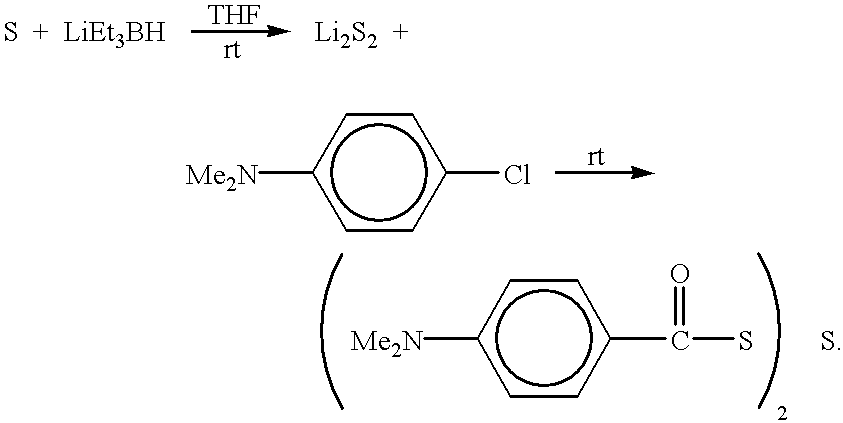
- special reagents, used to prepare the photoinitiators of the present invention are produced by reacting sulfur with a desired amount of lithium triethylborohydride to produce lithium sulfide compounds. The above-described reaction is shown by the following mechanism:
- lithium sulfide compounds may be produced by the above-described reaction including, but not limited to, Li 2 S, Li 2 S 2 , and Li 2 S 3 .
- y is an integer from 1 to 4.
- the above-described reaction results in a variety of lithium sulfide compounds wherein y varies from 1 to 3.
- these compounds may be separated using separation techniques known to those of ordinary skill in the art if desired.
- the lithium sulfide compounds may be further reacted with a substituted benzoyl chloride, a phthaloylglycine chloride or other carbonyl chloride compounds to produce one or more photoinitiators of the present invention.
- a morpholinobenzoyl chloride is reacted with one or more lithium sulfide compounds to produce one or more morpholinobenzoyl sulfide compounds.
- phthaloylglycine chloride is reacted with one or more lithium sulfide compounds to produce one or more phthaloylglycine sulfide compounds.
- the resulting photoinitiators are stable at room temperature (from about 15° C. to 25° C.) and normal room humidity (from about 30% to 60%). However, upon exposure to radiation, the photoinitiators efficiently produce one or more free radicals.
- the photoinitiators of the present invention have a high intensity of absorption.
- the photoinitiators of the present invention may have a molar extinction coefficient greater than about 2,000 liters per mole per cm (1 mole ⁇ 1 cm ⁇ 1 ) at an absorption maximum.
- the photoinitiators of the present invention may have a molar extinction coefficient (absorptivity) greater than about 5,000 1 mole ⁇ 1 cm ⁇ 1 .
- the photoinitiators of the present invention may have a molar extinction coefficient (absorptivity) greater than about 10,000 1 mole ⁇ 1 cm ⁇ 1 .
- the photoinitiators of the present invention will have a molar extinction coefficient greater than about 20,000 1 mole ⁇ 1 cm ⁇ 1 .
- the present invention is also directed to a method of generating a reactive species.
- the method of generating a reactive species involves generating a reactive species by exposing one or more of the above-described photoinitiators to radiation. The exposure of the photoinitiators to a radiation source triggers a photochemical process.
- quantum yield is used herein to indicate the efficiency of a photochemical process. More particularly, quantum yield is a measure of the probability that a particular molecule (photoinitiator) will absorb a quantum of light during its interaction with a photon. The term expresses the number of photochemical events per photon absorbed. Thus, quantum yields may vary from zero (no absorption) to 1.
- the photoinitiators of the present invention absorb photons having a specific wavelength and transfers the absorbed energy to one or more excitable portions of the molecule.
- the excitable portion of the molecule absorbs enough energy to cause a bond breakage, which generates one or more reactive species.
- the efficiency with which a reactive species is generated with the photoinitiators of the present invention is significantly greater than that experienced with photoinitiators of the prior art as indicated by faster cure times.
- the photoinitiators of the present invention desirably will have a quantum yield greater than about 0.5. More desirably, the quantum yield of the photoinitiators of the present invention will be greater than about 0.6.
- the quantum yield of the photoinitiators of the present invention will be greater than about 0.7. Still more desirably, the quantum yield of the photoinitiators of the present invention will be greater than about 0.8, with the most desirable quantum yield being greater than about 0.9.
- the photoinitiators of the present invention may be employed in any situation where reactive species are required, such as for the polymerization of an unsaturated monomer and the curing of an unsaturated oligomer/monomer mixture.
- the unsaturated monomers and oligomers may be any of those known to one having ordinary skill in the art.
- the polymerization and curing media also may contain other materials as desired, such as pigments, extenders, amine synergists, and such other additives as are well known to those having ordinary skill in the art.
- examples of unsaturated monomers and oligomers include ethylene, propylene, vinyl chloride, isobutylene, styrene, isoprene, acrylonitrile, acrylic acid, methacylic acid, ethyl acrylate, methyl methacrylate, vinyl acrylate, allyl methacrylate, tripropylene glycol diacrylate, trimethylol propane ethoxylate acrylate, epoxy acrylates, such as the reaction product of a bisphenol A epoxide with acrylic acid; polyester acrylates, such as the reaction product of acrylic acid with an adipic add/ hexanediol-based polyester, urethane acrylates, such as the reaction product of hydroxypropyl acrylate with diphenylmethane-4,4′-diisocyanate, and polybutadiene diacrylate oligomer.
- the types of reactions that various reactive species enter into include, but are not limited to, addition reactions, including polymerization reactions; abstraction reactions; rearrangement reactions; elimination reactions, including decarboxylation reactions; oxidation-reduction (redox) reactions; substitution reactions; and conjugation/deconjugation reactions.
- addition reactions including polymerization reactions; abstraction reactions; rearrangement reactions; elimination reactions, including decarboxylation reactions; oxidation-reduction (redox) reactions; substitution reactions; and conjugation/deconjugation reactions.
- the present invention also comprehends a method of polymerizing an unsaturated monomer by exposing the unsaturated monomer to radiation in the presence of the efficacious photoinitiators of the present invention described above.
- an unsaturated oligomer/monomer mixture is employed in place of the unsaturated monomer, curing is accomplished.
- the polymerizable material admixed with the photoinitiators of the present invention is to be admixed by means known in the art, and that the mixture will be irradiated with an amount of radiation sufficient to polymerize the material.
- the amount of radiation sufficient to polymerize the material is readily determinable by one of ordinary skill in the art, and depends upon the identity and amount of photoinitiators, the identity and amount of the polymerizable material, the intensity and wavelength of the radiation, and the duration of exposure to the radiation.
- radiation exposure results in the generation of free radicals from the photoinitiators of the present invention by one or more of the following: cleavage of a sulfur-sulfur bond resulting in two sulfur-terminated free radicals; and cleavage of a carbon-sulfur bond resulting in a carbon-terminated free radical and a sulfur-terminated free radical.
- the present invention further includes a film and a method for producing a film, by drawing an admixture of unsaturated polymerizable material and one or more photoinitiators of the present invention, into a film and irradiating the film with an amount of radiation sufficient to polymerize the composition.
- the unsaturated polymerizable material is an unsaturated oligomer/monomer mixture
- curing is accomplished. Any film thickness may be produced, as per the thickness of the admixture formed, so long as the admixture sufficiently polymerizes upon exposure to radiation.
- the admixture maybe drawn into a film on a nonwoven web or on a fiber, thereby providing a polymer-coated nonwoven web or fiber, and a method for producing the same.
- any method known in the art of drawing the admixture into a film may be used in the present invention.
- the amount of radiation sufficient to polymerize the material is readily determinable by one of ordinary skill in the art, and depends upon the identity and amount of photoinitiator, the identity and amount of the polymerizable material, the thickness of the admixture, the intensity and wavelength of the radiation, and duration of exposure to the radiation.
- the present invention also includes an adhesive composition comprising an unsaturated polymerizable material admixed with one or more photoinitiators of the present invention.
- the present invention includes a laminated structure comprising at least two layers bonded together with the above-described adhesive composition.
- a laminate is produced wherein at least one layer is a cellulosic or polyolefin nonwoven web or film.
- the present invention provides a method of laminating a structure wherein a structure having at least two layers with the above-described adhesive composition between the layers is irradiated to polymerize the adhesive composition.
- the unsaturated polymerizable material in the adhesive is an unsaturated oligomer/monomer mixture, the adhesive is irradiated to cure the composition.
- any layers may be used in the laminates of the present invention, on the condition that at least one of the layers allows sufficient radiation to penetrate through the layer to enable the admixture to polymerize sufficiently.
- any cellulosic or polyolefin nonwoven web or film known in the art may be used as one of the layers so long as they allow radiation to pass through.
- the amount of radiation sufficient to polymerize the admixture is readily determinable by one of ordinary skill in the art, and depends upon the identity and amount of photoinitiator, the identity and amount of the polymerizable material, the thickness of the admixture, the identity and thickness of the layer, the intensity and wavelength of the radiation, and the duration of exposure to the radiation.
- the radiation to which the photoinitiators of the present invention may be exposed generally will have a wavelength of from about 4 to about 1,000 nanometers.
- the radiation may be ultraviolet radiation, including near ultraviolet and far or vacuum ultraviolet radiation; visible radiation; and near infrared radiation.
- the radiation will have a wavelength of from about 100 to about 900 nanometers. More desirably, the radiation will have a wavelength of from about 100 to 700 nanometers.
- the radiation will be ultraviolet radiation having a wavelength of from about 4 to about 400 nanometers. More desirably, the radiation will have a wavelength of from about 100 to about 390 nanometers, and even more desirably will have a wavelength of from 200 to about 380 nanometers. For example, the radiation may have a wavelength of from about 222 to about 370 nanometers.
- the radiation desirably will be incoherent, pulsed ultraviolet radiation from a dielectric barrier discharge excimer lamp or radiation from a mercury lamp.
- Excimers are unstable excited-state molecular complexes which occur only under extreme conditions, such as those temporarily existing in special types of gas discharge. Typical examples are the molecular bonds between two rare gaseous atoms or between a rare gas atom and a halogen atom. Excimer complexes dissociate within less than a microsecond and, while they are dissociating, release their binding energy in the form of ultraviolet radiation.
- the dielectric barrier excimers in general emit in the range of from about 125 nm to about 500 nm, depending upon the excimer gas mixture.
- Dielectric barrier discharge excimer lamps (also referred to hereinafter as “excimer lamp”) are described, for example, by U. Kogelschatz, “Silent discharges for the generation of ultraviolet and vacuum ultraviolet excimer radiation.” Pure & Appl. Chem., 62, No. 9, pp. 16671674 (1990); and E. Eliasson and U. Kogelschatz, “UV Excimer Radiation from Dielectric-Barrier Discharges.” Appl. Phys. B. 46, pp. 299-303 (1988).
- Excimer lamps were developed by ABB Infocom Ltd., Lenzburg, Switzerland, and at the present time are available from Heraeus Noblelight GmbH, Kleinostheim, Germany.
- the excimer lamp emits incoherent, pulsed ultraviolet radiation.
- Such radiation has a relatively narrow bandwidth, i.e., the half width is of the order of approximately 5 to 100 nanometers.
- the radiation will have a half width of the order of approximately 5 to 50 nanometers, and more desirably will have a half width of the order of 5 to 25 nanometers.
- the half width will be of the order of approximately 5 to 15 nanometers.
- the ultraviolet radiation emitted from an excimer lamp can be emitted in a plurality of wavelengths, wherein one or more of the wavelengths within the band are emitted at a maximum intensity. Accordingly, a plot of the wavelengths in the band against the intensity for each wavelength in the band produces a bell curve.
- the “half width” of the range of ultraviolet radiation emitted by an excimer lamp is defined as the width of the bell curve at 50% of the maximum height of the bell curve.
- excimer lamp The emitted radiation of an excimer lamp is incoherent and pulsed, the frequency of the pulses being dependent upon the frequency of the alternating current power supply which typically is in the range of from about 20 to about 300 kHz.
- An excimer lamp typically is identified or referred to by the wavelength at which the maximum intensity of the radiation occurs, which convention is followed throughout this specification and the claims.
- excimer lamp radiation is essentially monochromatic.
- the source of radiation used with the photoinitiators of the present invention may be any radiation source known to those of ordinary skill in the art.
- a mercury lamp with a D-bulb which produces radiation having an emission peak of 350 nm is used to produce free radicals from the above-described photoinitiators.
- This radiation source is particularly useful when matched with one or more photoinitiators of the present invention having an absorption maximum of 350 nanometers, corresponding to the emission peak of the mercury lamp.
- the photoinitiators of the present invention absorbing radiation in the range of about 250 to about 350 nanometers, the photoinitiators of the present invention will generate one or more reactive species upon exposure to sunlight. Accordingly, these photoinitiators of the present invention provides a method for the generation of reactive species that does not require the presence of a special light source.
- the photoinitiators of the present invention enable the production of adhesive and coating compositions that consumers can apply to a desired object and polymerize or cure upon exposure to sunlight. These photoinitiators also enable numerous industry applications wherein unsaturated polymerizable materials may be polymerized merely upon exposure to sunlight. Therefore, depending upon how the photoinitiator is designed, the photoinitiator of the present invention can eliminate the cost of purchasing and maintaining light sources in numerous industries wherein such light sources are necessary without the photoinitiators of the present invention.
- the effective tuning of the photoinitiators of the present invention for a specific wavelength band permits the photoinitiators of the present invention to more efficiently utilize the target radiation in the emission spectrum of the radiating source corresponding to the “tuned” wavelength band, even though the intensity of such radiation may be much lower than, for example, radiation from a narrow band emitter, such as an excimer lamp.
- a narrow band emitter such as an excimer lamp.
- the photoinitiators of the present invention may be desirable to utilize a mercury lamp that emits radiation having a wavelength of approximately 350 nm with the substituted benzoyl-containing photoinitiators of the present invention.
- the effectiveness of the photoinitiators of the present invention is not necessarily dependent upon the availability or use of a narrow wavelength band radiation source.
- a major advantage of the photoinitiators of the present invention is that they have rapid curing times in comparison to the curing times of the prior art.
- Another advantage of the present invention is that the photoinitiators of the present invention are highly sensitive photoinitiators and are beneficially used in situations having lower light levels.
- This example describes a method of synthesizing the following compound, 3-morpholinobenzoic acid, which is used in the reaction mechanism for preparing bis-m-morpholinobenzoyl trisulfide:
- This example describes a method of synthesizing the following compound, 3-morpholinobenzoyl chloride, which is used as a reactant to form bis-m-morpholinobenzoyl trisulfide:
- the above reagents including 25 g of 3-morpholinobenzoic acid and 15.2 g of oxalyl chloride, were mixed in dioxane at 0° C. under argon gas. The reaction proceeded for about 2 hours, one hour at 0° C. and one hour at room temperature. The solvent was then removed under reduced pressure to yield 22.1 g of 3-morpholinobenzoyl chloride, which was used without further purification.
- This example describes a method of synthesizing the following compound, bis-m-morpholinobenzoyl trisulfide:
- reaction product was filtered to yield a yellow solid which was washed with water, benzene, and subsequently dried under vacuum.
- the reaction yielded 3.4 g of bis-m-morpholinobenzoyl trisulfide.
- reaction HPLC showed complete reaction after about 30 minutes, yielding two products with retention times respectively of about 10 and about 15 minutes in a ratio of about 25:75.
- the 75% peak was the bis-m-morpholinobenzoyl trisulfide solid while the 25% peak was in the filtrated liquid.
- a 2% wt/wt mixture of bis-m-morpholinobenzoyl trisulfide powder was added to a 1 g sample of red flexo ink (Gamma Graphics).
- the solubility was poor at room temperature; however, the solubility improved upon heating the mixture on a hot plate.
- a drop of the mixture was placed on a metal plate and drawn down with a zero bar.
- the thin film was exposed to a brief flash of a D-bulb lamp (Fusion Systems). The thin film was instantly cured.
- Another thin film sample was cured using a medium pressure mercury lamp.
- the mercury lamp has a good emission at a wavelength of 350 nm. Exposure of less than one second resulted in full curing of the thin film.
- the above reagents including 100 g of ethyl 4-aminobenzoic acid ester and 114 g of oxalyl chloride, were placed in a three liter round-bottom flask with condenser and mechanical stirrer. The reaction mixture was stirred at reflux for 15 hours. The hot solution was filtered to remove the solvent and yield a white solid. The white solid was recrystallized in benzene to yield 100 g of a white crystalline solid, p-morpholinobenzoyl ester.
- a solution was formed with 60 g of 4-morpholinobenzoic acid in toluene at 0° C. To the solution was added 28.5 g of oxalyl chloride in 50 milliliters of THF over a period of about 10 minutes. The reaction mixture was stirred at 0° C. for about 1 hour followed by stirring at room temperature for about 2 hours. The solution was filtered and the solvent removed under reduced pressure to yield a white solid. The reaction yielded 58.2 g of 4-morpholinobenzoyl chloride, which was used in subsequent reactions without further purification.
- a 2% wt/wt mixture of bis-p-morpholinobenzoyl trisulfide and 1.0 g of red flexo resin (Gamma Graphics) was mixed for about 5 minutes while stirring at a temperature of about 30 to 40° C. A drop of the mixture was placed on a metal plate and drawn down with a 0 bar. The resulting film was exposed to radiation from a medium pressure mercury lamp for approximately 0.1 seconds to fully cure the film.
- a 2% wt/wt. mixture of p-dimethylaminobenzoyl trisulfide and 1.0 g of red flexo resin (Gamma Graphics) was mixed for about 5 minutes while stirring at a temperature of about 30 to 40° C.
- Adrop of the mixture was placed on a metal plate and drawn down with a 0 bar.
- the resulting film was exposed to radiation from a medium pressure mercury lamp for approximately 0.1 seconds to fully cure the film.
Abstract
Description


Claims (25)


Priority Applications (1)
| Application Number | Priority Date | Filing Date | Title |
|---|---|---|---|
| US09/293,162 US6294698B1 (en) | 1999-04-16 | 1999-04-16 | Photoinitiators and applications therefor |
Applications Claiming Priority (1)
| Application Number | Priority Date | Filing Date | Title |
|---|---|---|---|
| US09/293,162 US6294698B1 (en) | 1999-04-16 | 1999-04-16 | Photoinitiators and applications therefor |
Publications (1)
| Publication Number | Publication Date |
|---|---|
| US6294698B1 true US6294698B1 (en) | 2001-09-25 |
Family
ID=23127924
Family Applications (1)
| Application Number | Title | Priority Date | Filing Date |
|---|---|---|---|
| US09/293,162 Expired - Fee Related US6294698B1 (en) | 1999-04-16 | 1999-04-16 | Photoinitiators and applications therefor |
Country Status (1)
| Country | Link |
|---|---|
| US (1) | US6294698B1 (en) |
Cited By (3)
| Publication number | Priority date | Publication date | Assignee | Title |
|---|---|---|---|---|
| US20040049836A1 (en) * | 2002-07-03 | 2004-03-18 | The Procter & Gamble Company | Radiation curable low stress relaxation elastomeric materials |
| US20050168137A1 (en) * | 2004-01-30 | 2005-08-04 | Vadim Adamovich | OLED efficiency by utilization of different doping concentrations within the device emissive layer |
| EP2236488A1 (en) | 2001-03-30 | 2010-10-06 | The Arizona Board of Regents on behalf of the University of Arizona | Materials, methods and uses for photochemical generation of acids and/or radical species |
Citations (717)
| Publication number | Priority date | Publication date | Assignee | Title |
|---|---|---|---|---|
| US575228A (en) * | 1897-01-12 | Moritz von gallois | ||
| US582853A (en) * | 1897-05-18 | Adolf feer | ||
| US893636A (en) * | 1904-06-14 | 1908-07-21 | Frederick J Maywald | Coloring material and process of making same. |
| US1013544A (en) * | 1910-08-30 | 1912-01-02 | Equilibrator Company | Ink. |
| US1325971A (en) * | 1919-12-23 | Kazue akashi | ||
| US1364406A (en) * | 1920-04-24 | 1921-01-04 | Chester Novelty Company Inc | Ink-stick |
| US1436856A (en) * | 1922-01-31 | 1922-11-28 | George W Brenizer | Printing process ink |
| GB275245A (en) | 1924-12-28 | 1928-10-29 | Ig Farbenindustrie Ag | Manufacture of stable diazo-salt preparations |
| US1803906A (en) * | 1928-02-16 | 1931-05-05 | Kalle & Co Ag | Diazo-types stabilized with alpha derivative of thiocarbonic acid and alpha processof preparing them |
| GB349339A (en) | 1929-06-17 | 1931-05-28 | Chem Ind Basel | Manufacture and application of stable diazo-preparations |
| GB355686A (en) | 1929-06-08 | 1931-08-26 | Kodak Ltd | Improvements in or relating to combined kinematographic and sound record films |
| US1844199A (en) * | 1928-08-30 | 1932-02-09 | Rca Corp | Pyro-recording paper |
| US1876880A (en) * | 1932-09-13 | Othmab dbapal | ||
| US1880573A (en) * | 1929-07-30 | 1932-10-04 | Agfa Ansco Corp | Light-sensitive material for the bleaching out process |
| US1880572A (en) * | 1929-09-09 | 1932-10-04 | Agfa Ansco Corp | Color photography |
| US1916779A (en) * | 1929-05-15 | 1933-07-04 | Agfa Ansco Corp | Light-sensitive material |
| US1916350A (en) * | 1930-08-14 | 1933-07-04 | Agfa Ansco Corp | Manufacture of color-pictures |
| GB399753A (en) | 1932-05-19 | 1933-10-12 | Ig Farbenindustrie Ag | Manufacture of solid stable diazo-azo-salts |
| US1955898A (en) * | 1931-08-04 | 1934-04-24 | Agfa Ansco Corp | Sensitizing of bleaching-out layers |
| US1962111A (en) * | 1930-01-07 | 1934-06-12 | Firm Chemical Works Formerly S | Stable tetrazomonoazo compounds and their preparation |
| US2005511A (en) * | 1931-12-22 | 1935-06-18 | Chemical Works Formerly Sandoz | Basic derivatives of porphins and metalloporphins and process for their manufacture |
| US2005378A (en) | 1931-12-16 | 1935-06-18 | Waldhof Zellstoff Fab | Manufacture of cellulose material |
| GB441085A (en) | 1933-07-13 | 1936-01-13 | Ig Farbenindustrie Ag | Manufacture of stable diazo-salt preparations |
| US2049005A (en) | 1932-01-04 | 1936-07-28 | Gaspar Bela | Color-photographic bleach out dyestuff layers |
| US2054390A (en) | 1934-08-09 | 1936-09-15 | Photographic bleachjng-out layers | |
| US2058489A (en) | 1930-06-16 | 1936-10-27 | Nat Aniline & Chem Co Inc | Dye powder compositions |
| US2062304A (en) | 1931-11-19 | 1936-12-01 | Gaspar Bela | Process for the production of a colored sound film |
| US2090511A (en) | 1935-04-18 | 1937-08-17 | Calco Chemical Co Inc | Colloidized vat dye |
| US2097119A (en) | 1932-09-30 | 1937-10-26 | Ig Farbenindustrie Ag | Bleaching-out dye layers |
| US2111692A (en) | 1935-06-28 | 1938-03-22 | Ici Ltd | Stabilized diazo compounds |
| CH197808A (en) | 1937-06-28 | 1938-05-31 | Fritz Busenhart | Air humidifier on radiators. |
| US2125015A (en) | 1932-10-26 | 1938-07-26 | Gaspar Bela | Multicolor photographic material and a process for using the same |
| US2130572A (en) | 1932-07-21 | 1938-09-20 | Agfa Ansco Corp | Layers containing bleaching-out dyes |
| US2132154A (en) | 1935-01-05 | 1938-10-04 | Gaspar Bela | Method of producing combined colored and black and white pictures |
| US2145960A (en) | 1936-10-27 | 1939-02-07 | Wheatley Christopher Wi Crouch | Color photography |
| US2154996A (en) | 1938-06-24 | 1939-04-18 | West Virginia Pulp & Paper Com | Manufacture of calcium sulphite filled paper |
| US2159280A (en) | 1936-12-31 | 1939-05-23 | Eastman Kodak Co | Sound image on multilayer film |
| US2171976A (en) | 1939-09-05 | Process of manufacturing stabilized | ||
| US2181800A (en) | 1937-06-23 | 1939-11-28 | Calco Chemical Co Inc | Colloidized azo coloring matter |
| US2185153A (en) | 1939-12-26 | Stable ice color producing | ||
| US2220178A (en) | 1936-01-09 | 1940-11-05 | Gen Aniline & Film Corp | Process of producing a sound track on a light-sensitive color film |
| US2230590A (en) | 1938-01-22 | 1941-02-04 | Gen Aniline & Film Corp | Color photographic process |
| US2237885A (en) | 1941-04-08 | Stable diazo compounds | ||
| US2243630A (en) | 1939-10-10 | 1941-05-27 | Rohm & Haas | Reaction of polysaccharides with aminomethyl pyrroles |
| US2268324A (en) | 1938-03-16 | 1941-12-30 | Polgar Andre | Process for the preparation of photographic bleaching-out layers |
| US2281895A (en) | 1939-11-20 | 1942-05-05 | Poser Gottlieb Von | Light sensitive material |
| CA413257A (en) | 1943-06-15 | Albert Genest Homer | Hat bat shrinking and felting machine | |
| US2328166A (en) | 1938-12-03 | 1943-08-31 | Polgar Andre | Manufacture of photographic bleaching layers |
| US2346090A (en) | 1942-08-19 | 1944-04-04 | Eastman Kodak Co | Photographic bleach-out layer |
| US2349090A (en) | 1939-05-25 | 1944-05-16 | Ici Ltd | Stabilized polydiazo-phthalocyanines |
| US2356618A (en) | 1941-05-23 | 1944-08-22 | Du Pont | Stabilized diazo printing paste |
| US2361301A (en) | 1941-07-03 | 1944-10-24 | Du Pont | Stabilization of azo dyestuffs |
| US2364359A (en) | 1940-11-06 | 1944-12-05 | American Cyanamid Co | Printing compositions and methods of printing therewith |
| US2381145A (en) | 1945-08-07 | Stable diazo salt preparation | ||
| US2382904A (en) | 1942-10-10 | 1945-08-14 | Du Pont | Stabilization of organic substances |
| US2386646A (en) | 1943-07-05 | 1945-10-09 | American Cyanamid Co | Stabilization of coloring compositions containing diazonium salts |
| US2402106A (en) | 1942-09-09 | 1946-06-11 | Gen Aniline & Film Corp | Stable diazonium salts |
| US2416145A (en) | 1938-12-27 | 1947-02-18 | Eterpen Sa Financiera | Writing paste |
| US2477165A (en) | 1946-12-27 | 1949-07-26 | Gen Aniline & Film Corp | Nondusting compositions containing stabilized diazo compounds |
| CA458808A (en) | 1949-08-09 | L. Gardner Frank | Cleat assembly for athletic shoes | |
| US2527347A (en) | 1946-12-27 | 1950-10-24 | Gen Aniline & Film Corp | Nondusting compositions for stabilizing diazo salts |
| US2580461A (en) | 1947-08-27 | 1952-01-01 | Sulphite Products Corp | Ultraviolet-radiation impervious wrapping material |
| US2601669A (en) * | 1950-09-30 | 1952-06-24 | American Cyanamid Co | Stabilized barium and strontium lithol toners |
| US2612494A (en) * | 1948-10-22 | 1952-09-30 | Gen Aniline & Film Corp | Stabilized diazonium salts and process of effecting same |
| US2612495A (en) * | 1952-09-30 | Process of effecting same | ||
| US2628959A (en) * | 1953-02-17 | Process for making stabilized | ||
| US2647080A (en) * | 1950-06-30 | 1953-07-28 | Du Pont | Light-stabilized photopolymerization of acrylic esters |
| US2680685A (en) * | 1951-04-10 | 1954-06-08 | Us Agriculture | Inhibition of color formation in nu, nu-bis (2-hydroxyethyl) lactamide |
| US2728784A (en) * | 1954-03-17 | 1955-12-27 | Eastman Kodak Co | Stabilization of oxidizable materials and stabilizers therefor |
| US2732301A (en) * | 1952-10-15 | 1956-01-24 | Chxcxch | |
| US2744103A (en) * | 1953-07-13 | 1956-05-01 | Hoechst Ag | Solid, stable diazonium compounds and process of preparing the same |
| US2757090A (en) * | 1951-09-01 | 1956-07-31 | Azoplate Corp | Photographic method and light sensitive article for making printing plates |
| US2763550A (en) * | 1953-06-18 | 1956-09-18 | Eastman Kodak Co | Silver sound track on multilayer color films |
| US2768171A (en) * | 1951-03-28 | 1956-10-23 | Ici Ltd | Acid stabilized isothiouronium dyestuffs |
| US2773056A (en) * | 1952-07-12 | 1956-12-04 | Allied Chem & Dye Corp | Stable finely divided alkyl amine dyes |
| CA537687A (en) | 1957-03-05 | J. Leavitt Julian | Stable solutions of mixtures of naphthols and stabilized diazo compounds | |
| US2798000A (en) * | 1952-12-16 | 1957-07-02 | Int Minerals & Chem Corp | Printing ink with anti-skinning agent |
| US2809189A (en) * | 1957-10-08 | Method of producing stabilized | ||
| DE1022801B (en) | 1953-11-14 | 1958-01-16 | Siemens Ag | Process for the production of branched polymerizing, soluble and stretchable or crosslinked copolymers with low dielectric loss, high dielectric strength and heat resistance |
| CA552565A (en) | 1958-02-04 | Scalera Mario | Stabilization of copperized azo dyestuffs | |
| US2827358A (en) * | 1953-06-15 | 1958-03-18 | American Cyanamid Co | Preparation of stable compositions of sulfuric acid half esters of leuco vat dyestuffs |
| US2834773A (en) * | 1952-09-23 | 1958-05-13 | American Cyanamid Co | Stabilization of copperized azo dyestuffs |
| DE1039835B (en) | 1956-07-21 | 1958-09-25 | Bayer Ag | Photographic process for the preparation of dye images |
| DE1040562B (en) | 1956-08-23 | 1958-10-09 | Hoechst Ag | Process for the production of solid, durable diazonium compounds |
| DE1045414B (en) | 1956-09-19 | 1958-12-04 | Hoechst Ag | Process for the production of solid, durable diazonium compounds |
| DE1047013B (en) | 1956-05-15 | 1958-12-18 | Agfa Ag | Process for photothermographic imaging |
| DE1047787B (en) | 1956-08-24 | 1958-12-31 | Hoechst Ag | Process for the production of solid, durable diazonium compounds |
| US2875045A (en) * | 1955-04-28 | 1959-02-24 | American Cyanamid Co | Alum containing antioxidant and manufacture of sized paper therewith |
| CA571792A (en) | 1959-03-03 | Ciba Limited | Process for printing textiles and printing preparations therefor | |
| US2892865A (en) * | 1957-09-20 | 1959-06-30 | Erba Carlo Spa | Process for the preparation of tertiary esters of benzoylcarbinol |
| US2936241A (en) | 1957-05-16 | 1960-05-10 | Sperry Rand Corp | Non-printing indicia ink |
| US2940853A (en) | 1958-08-21 | 1960-06-14 | Eastman Kodak Co | Azide sensitized resin photographic resist |
| US2955067A (en) | 1954-10-20 | 1960-10-04 | Rohm & Haas | Cellulosic paper containing ion exchange resin and process of making the same |
| US2992198A (en) | 1956-12-24 | 1961-07-11 | Funahashi Takaji | Process of producing liquid color |
| US2992129A (en) | 1957-03-25 | 1961-07-11 | Ludlow Corp | Gummed product printed with conditioner |
| US3030208A (en) | 1956-03-14 | 1962-04-17 | Bayer Ag | Light-sensitive compounds and their use in the reproduction techinc |
| DE1132540B (en) | 1959-09-15 | 1962-07-05 | Hoechst Ag | Process for the production of solutions of coupling components of the ice color series |
| US3071815A (en) | 1958-09-09 | 1963-01-08 | Allied Chem | Process for producing free flowing oil soluble fusible organic dyestuffs |
| US3075014A (en) | 1960-06-14 | 1963-01-22 | Richardson Merrell Inc | Basic substituted alkoxy diphenylalkanols, diphenylalkenes and diphenylalkanes |
| US3076813A (en) | 1957-11-13 | 1963-02-05 | Monsanto Chemicals | alpha, beta, gamma, sigma-tetra-arylporphins |
| DE1154069B (en) | 1958-12-27 | 1963-09-12 | Bayer Ag | Process for the production of water-insoluble azo dyes on structures made of aromatic polyesters, in particular polyethylene terephthalates, synthetic polyamides and polyurethanes |
| US3104973A (en) | 1960-08-05 | 1963-09-24 | Horizons Inc | Photographic bleaching out of cyanine dyes |
| US3114634A (en) | 1960-10-27 | 1963-12-17 | Ilford Ltd | Colour photography |
| US3121632A (en) | 1961-08-30 | 1964-02-18 | Horizons Inc | Photographic process and composition including leuco triphenylmethane dyes |
| US3123647A (en) | 1964-03-03 | Certificate of correction | ||
| US3133049A (en) | 1959-10-09 | 1964-05-12 | Hoechst Ag | Solid, stable diazonium compounds |
| US3140949A (en) | 1961-10-18 | 1964-07-14 | Horizons Inc | Printout process and leuco bases of triphenyl methane dyes used therein |
| US3154416A (en) | 1961-03-30 | 1964-10-27 | Horizons Inc | Photographic process |
| US3155509A (en) | 1961-09-05 | 1964-11-03 | Horizons Inc | Photographic process |
| US3175905A (en) | 1960-10-08 | 1965-03-30 | Azoplate Corp | Light sensitive material |
| US3178285A (en) * | 1960-03-24 | 1965-04-13 | Ciba Ltd | Photographic layers for the silver dyestuff bleaching process |
| US3238163A (en) * | 1961-06-30 | 1966-03-01 | Ici Ltd | Dye receptive polyolefin compositions comprising a magnesium or zinc compound and a hydroxy substituted benzophenone |
| US3242215A (en) * | 1960-04-04 | 1966-03-22 | Du Pont | Bis-(2-chloroacryloyl) aryl compounds |
| US3248337A (en) * | 1966-04-26 | Composite reducing agent for use in the textile industry | ||
| US3266973A (en) * | 1963-07-25 | 1966-08-16 | Richard P Crowley | Method of preparing adsorbent filter paper containing crystalline zeolite particles, and paper thereof |
| US3282886A (en) * | 1962-07-27 | 1966-11-01 | Du Pont | Polycarbonamides of improved photostability and dye lightfastness |
| US3284205A (en) * | 1963-09-17 | 1966-11-08 | Horizons Inc | Benzotriazole and heterocyclic ketimide activators for leuco compounds |
| US3300314A (en) * | 1963-02-01 | 1967-01-24 | Eastman Kodak Co | Nonsilver, light-sensitive photographic elements |
| US3304297A (en) * | 1959-02-12 | 1967-02-14 | Ciba Ltd | Dyestuffs consisting of organic dyestuffs bound to polyhydroxylated organic polymers |
| US3305361A (en) * | 1962-12-28 | 1967-02-21 | Gen Electric | Information recording |
| US3313797A (en) * | 1963-01-17 | 1967-04-11 | Du Pont | Stabilized fiber-reactive dyes |
| US3320080A (en) * | 1964-06-05 | 1967-05-16 | Nat Starch Chem Corp | Water resistant paper coating compositions |
| DE1240811B (en) | 1961-08-22 | 1967-05-24 | Hoechst Ag | Process for the production of colored synthetic resin films on fiber materials and planar structures |
| US3330659A (en) * | 1964-01-29 | 1967-07-11 | Horizons Inc | Photographic product and method of making same |
| US3341492A (en) * | 1964-05-11 | 1967-09-12 | Celanese Corp | Polyamides stabilized with iodine and/or bromine substituted phenols |
| US3359109A (en) * | 1964-04-29 | 1967-12-19 | Du Pont | Leuco dye-n, n. o-triacylhydroxylamine light-sensitive dye former compositions |
| US3361827A (en) * | 1965-01-05 | 1968-01-02 | American Plastic & Chemical Co | Preparation of benzalacetophenone |
| US3363969A (en) * | 1964-02-12 | 1968-01-16 | Du Pont | Dyeing and light stabilizing nylon yarns with sulfonated dyes; sterically hindered phenols, and alkylnaphthalene sulfonates with or without other ultraviolet light absorbers |
| CA779239A (en) | 1968-02-27 | General Electric Company | Information recording | |
| US3385700A (en) * | 1964-06-12 | 1968-05-28 | Gevaert Photo Producten | Recording process |
| US3397984A (en) * | 1965-08-19 | 1968-08-20 | Eastman Kodak Co | Silver dye bleach materials improving image density |
| US3415875A (en) | 1965-06-04 | 1968-12-10 | Ciba Ltd | Hydroxybenzophenones containing sulfonic acid groups |
| US3418118A (en) | 1965-06-03 | 1968-12-24 | Du Pont | Photographic processes and products |
| GB1150987A (en) | 1966-04-29 | 1969-05-07 | Agfa Gevaert Ag | Sensitization of Light-Sensitive Polymers |
| US3445234A (en) | 1962-10-31 | 1969-05-20 | Du Pont | Leuco dye/hexaarylbiimidazole imageforming composition |
| US3453259A (en) | 1967-03-22 | 1969-07-01 | Corn Products Co | Cyclodextrin polyol ethers and their oxidation products |
| US3453258A (en) | 1967-02-20 | 1969-07-01 | Corn Products Co | Reaction products of cyclodextrin and unsaturated compounds |
| US3464841A (en) | 1965-10-23 | 1969-09-02 | Customark Corp | Method of preparing security paper containing an ultraviolet inhibitor |
| US3467647A (en) | 1966-03-10 | 1969-09-16 | Scholten Chemische Fab | Cationic and anionic substituted polysaccharides and process for preparing same |
| US3479185A (en) | 1965-06-03 | 1969-11-18 | Du Pont | Photopolymerizable compositions and layers containing 2,4,5-triphenylimidazoyl dimers |
| US3502476A (en) | 1965-10-20 | 1970-03-24 | Konishiroku Photo Ind | Light-sensitive photographic materials |
| US3503744A (en) | 1967-02-16 | 1970-03-31 | Keuffel & Esser Co | Photographic bleaching out of azomethine and azoaniline dyes |
| US3514597A (en) | 1966-04-05 | 1970-05-26 | Agfa Gevaert Nv | Thermographic recording processes and materials |
| US3541142A (en) | 1966-09-02 | 1970-11-17 | Merck & Co Inc | (4-(2-hydroxymethylalkanoyl)phenoxy) acetic acids |
| US3546161A (en) | 1968-01-22 | 1970-12-08 | Allied Chem | Polyolefins with improved light stability |
| US3547646A (en) | 1966-12-16 | 1970-12-15 | Keuffel & Esser Co | Light-sensitive imaging material containing hydrazones |
| US3549367A (en) | 1968-05-24 | 1970-12-22 | Du Pont | Photopolymerizable compositions containing triarylimidazolyl dimers and p-aminophenyl ketones |
| US3553710A (en) | 1969-03-14 | 1971-01-05 | Edward C Lloyd | Erasable trace recorder |
| US3563931A (en) | 1965-08-06 | 1971-02-16 | Shojiro Horiguchi | Method of making chromogen-bonded-polymer and products thereof |
| US3565753A (en) | 1967-07-17 | 1971-02-23 | Ncr Co | Capsule-cellulose fiber units and products made therewith |
| US3574624A (en) | 1968-02-08 | 1971-04-13 | Eastman Kodak Co | Photographic elements containing dithiolium salts |
| US3579533A (en) | 1968-03-18 | 1971-05-18 | Antioch College | Preparation of porphin,substituted porphin and metal chelates thereof |
| US3595658A (en) | 1968-10-03 | 1971-07-27 | Little Inc A | Non-silver direct positive dye bleachout system using polymethine dyes and colored activators |
| US3595657A (en) | 1968-10-03 | 1971-07-27 | Little Inc A | Non-silver direct positive dye bleachout system using indigoid dyes and colorless activators |
| US3595655A (en) | 1968-10-03 | 1971-07-27 | Little Inc A | Non-silver direct positive dyes bleachout system using polymethine dyes and colorless activators |
| US3595659A (en) | 1968-10-03 | 1971-07-27 | Little Inc A | Non-silver direct positive dye bleachout system using indigoid dyes and colored activators |
| US3607863A (en) | 1967-02-28 | 1971-09-21 | Dyckerhoff Zementwerke Ag | Clathrate compounds |
| US3607693A (en) | 1968-07-26 | 1971-09-21 | Bayer Ag | Polyester compounds which are hardenable by ultraviolet radiation in the presence of an alpha-substituted benzoin ether |
| US3607639A (en) | 1967-07-17 | 1971-09-21 | Asea Ab | Fuel assembly for nuclear reactors |
| US3615562A (en) | 1968-04-25 | 1971-10-26 | Rca Corp | Cyanine dye photographic film |
| US3617335A (en) | 1968-07-15 | 1971-11-02 | Fuji Photo Film Co Ltd | Pressure-sensitive copying paper |
| US3617288A (en) | 1969-09-12 | 1971-11-02 | Minnesota Mining & Mfg | Propenone sensitizers for the photolysis of organic halogen compounds |
| US3619238A (en) | 1968-07-15 | 1971-11-09 | Fuji Photo Film Co Ltd | Pressure sensitive copying paper |
| US3619239A (en) | 1968-12-10 | 1971-11-09 | Fuji Photo Film Co Ltd | Pressure sensitive copying paper |
| US3637337A (en) | 1966-08-03 | 1972-01-25 | Brian Pilling | Improving the dye lightfastness of acrylic substrates with triazine compounds |
| US3637581A (en) | 1967-08-04 | 1972-01-25 | Shojiro Horiguchi | Method of making chromogen-bonded-polymer and products thereof |
| US3642472A (en) | 1967-08-30 | 1972-02-15 | Holotron Corp | Bleaching of holograms |
| US3647467A (en) | 1969-05-22 | 1972-03-07 | Du Pont | Hexaarylbiimidazole-heterocyclic compound compositions |
| US3652275A (en) | 1970-07-09 | 1972-03-28 | Du Pont | HEXAARYLBIIMIDAZOLE BIS (p-DIALKYL-AMINOPHENYL-{60 ,{62 -UNSATURATED) KETONE COMPOSITIONS |
| NL7113828A (en) | 1970-10-15 | 1972-04-18 | ||
| US3660542A (en) | 1969-12-11 | 1972-05-02 | Takeda Chemical Industries Ltd | Alkylbenzoylcarbinol phosphate esters |
| US3668188A (en) | 1969-11-03 | 1972-06-06 | Monsanto Co | Thermally stable polyester fibers having improved dyeability and dye lightfastness |
| US3667954A (en) | 1969-04-21 | 1972-06-06 | Keuffel & Esser Co | Tribromomethyl sulfonyl pyridazine or phthalazine photoactivators |
| US3669925A (en) | 1970-04-28 | 1972-06-13 | Monsanto Co | Thermally stable dyeable polyesters having improved dyed lightfastness |
| US3671096A (en) | 1971-02-03 | 1972-06-20 | Us Navy | Erasable holographic recording |
| US3671251A (en) | 1970-12-10 | 1972-06-20 | Eastman Kodak Co | Sensitized pyrylium photobleachable dye in gelatin |
| US3676690A (en) | 1971-01-04 | 1972-07-11 | Westinghouse Learning Corp | Reflected light document reading head |
| US3678044A (en) | 1970-10-22 | 1972-07-18 | Chevron Res | Substituted flavanones |
| DE2202497A1 (en) | 1971-01-19 | 1972-08-03 | Fuji Photo Film Co Ltd | Process for producing images |
| US3689565A (en) | 1970-05-04 | 1972-09-05 | Horst Hoffmann | {60 -methylolbenzoin ethers |
| US3694241A (en) | 1971-04-19 | 1972-09-26 | Grace W R & Co | Method for chemically printing |
| US3695879A (en) | 1970-04-20 | 1972-10-03 | Ibm | Hologram life extension |
| US3697280A (en) | 1969-05-22 | 1972-10-10 | Du Pont | Hexaarylbiimidazole-selected aromatic hydrocarbon compositions |
| US3705043A (en) | 1970-12-07 | 1972-12-05 | Dick Co Ab | Infrared absorptive jet printing ink composition |
| US3707371A (en) | 1970-12-14 | 1972-12-26 | Xerox Corp | Photosensitive element comprising a polymer matrix including styrene,auramine o,and a proxide and the use thereof in volume recording |
| US3729313A (en) | 1971-12-06 | 1973-04-24 | Minnesota Mining & Mfg | Novel photosensitive systems comprising diaryliodonium compounds and their use |
| US3737628A (en) | 1971-06-11 | 1973-06-05 | Automatic Corp | Automatically programmed test grading and scoring method and system |
| CA930103A (en) | 1970-03-16 | 1973-07-17 | Dominion Textile Limited | Printing and dyeing process for blended fibre fabrics |
| US3765896A (en) | 1971-11-22 | 1973-10-16 | Eastman Kodak Co | Photographic element containing a light sensitive photobleachant and a colored stable 2-amino-aryl-7-oxyl-3-oxide-2-imidazoline free radical |
| US3775130A (en) | 1970-12-28 | 1973-11-27 | Ricoh Kk | Photosensitive material comprising benzopyrylium dye sensitizer |
| US3788849A (en) | 1970-11-26 | 1974-01-29 | Fuji Photo Film Co Ltd | Negative-working photographic process utilizing heat bleachable thin layer of a dye |
| US3800439A (en) | 1972-05-04 | 1974-04-02 | Scan Tron Corp | Test scoring apparatus |
| US3801329A (en) | 1971-12-17 | 1974-04-02 | Union Carbide Corp | Radiation curable coating compositions |
| US3817752A (en) | 1971-09-14 | 1974-06-18 | Agfa Gevaert Nv | Free radical photographic system containing a pyrylium dye former |
| US3840338A (en) | 1969-04-11 | 1974-10-08 | Oreal | Light stabilized hair dye compositions |
| US3844790A (en) | 1972-06-02 | 1974-10-29 | Du Pont | Photopolymerizable compositions with improved resistance to oxygen inhibition |
| USRE28225E (en) | 1968-10-09 | 1974-11-05 | Photobleachable dye compositions | |
| DE2437380A1 (en) | 1973-08-03 | 1975-02-13 | Fuji Photo Film Co Ltd | METHOD FOR GENERATING AN OPTICAL SOUND TRACK |
| DE2432563A1 (en) | 1973-07-06 | 1975-02-27 | Union Carbide Corp | PROCESS FOR THE PRODUCTION OF ARYLDIALCOXYMETHYL KETONES |
| US3870524A (en) | 1973-02-07 | 1975-03-11 | Fuji Photo Film Co Ltd | Photopolymerizable composition |
| US3873500A (en) | 1970-06-16 | 1975-03-25 | Agency Ind Science Techn | Photosensitive polymers |
| DE2444520A1 (en) | 1973-09-20 | 1975-03-27 | Agfa Gevaert Ag | PROCESS FOR THE PRODUCTION AND STABILIZATION OF IMAGES IN FREE-RADICAL PHOTO-SENSITIVE MATERIALS |
| US3876496A (en) | 1973-05-14 | 1975-04-08 | Ernesto B Lozano | Method and means for protecting documents |
| US3887450A (en) | 1971-02-04 | 1975-06-03 | Dynachem Corp | Photopolymerizable compositions containing polymeric binding agents |
| US3895949A (en) | 1972-07-24 | 1975-07-22 | Asahi Chemical Ind | Photosensitive element comprising photopolymerizable layer and protective layer |
| US3901779A (en) | 1971-05-13 | 1975-08-26 | Dow Chemical Co | Vinyl ester resin and process for curing same with ionizing radiation in the presence of amines |
| US3904562A (en) | 1973-01-31 | 1975-09-09 | Sherwin Williams Co | Organic pigments encapsulated with vinylpyrrolidone polymer |
| US3910993A (en) | 1972-06-23 | 1975-10-07 | Sandoz Ltd | Aryl phosphonous acids useful as U.V. stabilizers |
| US3914166A (en) | 1968-11-06 | 1975-10-21 | Bayer Ag | Butyric acid derivatives as novel photosensitizers |
| US3914165A (en) | 1972-09-18 | 1975-10-21 | Desoto Inc | Radiation curable non-gelled michael addition reaction products |
| US3915824A (en) | 1973-03-30 | 1975-10-28 | Scm Corp | Uv and laser curing of the polymerizable binder |
| US3919323A (en) | 1974-08-08 | 1975-11-11 | Sandoz Ag | Acyl substituted dibenzylethers |
| US3926641A (en) | 1971-11-18 | 1975-12-16 | Sun Chemical Corp | Photopolymerizable compositions comprising polycarboxysubstituted benzophenone reaction products |
| US3928264A (en) | 1972-02-11 | 1975-12-23 | Monsanto Co | Polymeric ultraviolet light stabilizers prepared from phenol-formaldehyde condensates |
| US3933682A (en) | 1973-01-31 | 1976-01-20 | Sun Chemical Corporation | Photopolymerization co-initiator systems |
| US3952129A (en) | 1970-10-07 | 1976-04-20 | Fuji Photo Film Co., Ltd. | Coated pressure sensitive copying paper |
| USRE28789E (en) | 1972-01-25 | 1976-04-27 | E. I. Du Pont De Nemours And Company | Photopolymerizable compositions containing cyclic cis-α-dicarbonyl compounds and selected sensitizers |
| US3960685A (en) | 1973-11-12 | 1976-06-01 | Sumitomo Chemical Company, Limited | Photosensitive resin composition containing pullulan or esters thereof |
| US3965157A (en) | 1973-12-17 | 1976-06-22 | Lilly Industries, Ltd. | Preparation of α-acetoxy aldehydes and ketones |
| US3978132A (en) | 1973-12-06 | 1976-08-31 | Sandoz, Inc. | Acyl benzyl ethers |
| US3984248A (en) | 1974-02-19 | 1976-10-05 | Eastman Kodak Company | Photographic polymeric film supports containing photobleachable o-nitroarylidene dyes |
| US3988154A (en) | 1974-02-19 | 1976-10-26 | Eastman Kodak Company | Photographic supports and elements utilizing photobleachable omicron-nitroarylidene dyes |
| US4004998A (en) | 1971-11-18 | 1977-01-25 | Sun Chemical Corporation | Photopolymerizable compounds and compositions comprising the product of the reaction of a hydroxy-containing ester and a monocarboxy-substituted benzophenone |
| US4012256A (en) | 1972-09-25 | 1977-03-15 | Keuffel & Esser Company | Photo-imaging utilizing alkali-activated photopolymerizable compositions |
| US4017652A (en) | 1974-10-23 | 1977-04-12 | Ppg Industries, Inc. | Photocatalyst system and ultraviolet light curable coating compositions containing the same |
| US4022674A (en) | 1973-10-11 | 1977-05-10 | Sun Chemical Corporation | Photopolymerizable compounds and compositions comprising the product of the reaction of a monomeric ester and a polycarboxy-substituted benzophenone |
| US4024324A (en) | 1975-07-17 | 1977-05-17 | Uop Inc. | Novel polyolefin composition of matter |
| DE2416259C3 (en) | 1974-04-03 | 1977-07-14 | Hoechst Ag, 6000 Frankfurt | Process for fixing dyeings or prints on textile goods |
| US4039332A (en) | 1973-09-20 | 1977-08-02 | Agfa-Gevaert N.V. | Stabilization of photosensitive recording material |
| US4043819A (en) | 1974-06-11 | 1977-08-23 | Ciba-Geigy Ag | Photo-polymerizable material for the preparation of stable polymeric images and process for making them by photopolymerization in a matrix |
| US4048034A (en) | 1976-08-27 | 1977-09-13 | Uop Inc. | Photopolymerization using an alpha-aminoacetophenone |
| US4054719A (en) | 1976-11-23 | 1977-10-18 | American Cyanamid Company | Phenacyl ester photosensitizers for radiation-curable coatings |
| DE2714978A1 (en) | 1976-04-15 | 1977-10-27 | Sandoz Ag | COLORING PROCESS |
| US4056665A (en) | 1972-10-26 | 1977-11-01 | Owens-Illinois, Inc. | Composition and process |
| US4058400A (en) | 1974-05-02 | 1977-11-15 | General Electric Company | Cationically polymerizable compositions containing group VIa onium salts |
| US4067892A (en) | 1973-08-23 | 1978-01-10 | Beecham Group Limited | Substituted (4-carboxyphenoxy) phenyl alkane compounds |
| US4071424A (en) | 1971-10-18 | 1978-01-31 | Imperial Chemical Industries Limited | Photopolymerizable composition |
| US4073968A (en) | 1975-10-27 | 1978-02-14 | Fuji Photo Film Co., Ltd. | Method for desensitization of a color developer |
| US4077769A (en) | 1975-01-27 | 1978-03-07 | Garcia D Santos | Process for obtaining materials having low content of soluble elements for multiple applications |
| US4079183A (en) | 1974-11-30 | 1978-03-14 | Ciba-Geigy Corporation | Polymerizable esters |
| US4085062A (en) | 1976-11-24 | 1978-04-18 | Givaudan Corporation | N,N'-bis-aromaticformamidines useful as sunscreening agents |
| US4090877A (en) | 1975-11-24 | 1978-05-23 | Minnesota Mining And Manufacturing Company | Photosensitive imageable composition containing a hexaaromaticbimidazole, a leuco dye and an oxygen-sensitizing compound |
| US4100047A (en) | 1976-10-12 | 1978-07-11 | Mobil Oil Corporation | Ultraviolet curable aqueous coatings |
| US4105572A (en) | 1976-03-31 | 1978-08-08 | E. I. Du Pont De Nemours And Company | Ferromagnetic toner containing water-soluble or water-solubilizable resin(s) |
| US4107733A (en) | 1975-01-08 | 1978-08-15 | Willi Schickedanz | Facsimile color bleaching copying method |
| US4110112A (en) | 1977-06-23 | 1978-08-29 | Neste Oy | Photosensitive material containing 2,3-di(2,3-diiodopropoxy)-propyl cellulose and uses thereof |
| CH603767A5 (en) | 1976-12-27 | 1978-08-31 | Sandoz Ag | Spray dried basic dyes |
| US4111699A (en) | 1977-06-06 | 1978-09-05 | Eastman Kodak Company | O-nitro-o-azaarylidene photobleachable dyes and photographic elements utilizing them |
| US4114028A (en) | 1977-05-26 | 1978-09-12 | Sealectro Corporation | Optical punched card reader |
| US4126412A (en) | 1975-12-29 | 1978-11-21 | Monsanto Company | Method for stabilizing brightened modacrylic fibers |
| US4132562A (en) | 1976-08-06 | 1979-01-02 | Marion Darrah And Joseph Y. Houghton, Co-Trustees | Intrachromospheruloid/inorganic pigment compositions and processes for producing same |
| US4141807A (en) | 1977-03-01 | 1979-02-27 | Stauffer Chemical Company | Photopolymerizable composition stabilized with nitrogen-containing aromatic compounds |
| US4144156A (en) | 1976-04-14 | 1979-03-13 | Basf Aktiengesellschaft | Manufacture of unsymmetric monoacetals of aromatic 1,2-diketones employable as photoiniatiators |
| US4148658A (en) | 1976-12-02 | 1979-04-10 | Fuji Photo Film Co., Ltd. | Photopolymerizable composition comprising multi-photoinitiator system |
| US4162162A (en) | 1978-05-08 | 1979-07-24 | E. I. Du Pont De Nemours And Company | Derivatives of aryl ketones and p-dialkyl-aminoarylaldehydes as visible sensitizers of photopolymerizable compositions |
| EP0003884A3 (en) | 1978-02-23 | 1979-09-19 | Imperial Chemical Industries Plc | Alpha-beta unsaturated ketone derivatives useful as herbicides |
| US4171977A (en) | 1976-08-12 | 1979-10-23 | Fuji Photo Film Co., Ltd. | Photopolymerizable composition with epoxy stabilizers |
| US4179577A (en) | 1974-11-30 | 1979-12-18 | Ciba-Geigy Corporation | Polymerisable esters derived from a phenolic unsaturated ketone |
| US4181807A (en) | 1974-11-30 | 1980-01-01 | Ciba-Geigy Corporation | Polymerizable esters derived from a glycidyl ether of a phenolic unsaturated ketone |
| US4190671A (en) | 1977-03-17 | 1980-02-26 | Biorex Laboratories Limited | Chalcone derivatives |
| US4197080A (en) | 1979-02-14 | 1980-04-08 | Eastman Kodak Company | Radiation-cleavable nondiffusible compounds and photographic elements and processes employing them |
| US4199420A (en) | 1978-04-06 | 1980-04-22 | Stauffer Chemical Company | Alkoxymethylbenzophenones as photoinitiators for photopolymerizable compositions and process based thereon |
| US4232106A (en) | 1977-11-28 | 1980-11-04 | Fuji Photo Film Co., Ltd. | Photosensitive compositions containing 2-halomethyl-5-vinyl-1,3,4-oxadiazoles as free radical progenitors |
| US4238492A (en) | 1978-05-31 | 1980-12-09 | Societe De Recherches Industrielles S.O.R.I. | Phenoxyalkylcarboxylic acids |
| US4239850A (en) | 1977-11-29 | 1980-12-16 | Fuji Photo Film Co., Ltd. | Photopolymerizable composition |
| US4239843A (en) | 1977-10-28 | 1980-12-16 | Fuji Photo Film Co., Ltd. | Method of stabilizing organic substrates against the action of light |
| US4241155A (en) | 1977-11-15 | 1980-12-23 | Fuji Photo Film Co., Ltd. | Method for stabilizing organic substrates including photographic dye images against light |
| US4242430A (en) | 1977-11-22 | 1980-12-30 | Fuji Photo Film Co., Ltd. | Method for stabilizing organic substrate materials including photographic dye images against light |
| US4242431A (en) | 1977-12-14 | 1980-12-30 | Fuji Photo Film Co., Ltd. | Method for stabilizing organic substrate materials including photographic dye images to light and a photographic material so stabilized |
| US4245033A (en) | 1974-12-28 | 1981-01-13 | Canon Kabushiki Kaisha | Heat developable photosensitive composition and a heat developable photosensitive member having a layer comprising the composition |
| US4245018A (en) | 1978-01-30 | 1981-01-13 | Fuji Photo Film Co., Ltd. | Method for stabilizing organic substrate materials including photographic dye images to light and a color diffusion transfer material |
| US4245995A (en) | 1977-02-25 | 1981-01-20 | Bayer Aktiengesellschaft | Stabilization of anionic indole dyestuffs |
| US4246330A (en) | 1978-04-17 | 1981-01-20 | Fuji Photo Film Co., Ltd. | Stabilization of organic substrate materials including photographic dye images against the action of light |
| US4248949A (en) | 1977-12-15 | 1981-02-03 | Fuji Photo Film Co., Ltd. | Method for stabilizing organic substrate materials including photographic dye images against the action of light and a photographic material so stabilized |
| US4250096A (en) | 1977-10-14 | 1981-02-10 | Ciba-Geigy Corporation | 3- and 4-Azidophthalic acid derivatives |
| US4251662A (en) | 1978-12-29 | 1981-02-17 | Nissan Chemical Industries, Limited | Phenoxypyridine derivatives |
| US4251622A (en) | 1973-05-25 | 1981-02-17 | Nippon Paint Co., Ltd. | Photo-sensitive composition for dry formation of image |
| US4254195A (en) | 1978-04-14 | 1981-03-03 | Fuji Photo Film Co., Ltd. | Stabilization of organic substrate materials including photographic dye images against the action of light |
| US4256493A (en) | 1979-10-04 | 1981-03-17 | Dai Nippon Tokyo Co., Ltd. | Jet ink composition |
| US4256817A (en) | 1977-12-14 | 1981-03-17 | Fuji Photo Film Co., Ltd. | Method of stabilizing organic substrate materials including photographic dye images to light and a photographic material so stabilized |
| US4258123A (en) | 1978-08-29 | 1981-03-24 | Fuji Photo Film Co., Ltd. | Photosensitive resin composition |
| US4258367A (en) | 1979-03-29 | 1981-03-24 | Whittaker Corporation | Light sensitive jet inks |
| US4259432A (en) | 1978-10-06 | 1981-03-31 | Fuji Photo Film Co., Ltd. | Photopolymerizable compositions having combined photoinitiators |
| US4262936A (en) | 1978-01-05 | 1981-04-21 | Fuji Photo Film Co., Ltd. | Color developing ink containing aliphatic esters with 8-25 carbon atoms |
| US4268667A (en) | 1980-04-21 | 1981-05-19 | E. I. Du Pont De Nemours And Company | Derivatives of aryl ketones based on 9,10-dihydro-9,10-ethanoanthracene and p-dialkyl-aminoaryl aldehydes as visible sensitizers for photopolymerizable compositions |
| US4270130A (en) | 1979-01-08 | 1981-05-26 | Eastman Kodak Company | Thermal deformation record device with bleachable dye |
| US4272244A (en) | 1978-03-06 | 1981-06-09 | Sandoz Ltd. | Disperse dyeing of polyvinyl chloride-acetelized polyvinyl alcohol fibers |
| US4276211A (en) | 1980-03-10 | 1981-06-30 | Troy Chemical Corporation | Stabilization composition for coating composition |
| US4277497A (en) | 1978-03-20 | 1981-07-07 | Unicler | Analgesic 2-(M-benzoylphenoxy)-propionic acid derivatives |
| US4279982A (en) | 1978-12-08 | 1981-07-21 | Fuji Photo Film Co., Ltd. | Photosensitive compositions |
| US4279653A (en) | 1975-12-05 | 1981-07-21 | Dai Nippon Toryo Co., Ltd. | Ink composition for ink jet recording |
| US4279985A (en) | 1976-02-18 | 1981-07-21 | Nippon Telegraph And Telephone Public Corporation | Photopolymer imaging using epoxy and bromine containing ethylenically unsaturated compounds |
| US4284485A (en) | 1978-07-13 | 1981-08-18 | Ciba-Geigy Corporation | Photocurable compositions |
| US4288631A (en) | 1979-09-05 | 1981-09-08 | General Electric Company | UV Stabilizers, coating compositions and composite structures obtained therefrom |
| US4289844A (en) | 1979-06-18 | 1981-09-15 | Eastman Kodak Company | Photopolymerizable compositions featuring novel co-initiators |
| US4290870A (en) | 1978-05-22 | 1981-09-22 | Fuji Photo Film Co., Ltd. | Photopolymerizable compositions |
| US4293458A (en) | 1979-01-22 | 1981-10-06 | Henkel Kommanditgesellschaft Auf Aktien | Thermoplastic polymer composition materials for pretreating paper |
| US4298679A (en) | 1976-09-14 | 1981-11-03 | Fuji Photo Film Co., Ltd. | Light-sensitive composition |
| US4300123A (en) | 1979-01-02 | 1981-11-10 | Westinghouse Electric Corp. | Optical reading system |
| US4301223A (en) | 1979-05-17 | 1981-11-17 | Fuji Photo Film Co., Ltd. | Method of stabilizing organic substrate materials to light |
| US4302606A (en) | 1980-05-23 | 1981-11-24 | Gaf Corporation | 2-Hydroxy,alkoxy,methylolbenzophenone intermediate compounds for the manufacture of improved copolymerizable ultraviolet light absorber compounds |
| US4306014A (en) | 1979-04-03 | 1981-12-15 | Ricoh Co., Ltd. | Photo-sensitive and heat-sensitive composition and recording element using same |
| US4307182A (en) | 1980-05-23 | 1981-12-22 | Minnesota Mining And Manufacturing Company | Imaging systems with tetra(aliphatic) borate salts |
| US4308400A (en) | 1977-12-22 | 1981-12-29 | Ciba-Geigy A.G. | Sensitizers for photopolymerization |
| US4318705A (en) | 1978-09-08 | 1982-03-09 | Chemische Fabrik | Process for improving the lightfastness of conventionally dyed leather |
| US4335055A (en) | 1980-05-13 | 1982-06-15 | Ciba-Geigy Corporation | Process for the preparation of alkenylbenzene derivatives or alkenylnaphthalene derivatives |
| US4335054A (en) | 1980-05-13 | 1982-06-15 | Ciba-Geigy Corporation | Process for the preparation of alkenylbenzenecarboxylic acid derivatives and alkenylnaphthalenecarboxylic acid derivatives |
| US4336323A (en) | 1979-12-07 | 1982-06-22 | Minnesota Mining And Manufacturing Company | Decolorizable imaging system |
| US4343891A (en) | 1980-05-23 | 1982-08-10 | Minnesota Mining And Manufacturing Company | Fixing of tetra (hydrocarbyl) borate salt imaging systems |
| US4345011A (en) | 1978-01-30 | 1982-08-17 | Eastman Kodak Company | Color imaging devices and color filter arrays using photo-bleachable dyes |
| US4347111A (en) | 1977-05-17 | 1982-08-31 | Merck Patent Gesellschaft Mit Beschrankter Haftung | Photosensitive hydroxyalkylphenones |
| US4349617A (en) | 1979-10-23 | 1982-09-14 | Fuji Photo Film Co., Ltd. | Function separated type electrophotographic light-sensitive members and process for production thereof |
| US4350753A (en) | 1981-06-15 | 1982-09-21 | Polychrome Corporation | Positive acting composition yielding pre-development high visibility image after radiation exposure comprising radiation sensitive diazo oxide and haloalkyl-s-triazine with novolak and dyestuff |
| US4351893A (en) | 1980-12-31 | 1982-09-28 | E. I. Du Pont De Nemours And Company | Derivatives of aryl ketones as visible sensitizers of photopolymerizable compositions |
| US4356255A (en) | 1979-06-28 | 1982-10-26 | Fuji Photo Film Co., Ltd. | Photosensitive members and a process for forming patterns using the same |
| US4357468A (en) | 1980-08-07 | 1982-11-02 | Chinoin Gyogyszer Es Vegyeszeti Termekek Gyara Rt. | Sorbents of cellulose basis capable of forming inclusion complexes and a process for the preparation thereof |
| US4359524A (en) | 1980-07-15 | 1982-11-16 | Fuji Photo Film Co., Ltd. | Heat developable photosensitive material |
| US4362806A (en) | 1979-02-02 | 1982-12-07 | Eastman Kodak Company | Imaging with nonplanar support elements |
| US4367072A (en) | 1978-10-02 | 1983-01-04 | Boehringer Mannheim Gmbh | Ligands assayed by host molecules including cyclophanes, crown ethers, crypstands and podands |
| US4367280A (en) | 1977-01-20 | 1983-01-04 | Fuji Photo Film Co., Ltd. | Photopolymerizable composition |
| DE3126433A1 (en) | 1981-07-04 | 1983-01-13 | Merck Patent Gmbh, 6100 Darmstadt | Novel mixtures based on substituted dialkoxyacetophenones, their use as photoinitiators, and photopolymerisable systems containing such mixtures |
| US4369283A (en) | 1981-03-06 | 1983-01-18 | E. I. Du Pont De Nemours & Company | High solids can coating composition containing epoxy, acrylic and aminoplast resins |
| US4370401A (en) | 1979-12-07 | 1983-01-25 | Minnesota Mining And Manufacturing Company | Light sensitive, thermally developable imaging system |
| US4372582A (en) | 1981-03-30 | 1983-02-08 | Minnesota Mining And Manufacturing Company | Stabilizer for electron doner-acceptor carbonless copying systems |
| US4373017A (en) | 1980-03-05 | 1983-02-08 | Konishiroku Photo Industry Co., Ltd. | Photosensitive compound and photosensitive material containing it |
| US4373020A (en) | 1979-12-07 | 1983-02-08 | Minnesota Mining And Manufacturing Company | Decolorizable imaging system |
| US4374984A (en) | 1980-03-05 | 1983-02-22 | Merck Patent Gesellschaft Mit Beschrankter Haftung | Aromatic-aliphatic ketones useful as photoinitiators |
| US4376887A (en) | 1979-02-01 | 1983-03-15 | Lgz Landis & Gyr Zug Ag | Device for the thermal erasure of mechanically readable optical markings |
| US4383835A (en) | 1980-10-31 | 1983-05-17 | Bayer Aktiengesellschaft | Process for improving the light fastness of polyamide dyeings with copper complexes of schiff bases or ortho-hydroxy benzophenone |
| US4390616A (en) | 1979-11-30 | 1983-06-28 | Fuji Photo Film Co., Ltd. | Image recording members |
| US4391867A (en) | 1977-12-16 | 1983-07-05 | E. I. Du Pont De Nemours & Co. | Polyvinyl butyral ink formulation |
| US4399209A (en) | 1981-11-12 | 1983-08-16 | The Mead Corporation | Transfer imaging system |
| US4400173A (en) | 1980-12-22 | 1983-08-23 | Lever Brothers Company | Bleach composition containing weakly to non-colored porphine photo-activator |
| US4401470A (en) | 1981-03-30 | 1983-08-30 | Mobil Oil Corporation | Intaglio printing ink and method of employing the same |
| US4416961A (en) | 1980-09-11 | 1983-11-22 | Eastman Kodak Company | Color imaging devices and color filter arrays using photo-bleachable dyes |
| US4421559A (en) | 1980-10-27 | 1983-12-20 | Epson Corporation | Jet printing ink composition |
| US4424325A (en) | 1980-05-27 | 1984-01-03 | Daikin Kogyo Co., Ltd. | Photosensitive material |
| US4425424A (en) | 1982-04-08 | 1984-01-10 | Eastman Kodak Company | Dye-forming compositions |
| US4425162A (en) | 1980-06-13 | 1984-01-10 | Fuji Photo Film Co., Ltd. | Method for providing a color image by ink-jet printing |
| US4426153A (en) | 1979-06-21 | 1984-01-17 | Ibm Corporation | Apparatus for the reduction of image intensity variations in a continuously variable reducing copier |
| US4434035A (en) | 1980-03-15 | 1984-02-28 | Merck Patent Gesellschaft mit beschr/a/ nkter Haftung | Mixtures of aromatic-aliphatic ketones as photoinitiators and photopolymerizable systems containing them |
| US4440827A (en) | 1980-12-25 | 1984-04-03 | Mitsubishi Paper Mills, Ltd. | Process for producing recording paper for ink jet recording and optical bar code printing |
| US4447521A (en) | 1982-10-25 | 1984-05-08 | Minnesota Mining And Manufacturing Company | Fixing of tetra(hydrocarbyl)borate salt imaging systems |
| US4450227A (en) | 1982-10-25 | 1984-05-22 | Minnesota Mining And Manufacturing Company | Dispersed imaging systems with tetra (hydrocarbyl) borate salts |
| US4460676A (en) | 1980-02-21 | 1984-07-17 | Fabel Warren M | Non-impact single and multi-ply printing method and apparatus |
| US4467112A (en) | 1979-01-30 | 1984-08-21 | Kawasaki Kasei Chemicals Ltd. | Process for producing p-n-alkylbenzoic acid |
| US4475999A (en) | 1983-06-06 | 1984-10-09 | Stauffer Chemical Company | Sensitization of glyoxylate photoinitiators |
| US4489334A (en) | 1981-06-17 | 1984-12-18 | Epson Corporation | Immersible oxygen absorbing capsule for ink jet fluid supply |
| US4495041A (en) | 1982-04-15 | 1985-01-22 | Mobil Oil Corporation | Photochemical process using shape-selective photoassisted heterogenous catalyst compositions |
| US4500355A (en) | 1982-10-29 | 1985-02-19 | Ricoh Company, Ltd. | Aqueous ink composition |
| US4508570A (en) | 1981-10-21 | 1985-04-02 | Ricoh Company, Ltd. | Aqueous ink for ink-jet printing |
| US4510392A (en) | 1983-04-08 | 1985-04-09 | E. I. Du Pont De Nemours And Company | Autoradiogram marking process |
| US4523924A (en) | 1982-12-20 | 1985-06-18 | Ciba-Geigy Corporation | Process for the preparation of stable aqueous solutions of water-soluble reactive dyes by membrane separation |
| US4524122A (en) | 1984-09-26 | 1985-06-18 | Eastman Kodak Company | Substituted 4-nitrophenylazo-1-naphthol cyan dyes having improved light stability |
| US4534838A (en) | 1984-04-16 | 1985-08-13 | Loctite Corporation | Siloxane polyphotoinitiators of the substituted acetophenone type |
| US4548896A (en) | 1983-03-15 | 1985-10-22 | Minnesota Mining And Manufacturing Company | Dye-bleach materials and process |
| US4555474A (en) | 1984-02-02 | 1985-11-26 | Fuji Photo Film Co., Ltd. | Photopolymerizable composition |
| US4557730A (en) | 1983-05-23 | 1985-12-10 | Sandoz Ltd. | Solutions of U.V. absorbers useful for improving the light fastness of dyeings on polyester |
| US4564560A (en) | 1983-12-29 | 1986-01-14 | Sanyo-Kokusaku Pulp Co., Ltd. | Recording sheets for water base ink and process for making the same |
| US4565769A (en) | 1984-11-21 | 1986-01-21 | E. I. Du Pont De Nemours And Company | Polymeric sensitizers for photopolymer composition |
| US4567171A (en) | 1983-04-21 | 1986-01-28 | Ciba-Geigy Corporation | Stable, concentrated, liquid dispersions of anionic dyestuffs |
| US4571377A (en) | 1984-01-23 | 1986-02-18 | Battelle Memorial Institute | Photopolymerizable composition containing a photosensitive donor and photoinitiating acceptor |
| DE3415033C2 (en) | 1983-04-20 | 1986-04-03 | Hitachi Chemical Co., Ltd. | 4'-Azidobenzal-2-methoxyacetophenone, process for its preparation and photosensitive composition containing it |
| US4595745A (en) | 1983-06-27 | 1986-06-17 | Ube Industries, Ltd. | Organic solvent-soluble photosensitive polyamide resin |
| US4604344A (en) | 1984-02-03 | 1986-08-05 | Ciba-Geigy Corporation | Process for the production of images using sequentially liquid polymerizing compositions and photocuring |
| US4605442A (en) | 1984-06-14 | 1986-08-12 | Taoka Chemical Company, Limited | Aqueous ink composition |
| US4613334A (en) | 1983-07-23 | 1986-09-23 | Basf Aktiengesellschaft | Lightfastness of dyeings obtained with acid dyes or metal complex dyes on polyamides |
| US4614723A (en) | 1983-06-03 | 1986-09-30 | Hoffmann-La Roche Inc. | Porphyrin derivatives as fluorescent markers for immunoassays |
| US4617380A (en) | 1984-09-11 | 1986-10-14 | Ciba-Geigy Corporation | Process for the preparation of concentrated stable liquid dye solutions of CI Direct Yellow 11 utilizing an extended surface silica filter aid during a desalting procedure |
| US4620875A (en) | 1984-04-10 | 1986-11-04 | Ricoh Company, Ltd. | Aqueous ink composition |
| US4620876A (en) | 1982-08-23 | 1986-11-04 | Ricoh Company, Ltd. | Aqueous ink for ink-jet printing |
| US4622286A (en) | 1985-09-16 | 1986-11-11 | E. I. Du Pont De Nemours And Company | Photoimaging composition containing admixture of leuco dye and 2,4,5-triphenylimidazolyl dimer |
| US4631085A (en) | 1984-10-23 | 1986-12-23 | Ricoh Company, Ltd. | Aqueous ink composition for ink-jet recording |
| US4632895A (en) | 1984-08-23 | 1986-12-30 | Minnesota Mining And Manufacturing Company | Diffusion or sublimation transfer imaging system |
| US4632891A (en) | 1984-10-04 | 1986-12-30 | Ciba-Geigy Corporation | Process for the production of images |
| US4634644A (en) | 1983-12-20 | 1987-01-06 | Ciba-Geigy Corporation | Process for the production images using sequentially gaseous polymerizing agents and photocuring |
| US4638340A (en) | 1984-07-27 | 1987-01-20 | Ricoh Company, Ltd. | Two-color thermosensitive recording label |
| US4647310A (en) | 1985-02-26 | 1987-03-03 | Ricoh Company, Ltd. | Aqueous ink composition for ink jet-recording |
| US4655783A (en) | 1985-05-09 | 1987-04-07 | Ciba-Geigy Corporation | Process for photochemical stabilization of non-dyed and dyed polyamide fibre material and mixtures thereof |
| US4663275A (en) | 1984-09-04 | 1987-05-05 | General Electric Company | Photolithographic method and combination including barrier layer |
| US4663641A (en) | 1985-03-28 | 1987-05-05 | Ricoh Company, Ltd. | Two-color thermosensitive recording adhesive label |
| US4668533A (en) | 1985-05-10 | 1987-05-26 | E. I. Du Pont De Nemours And Company | Ink jet printing of printed circuit boards |
| US4672041A (en) | 1985-02-22 | 1987-06-09 | Beckman Instruments, Inc. | Method and stable diazo reagent for detecting bilirubin |
| EP0127574B1 (en) | 1983-04-26 | 1987-10-07 | Ciba-Geigy Ag | Light cross-linkable composition |
| US4701402A (en) | 1984-02-13 | 1987-10-20 | Minnesota Mining And Manufacturing Company | Oxidative imaging |
| US4702996A (en) | 1983-09-28 | 1987-10-27 | General Electric Company | Method of enhancing the contrast of images and materials therefor |
| US4704133A (en) | 1984-12-21 | 1987-11-03 | Ciba-Geigy Corporation | Process for the photochemical stabilization of synthetic polyamide fibre materials with water-soluble copper complex dye |
| US4707430A (en) | 1983-10-13 | 1987-11-17 | Hiroshi Ozawa | Optical recording medium |
| US4707425A (en) | 1983-11-18 | 1987-11-17 | Mitsui Toatsu Chemicals, Incorporated | Optical recording method and media therefor |
| US4707161A (en) | 1983-07-23 | 1987-11-17 | Basf Aktiengesellschaft | Lightfastness of dyeings obtained with acid dyes or metal complex dyes on polyamides: treatment with copper hydroxamates |
| US4711668A (en) | 1985-04-17 | 1987-12-08 | Ricoh Company, Ltd. | Aqueous ink composition |
| US4711802A (en) | 1986-08-14 | 1987-12-08 | E. I. Du Pont De Nemours And Company | Aqueous ink for use on fluorocarbon surfaces |
| US4713113A (en) | 1984-10-23 | 1987-12-15 | Ricoh Company, Ltd. | Aqueous ink composition for ink-jet recording |
| US4720450A (en) | 1985-06-03 | 1988-01-19 | Polaroid Corporation | Thermal imaging method |
| US4721531A (en) | 1986-07-08 | 1988-01-26 | Plasticolors, Inc. | Pigment dispersions exhibiting improved compatibility in polyurethane systems |
| US4724201A (en) | 1985-05-01 | 1988-02-09 | Fuji Photo Film Co., Ltd. | Photoresponsive material |
| US4724021A (en) | 1986-07-23 | 1988-02-09 | E. I. Du Pont De Nemours And Company | Method for making porous bottom-layer dielectric composite structure |
| US4725527A (en) | 1984-12-30 | 1988-02-16 | Richard L. Scully | Photosensitive compositions for direct positive color photography |
| US4727824A (en) | 1986-09-22 | 1988-03-01 | Personal Pet Products Partnership | Absorbent composition, method of making and using same |
| US4732615A (en) | 1985-03-29 | 1988-03-22 | Taoka Chemical Co., Ltd. | Copper phthalocyanine compound and aqueous ink composition comprising the same |
| US4737438A (en) | 1985-10-30 | 1988-04-12 | Tokyo Ohka Kogyo Co., Ltd. | Negative-working photosensitive composition comprising a diphenylamine-melamine condensate and an azide compound |
| US4737190A (en) | 1984-10-23 | 1988-04-12 | Ricoh Company, Ltd. | Aqueous ink composition for ink-jet recording |
| US4740451A (en) | 1981-10-26 | 1988-04-26 | Tokyo Ohka Kogyo Co., Ltd. | Photosensitive compositions and a method of patterning using the same |
| US4745042A (en) | 1984-04-19 | 1988-05-17 | Matsushita Electric Industrial Co., Ltd. | Water-soluble photopolymer and method of forming pattern by use of the same |
| US4746735A (en) | 1986-11-21 | 1988-05-24 | The Dow Chemical Company | Regiospecific aryl nitration of meso-substituted tetraarylporphyrins |
| US4752341A (en) | 1986-08-11 | 1988-06-21 | Pq Corporation | Pigment system for paper |
| US4755450A (en) | 1986-04-22 | 1988-07-05 | Minnesota Mining And Manufacturing Company | Spectral sensitizing dyes in photopolymerizable systems |
| US4761181A (en) | 1986-01-24 | 1988-08-02 | Fuji Photo Film Co., Ltd. | Method for stabilizing organic base substances to light |
| US4766055A (en) | 1985-08-01 | 1988-08-23 | Nippon Paint Co., Ltd. | Photopolymerizable composition containing a certain xanthene or thioxanthene dyestuff |
| US4766050A (en) | 1987-03-27 | 1988-08-23 | The Mead Corporation | Imaging system with integral cover sheet |
| US4770667A (en) | 1982-12-07 | 1988-09-13 | Board Of Regents, U T Systems | Use of substituted 2-(2'-hydroxyaryl)-2H-benzotriazolesulfonates as photostabilizing agents for natural and synthetic fibres |
| AU1262488A (en) | 1987-03-12 | 1988-09-15 | Ciba Specialty Chemicals Holding Inc. | Coreactive photoinitiators |
| US4772541A (en) | 1985-11-20 | 1988-09-20 | The Mead Corporation | Photohardenable compositions containing a dye borate complex and photosensitive materials employing the same |
| US4772291A (en) | 1986-05-12 | 1988-09-20 | Japan Liquid Crystal Co., Ltd. | Process for the preparation of densely colored pellet for synthetic resins |
| US4775386A (en) | 1986-05-05 | 1988-10-04 | Ciba-Geigy Corporation | Process for photochemical stabilization of undyed and dyed polyamide fibre material and blends thereof with other fibres: copper complex and light stabilizer treatment |
| US4786586A (en) | 1985-08-06 | 1988-11-22 | Morton Thiokol, Inc. | Radiation curable coating for photographic laminate |
| US4789382A (en) | 1986-07-26 | 1988-12-06 | Basf Aktiengesellschaft | Benzophenone ether esters and use thereof to improve the light fastness of polyester dyeings |
| US4790565A (en) | 1984-10-24 | 1988-12-13 | Steed Signs Pty., Limited | Game |
| US4800149A (en) | 1986-10-10 | 1989-01-24 | The Mead Corporation | Photohardenable compositions containing a dye borate complex and photosensitive materials employing the same |
| US4803008A (en) | 1987-09-23 | 1989-02-07 | The Drackett Company | Cleaning composition containing a colorant stabilized against fading |
| US4808189A (en) | 1987-02-04 | 1989-02-28 | Hoyu Co., Ltd. | Powdered hair dye containing cyclodextrin inclusion complex |
| US4812139A (en) | 1988-05-04 | 1989-03-14 | Burlington Industries, Inc. | Dyed polyester fabrics with improved lightfastness |
| US4812517A (en) | 1987-12-28 | 1989-03-14 | E. I. Du Pont De Nemours And Company | Dispersants resistant to color change |
| US4813970A (en) | 1988-02-10 | 1989-03-21 | Crompton & Knowles Corporation | Method for improving the lightfasteness of nylon dyeings using copper sulfonates |
| US4822714A (en) | 1981-11-12 | 1989-04-18 | The Mead Corporation | Transfer imaging system |
| US4831068A (en) | 1987-02-27 | 1989-05-16 | Ciba-Geigy Corporation | Process for improving the photochemical stability of dyeings on polyester fibre materials |
| US4834771A (en) | 1984-11-19 | 1989-05-30 | Sumitomo Chemical Company, Limited | Aqueous liquid dye composition of C.I. reactive blue ZI and caprolactam or N-methyl pyrrolidone |
| US4837106A (en) | 1984-06-13 | 1989-06-06 | Fuji Photo Film Co., Ltd. | Recording materials containing photopolymerizable composition and component capable of causing a color reaction in microcapsules |
| US4837331A (en) | 1983-05-30 | 1989-06-06 | Wako-Pure Chemical Industries, Ltd. | Stabilization of tetrazolium salts with cyclodextrins |
| US4839269A (en) | 1986-09-17 | 1989-06-13 | Fuji Photo Film Co., Ltd. | Light-responsive material containing a dye comprising two cyclodextrin groups |
| US4838938A (en) | 1987-02-16 | 1989-06-13 | Canon Kabushiki Kaisha | Recording liquid and recording method by use thereof |
| US4849320A (en) | 1986-05-10 | 1989-07-18 | Ciba-Geigy Corporation | Method of forming images |
| US4853037A (en) | 1987-10-30 | 1989-08-01 | Hewlett-Packard Company | Low glycol inks for plain paper printing |
| US4853398A (en) | 1987-04-13 | 1989-08-01 | Eli Lilly And Company | Leukotriene antagonists and use thereas |
| US4854971A (en) | 1986-12-02 | 1989-08-08 | E.C.C. International Limited | Clay composition |
| US4857438A (en) | 1986-03-20 | 1989-08-15 | Basf Aktiengesellschaft | Photochromic system and layers produced therewith |
| US4861916A (en) | 1985-04-03 | 1989-08-29 | Merck Patent Gesellschaft Mit Beschrankter Haftung | Photoinitiators for photopolymerization of unsaturated systems |
| US4874391A (en) | 1986-07-29 | 1989-10-17 | Ciba-Geigy Corporation | Process for photochemical stabilization of polyamide fiber material and mixtures thereof with other fibers: water-soluble copper complex dye and light-stabilizer |
| US4874899A (en) | 1987-06-24 | 1989-10-17 | Basf Aktiengesellschaft | Preparation of unsaturated and saturated ketones |
| US4885395A (en) | 1986-09-25 | 1989-12-05 | Basf Aktiengsellschaft | Preparation of alpha, beta-unsaturated ketones |
| US4886774A (en) | 1988-08-09 | 1989-12-12 | Alfred Doi | Ultraviolet protective overcoat for application to heat sensitive record materials |
| DE3921600C1 (en) | 1988-07-02 | 1990-01-04 | Asea Brown Boveri Ag, 6800 Mannheim, De | |
| US4892941A (en) | 1987-04-17 | 1990-01-09 | Dolphin David H | Porphyrins |
| US4895880A (en) | 1986-05-06 | 1990-01-23 | The Mead Corporation | Photocurable compositions containing photobleachable ionic dye complexes |
| US4900581A (en) | 1987-08-17 | 1990-02-13 | Asea Brown Boveri Aktiengesellschaft | Method for producing metal films |
| US4902299A (en) | 1989-02-28 | 1990-02-20 | E. I. Du Pont De Nemours And Company | Nylon fabrics with cupric salt and oxanilide for improved dye-lightfastness |
| US4902725A (en) | 1986-12-22 | 1990-02-20 | General Electric Company | Photocurable acrylic coating composition |
| US4902787A (en) | 1988-04-21 | 1990-02-20 | North Carolina State University | Method for producing lightfast disperse dyestuffs containing a build-in photostabilizer [molecule] compound |
| US4911899A (en) | 1983-01-21 | 1990-03-27 | Kanebo Limited | Zeolite particles having bacteriocidal properties |
| US4911732A (en) | 1987-09-30 | 1990-03-27 | Basf Aktiengesellschaft | Light fastness of polyester dyeings using benzophenone ether esters, and novel benzophenone ether esters |
| DE3833438A1 (en) | 1988-10-01 | 1990-04-05 | Basf Ag | RADIATION SENSITIVE MIXTURES AND THEIR USE |
| DE3833437A1 (en) | 1988-10-01 | 1990-04-05 | Basf Ag | RADIATION SENSITIVE MIXTURES AND THEIR USE |
| US4917956A (en) | 1988-07-11 | 1990-04-17 | Uop | Method of preparing cyclodextrin-coated surfaces |
| US4921317A (en) | 1984-07-16 | 1990-05-01 | Fuji Photo Film Co., Ltd. | Infrared absorbent comprising a metal complex compound containing two thiolato bidentate ligands |
| US4926190A (en) | 1987-02-18 | 1990-05-15 | Ciba-Geigy Corporation | Ink jet recording process using certain benzotriazole derivatives as light stabilizers |
| US4925777A (en) | 1987-10-20 | 1990-05-15 | Fuji Photo Film Co., Ltd. | Direct positive color image forming method |
| US4925770A (en) | 1986-05-20 | 1990-05-15 | Director General Of Agency Of Industrial Science And Technology | Contrast-enhancing agent for photolithography |
| EP0209831B1 (en) | 1985-07-23 | 1990-05-16 | FRATELLI LAMBERTI S.p.A. | Substituted benzophenones and their liquid mixtures suitable for use as photopolymerisation initiators |
| US4933948A (en) | 1989-05-30 | 1990-06-12 | Eastman Kodak Company | Dye laser solutions |
| US4933265A (en) | 1986-09-01 | 1990-06-12 | Fuji Photo Film Co., Ltd. | Process for forming direct positive color image |
| US4937161A (en) | 1987-07-06 | 1990-06-26 | Fuji Photo Film Co., Ltd. | Photopolymerizable composition |
| US4942113A (en) | 1986-03-27 | 1990-07-17 | Plessey Overseas Limited | Contrast enhanced photolithography |
| US4944988A (en) | 1987-12-29 | 1990-07-31 | Oji Paper Co., Ltd. | Ink jet recording sheet and process for producing same |
| US4950304A (en) | 1987-10-02 | 1990-08-21 | Ciba-Geigy Corporation | Process for quenching or suppressing the fluorescence of substrates treated with fluorescent whitening agents |
| US4952478A (en) | 1986-12-02 | 1990-08-28 | Canon Kabushiki Kaisha | Transfer recording medium comprising a layer changing its transferability when provided with light and heat |
| US4952680A (en) | 1987-04-23 | 1990-08-28 | Basf Aktiengesellschaft | Preparation of stable solutions of azo dyes of m-phenylenediamine by reaction with formic acid |
| US4954416A (en) | 1988-12-21 | 1990-09-04 | Minnesota Mining And Manufacturing Company | Tethered sulfonium salt photoinitiators for free radical polymerization |
| US4954380A (en) | 1987-11-27 | 1990-09-04 | Canon Kabushiki Kaisha | Optical recording medium and process for production thereof |
| US4956254A (en) | 1988-03-03 | 1990-09-11 | Fuji Photo Film Co., Ltd. | Image forming material and method |
| EP0390439A1 (en) | 1989-03-27 | 1990-10-03 | The Mead Corporation | Complexes useful as photoinitiators and photohardenable compositions containing the same |
| US4965294A (en) | 1988-05-07 | 1990-10-23 | Merck Patent Gesellschaft Mit Beschrankter Haftung | Photoinitiator dispersions |
| US4964871A (en) | 1988-05-04 | 1990-10-23 | Ciba-Geigy Corporation | Process for preventing yellowing of polyamide fibre materials treated with stain-blocking agents by treatment with water-soluble light stabilizer having fibre affinity |
| US4966607A (en) | 1988-04-18 | 1990-10-30 | Fuji Photo Film Co. Ltd. | Method of producing dyed polysaccharide:amino or imino starch derivative with reactive dye |
| US4966833A (en) | 1987-10-05 | 1990-10-30 | Fuji Photo Film Co., Ltd. | Method for the formation of direct positive color images |
| US4968596A (en) | 1987-11-02 | 1990-11-06 | Fuji Photo Film Co. Ltd. | Method for forming a direct positive image |
| US4968813A (en) | 1989-12-22 | 1990-11-06 | Eastman Kodak Company | Derivatives of 4H-thiopyran-1,1-dioxides |
| US4985345A (en) | 1989-02-02 | 1991-01-15 | Ricoh Company, Ltd. | Recording material |
| US4987056A (en) | 1988-06-02 | 1991-01-22 | Toyo Boseki Kabushiki Kaisha | Photopolymerizable composition |
| US4988561A (en) | 1986-06-17 | 1991-01-29 | J. M. Huber Corporation | Paper coated with synthetic alkali metal aluminosilicates |
| EP0223587B1 (en) | 1985-11-20 | 1991-02-13 | The Mead Corporation | Photosensitive materials containing ionic dye compounds as initiators |
| US4997745A (en) | 1988-08-11 | 1991-03-05 | Fuji Photo Film Co., Ltd. | Photosensitive composition and photopolymerizable composition employing the same |
| US5001330A (en) | 1988-03-02 | 1991-03-19 | National Computer Systems, Inc. | Optically scanned document with fail-safe marking |
| US5003142A (en) | 1988-06-03 | 1991-03-26 | E. I. Du Pont De Nemours And Company | Easy opening microwave pouch |
| US5002993A (en) | 1986-07-25 | 1991-03-26 | Microsi, Inc. | Contrast enhancement layer compositions, alkylnitrones, and use |
| US5002853A (en) | 1988-10-07 | 1991-03-26 | Fuji Photo Film Co., Ltd. | Positive working photosensitive composition |
| US5006758A (en) | 1988-10-10 | 1991-04-09 | Asea Brown Boveri Ltd. | High-power radiator |
| US5013959A (en) | 1989-02-27 | 1991-05-07 | Asea Brown Boveri Limited | High-power radiator |
| US5017195A (en) | 1987-07-01 | 1991-05-21 | Nippon Kayaku Kabushiki Kaisha | Non-dustable granular dye: dye particles coated with hydroxylpropyl cellulose or carbohydrate |
| US5023129A (en) | 1989-07-06 | 1991-06-11 | E. I. Du Pont De Nemours And Company | Element as a receptor for nonimpact printing |
| US5025036A (en) | 1987-10-01 | 1991-06-18 | Hoffmann-La Roche Inc. | Catechol carboxylic acids |
| US5026427A (en) | 1988-10-12 | 1991-06-25 | E. I. Dupont De Nemours And Company | Process for making pigmented ink jet inks |
| US5026425A (en) | 1989-12-11 | 1991-06-25 | Hewlett-Packard Company | Waterfastness of DB-168 ink by cation substitution |
| US5028792A (en) | 1987-03-19 | 1991-07-02 | Xytronyx, Inc. | System for the visualization of exposure to ultraviolet radiation |
| US5028262A (en) | 1989-11-02 | 1991-07-02 | Eastman Kodak Company | Stabilization of ink compositions |
| US5030248A (en) | 1988-08-31 | 1991-07-09 | Sandoz Ltd. | Dyeing method |
| US5030243A (en) | 1989-01-05 | 1991-07-09 | Ciba-Geigy Corporation | Process for the photochemical stabilization of undyed and dyeable artificial leather with a sterically hindered amine |
| US5034526A (en) | 1988-09-07 | 1991-07-23 | Minnesota Mining And Manufacturing Company | Halomethyl-1,3,5-triazines containing a sensitizer moiety |
| US5037726A (en) | 1987-12-08 | 1991-08-06 | Fuji Photo Film Co., Ltd. | Method for forming a direct positive image from a material comprising a nucleation accelerator |
| US5045435A (en) | 1988-11-25 | 1991-09-03 | Armstrong World Industries, Inc. | Water-borne, alkali-developable, photoresist coating compositions and their preparation |
| US5047556A (en) | 1988-08-09 | 1991-09-10 | Merck Patent Gesellschaft Mit Beschrankter Haftung | Photoinitiators having a combined structure |
| US5049777A (en) | 1989-03-29 | 1991-09-17 | Asea Brown Boveri Limited | High-power radiator |
| US5053320A (en) | 1990-04-16 | 1991-10-01 | Richard L. Scully | Direct dry negative color printing process and composition |
| US5055579A (en) | 1988-03-07 | 1991-10-08 | Hoechst Aktiengesellschaft | Heterocyclic compounds containing 4,6-bis-trichloromethyl-s-triazin-2-ly groups |
| US5057562A (en) | 1988-06-14 | 1991-10-15 | Ciba-Geigy Corporation | Process for the photochemical stabilization of undyed and dyed polypropylene fibres |
| US5068364A (en) | 1988-11-21 | 1991-11-26 | Dainippon Ink And Chemicals, Inc. | Chalcone derivatives and process for producing the same |
| US5068140A (en) | 1989-08-02 | 1991-11-26 | Xerox Corporation | Transparencies |
| US5069681A (en) | 1990-01-03 | 1991-12-03 | Ciba-Geigy Corporation | Process for the photochemical stabilization of dyed polyamide fibres with foamed aqueous composition of copper organic complexes |
| US5070001A (en) | 1986-11-05 | 1991-12-03 | Hoechst Aktiengesellschaft | Light-sensitive mixture for producing positive or negative relief copies |
| US5073448A (en) | 1988-12-14 | 1991-12-17 | Ciba-Geigy Corporation | Recording materials for ink-jet printing |
| US5074885A (en) | 1989-09-06 | 1991-12-24 | Ciba-Geigy Corporation | Process for the dyeing of wool with anionic dyes and ultra-violet absorber and oxidative bleaching following by reductive bleaching |
| US5076808A (en) | 1989-12-14 | 1991-12-31 | Basf Aktiengesellschaft | Dyeing of polyamide substrates with an organic n-nitroso-hydroxylamine as light stabilizer |
| US5085698A (en) | 1990-04-11 | 1992-02-04 | E. I. Du Pont De Nemours And Company | Aqueous pigmented inks for ink jet printers |
| US5089050A (en) | 1990-05-10 | 1992-02-18 | Ciba-Geigy Corporation | Inks containing a water soluble compound as a stabilizer particularly for ink jet printing |
| US5089374A (en) | 1990-08-20 | 1992-02-18 | Eastman Kodak Company | Novel bis-onium salts and the use thereof as photoinitiators |
| US5096781A (en) | 1988-12-19 | 1992-03-17 | Ciba-Geigy Corporation | Water-soluble compounds as light stabilizers |
| US5096456A (en) | 1990-01-19 | 1992-03-17 | Ciba-Geigy Corporation | Thermal and photochemical stabilisation of dyeings on polyamide fibres: application of sulfonated hindered phenolic derivative |
| US5096489A (en) | 1989-08-25 | 1992-03-17 | Ciba-Geigy Corporation | Light-stabilized ink compositions |
| US5098806A (en) | 1989-09-22 | 1992-03-24 | Board Of Regents, The University Of Texas System | Photosensitive elements based on polymeric matrices of diacetylenes and spiropyrans and the use thereof as coatings to prevent document reproduction |
| US5098477A (en) | 1988-12-14 | 1992-03-24 | Ciba-Geigy Corporation | Inks, particularly for ink printing |
| US5098793A (en) | 1988-09-29 | 1992-03-24 | Uop | Cyclodextrin films on solid substrates |
| CA2053094A1 (en) | 1990-10-18 | 1992-04-19 | Tetsuji Aoyagi | Erasible and reprintable paper and ink, and printing and erasing system using such paper and ink |
| US5106723A (en) | 1988-03-10 | 1992-04-21 | Microsi, Inc. | Contrast enhancement layer compositions, alkylnitrones, and use |
| US5108874A (en) | 1982-11-01 | 1992-04-28 | Microsi, Inc. | Composite useful in photolithography |
| US5108505A (en) | 1990-05-16 | 1992-04-28 | Hewlett-Packard Company | Waterfast inks via cyclodextrin inclusion complex |
| US5110709A (en) | 1990-04-06 | 1992-05-05 | Fuji Photo Film Co., Ltd. | Light-sensitive positive working composition containing a pisolfone compound |
| US5110706A (en) | 1989-11-14 | 1992-05-05 | Japan Synthetic Rubber Co., Ltd. | I-line radiation-sensitive alkali-soluble resin composition utilizing 1,2-quinone diazide compound and hydroxy-chalcone additive |
| US5114832A (en) | 1988-09-10 | 1992-05-19 | Hoechst Aktiengesellschaft | Photopolymerizable mixture and recording material prepared therefrom, having a photoinitiating set of compounds which give increased absorption below 450 nm |
| US5124723A (en) | 1989-08-25 | 1992-06-23 | Ciba-Geigy Corporation | Light-stabilized ink composition |
| US5130227A (en) | 1983-05-09 | 1992-07-14 | Vickers Plc | Radiation sensitive plates |
| US5133803A (en) | 1991-07-29 | 1992-07-28 | Hewlett-Packard Company | High molecular weight colloids which control bleed |
| US5135940A (en) | 1982-09-23 | 1992-08-04 | Merck Frosst Canada, Inc. | Leukotriene antagonists |
| US5139572A (en) | 1989-06-20 | 1992-08-18 | Kiyoharu Kawashima | Reusable hidden indicia printed sheet |
| US5139687A (en) | 1990-05-09 | 1992-08-18 | The Proctor & Gamble Company | Non-destructive carriers for cyclodextrin complexes |
| US5141556A (en) | 1991-06-13 | 1992-08-25 | E. I. Du Pont De Nemours And Company | Penetrants for aqueous ink jet inks |
| US5141797A (en) | 1991-06-06 | 1992-08-25 | E. I. Du Pont De Nemours And Company | Ink jet paper having crosslinked binder |
| US5144964A (en) | 1991-03-14 | 1992-09-08 | Philip Morris Incorporated | Smoking compositions containing a flavorant-release additive |
| US5147901A (en) | 1982-10-01 | 1992-09-15 | Ciba-Geigy Corporation | Propionphenone derivatives as photoinitiators for photopolymerization |
| US5153104A (en) | 1990-06-18 | 1992-10-06 | Minnesota Mining And Manufacturing Company | Thermally developable light-sensitive layers containing photobleachable sensitizers |
| US5153166A (en) | 1988-08-18 | 1992-10-06 | Trustees Of At Biochem | Chromatographic stationary supports |
| US5153105A (en) | 1990-06-18 | 1992-10-06 | Minnesota Mining And Manufacturing Company | Thermally developable light sensitive imageable layers containing photobleachable dyes |
| EP0351615B1 (en) | 1988-07-20 | 1992-10-28 | BASF Aktiengesellschaft | Process for the preparation of 4-alkoxy-2-hydroxybenzophenone-5-sulfonic acids |
| US5160372A (en) | 1991-06-13 | 1992-11-03 | E. I. Du Pont De Nemours And Company | Aqueous ink jet inks containing ester diol and amide diol cosolvents |
| US5160346A (en) | 1990-07-12 | 1992-11-03 | Ciba-Geigy Corporation | Photochemical and thermal stabilization of polyamide fibre materials with tetra-methyl-piperidinyl substituted triazine |
| US5166041A (en) | 1990-07-23 | 1992-11-24 | Showa Denko K.K. | Near infrared ray-decolorizable recording material |
| US5169438A (en) | 1991-06-13 | 1992-12-08 | E. I. Du Pont De Nemours And Company | Aqueous ink jet inks containing cycloaliphatic diol pluggage inhibitors |
| US5169436A (en) | 1992-05-13 | 1992-12-08 | E. I. Du Pont De Nemours And Company | Sulfur-containing penetrants for ink jet inks |
| US5173112A (en) | 1992-04-03 | 1992-12-22 | E. I. Du Pont De Nemours And Company | Nitrogen-containing organic cosolvents for aqueous ink jet inks |
| US5176984A (en) | 1989-10-25 | 1993-01-05 | The Mead Corporation | Photohardenable compositions containing a borate salt |
| US5178420A (en) | 1992-03-19 | 1993-01-12 | Shelby Meredith E | Reusable facsimile transmittal sheet and method |
| US5180624A (en) | 1987-09-21 | 1993-01-19 | Jujo Paper Co., Ltd. | Ink jet recording paper |
| US5180425A (en) | 1991-11-05 | 1993-01-19 | E. I. Du Pont De Nemours And Company | Aqueous ink jet inks containing polyol/alkylene oxide condensates as cosolvents |
| US5180652A (en) | 1989-01-18 | 1993-01-19 | Fuji Photo Film Co., Ltd. | Light- and heat-sensitive composition, and recording material |
| US5181935A (en) | 1990-05-31 | 1993-01-26 | Ciba-Geigy Corporation | Thermal and photochemical stabilization of dyeings on polyamide fibers:sterically hindered phenol and ultra-violet absorber |
| US5185236A (en) | 1988-12-09 | 1993-02-09 | Fuji Photo Film Co., Ltd. | Full color recording materials and a method of forming colored images |
| US5187049A (en) | 1990-07-16 | 1993-02-16 | Minnesota Mining And Manufacturing Company | Photosensitive thermally developed compositions |
| US5187045A (en) | 1988-09-07 | 1993-02-16 | Minnesota Mining And Manufacturing Company | Halomethyl-1,3,5-triazines containing a sensitizer moiety |
| US5190710A (en) | 1991-02-22 | 1993-03-02 | The B. F. Goodrich Company | Method for imparting improved discoloration resistance to articles |
| US5190565A (en) | 1986-07-28 | 1993-03-02 | Allied-Signal Inc. | Sulfonated 2-(2'-hydroxyaryl)-2H-benzotriazoles and/or sulfonated aromatic formaldehyde condensates and their use to improve stain resistance and dye lightfasteness |
| US5190845A (en) | 1987-07-28 | 1993-03-02 | Nippon Kayaku Kabushiki Kaisha | Photosensitive resin composition and color filter comprising a polymer dyeable with an anionic dye, an azide compound and a compound with at least two acrylol groups |
| US5193854A (en) | 1992-02-28 | 1993-03-16 | Babn Technologies Inc. | Tamper-resistant article and method of authenticating the same |
| US5196295A (en) | 1987-07-31 | 1993-03-23 | Microsi, Inc. | Spin castable mixtures useful for making deep-UV contrast enhancement layers |
| US5198330A (en) | 1991-10-11 | 1993-03-30 | Eastman Kodak Company | Photographic element with optical brighteners having reduced migration |
| US5197991A (en) | 1990-09-13 | 1993-03-30 | Ciba-Geigy Corporation | Process for the photochemical stabilization of wool with triazinyl ultra-violet absorbing compound |
| US5202210A (en) | 1990-11-22 | 1993-04-13 | Fuji Xerox Co., Ltd. | Carrier for magnetic brush developer |
| US5202212A (en) | 1990-01-16 | 1993-04-13 | Mitsui Toatsu Chemicals, Inc. | Toner composition for electrophotography |
| US5202215A (en) | 1990-03-07 | 1993-04-13 | Nippon Paint Co., Ltd. | Method of producing a toner comprising silicone containing organic resin microparticles |
| US5202211A (en) | 1990-02-05 | 1993-04-13 | Oce-Nederland B.V. | Toner powder comprising particles having a coating of fluorine-doped tin oxide particles |
| US5202209A (en) | 1991-10-25 | 1993-04-13 | Xerox Corporation | Toner and developer compositions with surface additives |
| US5202213A (en) | 1988-08-31 | 1993-04-13 | Canon Kabushiki Kaisha | Developer with surface treated silicic acid for developing electrostatic image |
| US5202221A (en) | 1988-11-11 | 1993-04-13 | Fuji Photo Film Co., Ltd. | Light-sensitive composition |
| US5205861A (en) | 1991-10-09 | 1993-04-27 | E. I. Du Pont De Nemours And Company | Aqueous ink jet inks containing alkylene oxide condensates of certain nitrogen heterocyclic compounds as cosolvents |
| US5208136A (en) | 1990-09-06 | 1993-05-04 | The United States Of America As Represented By The Secretary Of The Air Force | Fabricating of integrated optics |
| US5209814A (en) | 1991-09-30 | 1993-05-11 | E. I. Du Pont De Nemours And Company | Method for diffusion patterning |
| US5219703A (en) | 1992-02-10 | 1993-06-15 | Eastman Kodak Company | Laser-induced thermal dye transfer with bleachable near-infrared absorbing sensitizers |
| US5221334A (en) | 1990-04-11 | 1993-06-22 | E. I. Du Pont De Nemours And Company | Aqueous pigmented inks for ink jet printers |
| US5224197A (en) | 1990-09-06 | 1993-06-29 | The United States Of America As Represented By The Secretary Of The Air Force | Integrated optics using photodarkened polystyrene |
| EP0373662B1 (en) | 1988-12-14 | 1993-06-30 | Sekisui Kagaku Kogyo Kabushiki Kaisha | Photopolymerizable liquid composition, viscoelastic product obtained from the composition, and process for producing the viscoelastic product |
| US5224476A (en) | 1992-02-24 | 1993-07-06 | Duke University | Method and apparatus for controlling fibrillation or tachycardia |
| US5224987A (en) | 1991-11-12 | 1993-07-06 | E. I. Du Pont De Nemours And Company | Penetrants for aqueous ink jet inks |
| US5226957A (en) | 1992-03-17 | 1993-07-13 | Hewlett-Packard Company | Solubilization of water-insoluble dyes via microemulsions for bleedless, non-threading, high print quality inks for thermal ink-jet printers |
| US5227022A (en) | 1991-06-08 | 1993-07-13 | Degussa Aktiengesellschaft | Process for increasing pulp brightness with zeolites and easily decomposable organic chelating agents |
| US5230982A (en) | 1989-03-09 | 1993-07-27 | The Mead Corporation | Photoinitiator compositions containing disulfides and photohardenable compositions containing the same |
| US5241059A (en) | 1990-05-21 | 1993-08-31 | Toppan Printing Co., Ltd. | Cyclodextrin derivatives |
| US5244476A (en) | 1989-09-13 | 1993-09-14 | Cassella Ag | Benzophenone ether esters, processes for their preparation, and their use for improving the light stability of polyester dyeings |
| US5250109A (en) | 1992-12-22 | 1993-10-05 | E. I. Du Pont De Nemours And Company | Derivatives of polyoxyalkyleneamines as cosolvents for aqueous ink jet inks |
| EP0371304B1 (en) | 1988-12-01 | 1993-10-06 | Heraeus Noblelight GmbH | High-power radiation device |
| US5254429A (en) | 1990-12-14 | 1993-10-19 | Anocoil | Photopolymerizable coating composition and lithographic printing plate produced therefrom |
| US5256193A (en) | 1992-06-25 | 1993-10-26 | Xerox Corporation | Porphyrin chromophore and dendrimer ink composition |
| US5258274A (en) | 1992-05-22 | 1993-11-02 | Minnesota Mining And Manufacturing Company | Thermal dye bleach construction sensitive to ultraviolet radiation |
| US5261953A (en) | 1990-05-10 | 1993-11-16 | Ciba-Geigy Corporation | Inks |
| US5262276A (en) | 1988-05-11 | 1993-11-16 | Fuji Photo Film Co., Ltd. | Light-sensitive compositions |
| US5268027A (en) | 1992-12-22 | 1993-12-07 | E. I. Du Pont De Nemours And Company | Alkylpolyol ethers as cosolvents for ink jet inks |
| US5270078A (en) | 1992-08-14 | 1993-12-14 | E. I. Du Pont De Nemours And Company | Method for preparing high resolution wash-off images |
| US5272201A (en) | 1990-04-11 | 1993-12-21 | E. I. Du Pont De Nemours And Company | Amine-containing block polymers for pigmented ink jet inks |
| US5271764A (en) | 1992-02-12 | 1993-12-21 | Xerox Corporation | Ink compositions |
| US5271765A (en) | 1992-02-03 | 1993-12-21 | E. I. Du Pont De Nemours And Company | Aqueous cationic dye-based ink jet inks |
| US5275646A (en) | 1990-06-27 | 1994-01-04 | Domino Printing Sciences Plc | Ink composition |
| US5279652A (en) | 1988-03-24 | 1994-01-18 | Rainer Kaufmann | Use of solids as antiblocking additives for marker liquids |
| US5282894A (en) | 1992-01-25 | 1994-02-01 | Basf Aktiengesellschaft | Use of a liquid containing IR dyes as printing ink |
| US5286286A (en) | 1991-05-16 | 1994-02-15 | Xerox Corporation | Colorless fast-drying ink compositions for printing concealed images detectable by fluorescence |
| US5286288A (en) | 1993-03-11 | 1994-02-15 | Videojet Systems International, Inc. | Hot melt inks for continuous jet printing |
| US5294528A (en) | 1988-10-07 | 1994-03-15 | Fuji Photo Film Co., Ltd. | Silver halide photographic material containing a magenta coupler and a compound that can break the aggregation of an azomethine dye |
| US5296556A (en) | 1990-10-30 | 1994-03-22 | Union Camp Corporation | Three-component curable resin compositions |
| US5296275A (en) | 1992-07-01 | 1994-03-22 | Xytronyx, Inc. | Phototranschromic ink |
| US5298030A (en) | 1992-02-21 | 1994-03-29 | Ciba-Geigy Corporation | Process for the photochemical and thermal stabilization of undyed and dyed or printed polyester fiber materials |
| US5300403A (en) | 1992-06-18 | 1994-04-05 | International Business Machines Corporation | Line width control in a radiation sensitive polyimide |
| US5300654A (en) | 1989-11-17 | 1994-04-05 | Nippon Soda Co., Ltd. | Method for the preparation of unsaturated ketones |
| US5302197A (en) | 1992-12-30 | 1994-04-12 | E. I. Du Pont De Nemours And Company | Ink jet inks |
| US5302195A (en) | 1991-05-22 | 1994-04-12 | Xerox Corporation | Ink compositions containing cyclodextrins |
| US5310778A (en) | 1992-08-25 | 1994-05-10 | E. I. Du Pont De Nemours And Company | Process for preparing ink jet inks having improved properties |
| US5312721A (en) | 1991-12-24 | 1994-05-17 | E. I. Du Pont De Nemours And Company | Bleachable antihalation system |
| US5312713A (en) | 1990-09-10 | 1994-05-17 | Mita Industrial Co., Ltd. | Information recording medium and information recording method |
| EP0303803B1 (en) | 1987-08-18 | 1994-06-22 | ROTRING INTERNATIONAL GMBH & Co KG | Thermosetting dyed latex colorant dispersions |
| US5324349A (en) | 1992-05-20 | 1994-06-28 | Seiko Epson Corporation | Ink compositions for ink jet printing |
| US5328504A (en) | 1989-08-09 | 1994-07-12 | Seiko Epson Corporation | Image recording ink |
| US5330860A (en) | 1993-04-26 | 1994-07-19 | E. I. Du Pont De Nemours And Company | Membrane and electrode structure |
| US5334455A (en) | 1988-08-12 | 1994-08-02 | Stamicarbon B.V. | Free-radical curable compositions |
| US5338319A (en) | 1991-04-26 | 1994-08-16 | Ciba-Geigy Corporation | Process for the photochemical and thermal stabilization of polyamide fibre material with a copper complex having fibre-affinity and an oxalic acid diarylamide |
| US5340631A (en) | 1990-08-31 | 1994-08-23 | Sony Corporation | Clathrate inclusion compounds and optical recording medium using the same |
| US5344483A (en) | 1992-03-30 | 1994-09-06 | Porelon, Inc. | High-density, low-viscosity ink for use in ink jet printers |
| DE4126461C2 (en) | 1991-08-09 | 1994-09-29 | Rainer Hoppe | Dye-loaded inorganic molecular sieve, process for its preparation and its use |
| US5356464A (en) | 1992-09-08 | 1994-10-18 | E. I. Du Pont De Nemours And Company | Aqueous ink compositions containing anti-curl agents |
| US5362592A (en) | 1991-11-14 | 1994-11-08 | Showa Denko K.K. | Decolorizable toner |
| US5368689A (en) | 1990-12-03 | 1994-11-29 | Mo Och Domsjo Aktiebolag | Paper and a method of paper manufacture |
| US5372387A (en) | 1992-12-15 | 1994-12-13 | Wajda; Tadeusz | Security device for document protection |
| US5372917A (en) | 1992-06-30 | 1994-12-13 | Kanzaki Paper Manufacturing Co., Ltd. | Recording material |
| EP0605840A3 (en) | 1992-12-25 | 1994-12-14 | Mitsubishi Paper Mills Ltd | Ink jet recording sheet. |
| US5374335A (en) | 1991-10-28 | 1994-12-20 | Eka Nobel Ab | Sized paper, process for producing same and use thereof |
| US5376503A (en) | 1990-12-20 | 1994-12-27 | Exxon Chemical Patents Inc. | UV/EB curable copolymers for lithographic and corrosion-resistant coating applications |
| US5383961A (en) | 1992-10-10 | 1995-01-24 | Cassella Ag | Water-soluble sulphur dyes, their preparation and use |
| US5384186A (en) | 1990-05-09 | 1995-01-24 | The Proctor & Gamble Company | Non-destructive carriers for cyclodextrin complexes |
| EP0635380A1 (en) | 1992-03-10 | 1995-01-25 | Dainichiseika Color & Chemicals Mfg. Co. Ltd. | Coloring composition for image recording |
| EP0639664A1 (en) | 1993-08-16 | 1995-02-22 | Basf Corporation | Nylon fibers with improved dye washfastness and heat stability |
| US5393580A (en) | 1992-12-22 | 1995-02-28 | E. I. Du Pont De Nemours And Company | Element containing latent image suited for aqueous wash-out development |
| US5401562A (en) | 1992-03-27 | 1995-03-28 | Fuji Photo Film Co., Ltd. | Paper material for photosensitive materials and method of producing the same |
| US5401303A (en) | 1994-04-26 | 1995-03-28 | E. I. Du Pont De Nemours And Company | Aqueous inks having improved halo characteristics |
| US5415686A (en) | 1993-04-07 | 1995-05-16 | Canon Kabushiki Kaisha | Ink, ink-jet recording method making use of the same and instrument provided with the ink |
| US5415976A (en) | 1991-10-25 | 1995-05-16 | Minnesota Mining And Manufacturing Company | Aminoketone sensitizers for photopolymer compositions |
| US5424407A (en) | 1993-02-25 | 1995-06-13 | Ensuiko Sugar Refining Co., Ltd. | Crocetin-containing coloring |
| US5426164A (en) | 1992-12-24 | 1995-06-20 | The Dow Chemical Company | Photodefinable polymers containing perfluorocyclobutane groups |
| US5425978A (en) | 1992-10-26 | 1995-06-20 | Bayer Aktiengesellschaft | Substrates secure against unauthorized copying and processes for their preparation |
| US5427415A (en) | 1992-12-09 | 1995-06-27 | Wallace Computer Services, Inc. | Heat sensitive system and use thereof |
| US5429628A (en) | 1993-03-31 | 1995-07-04 | The Procter & Gamble Company | Articles containing small particle size cyclodextrin for odor control |
| US5432274A (en) | 1993-07-28 | 1995-07-11 | National Research Council Of Canada | Redox dye and method of preparation thereof using 2-hydroxypropyl-β-cyclodextrin and 1,1'-dimethylferrocene |
| US5431720A (en) | 1992-10-01 | 1995-07-11 | Ricoh Company, Ltd. | Aqueous ink composition and ink-jet printing method using the same |
| US5445842A (en) | 1993-02-25 | 1995-08-29 | Ensuiko Sugar Refining Co., Ltd. | Quercetin-containing coloring |
| US5445651A (en) | 1992-01-31 | 1995-08-29 | The Procter & Gamble Company | Detergent compositions inhibiting dye transfer in washing |
| EP0458140B1 (en) | 1990-05-22 | 1995-09-06 | Heraeus Noblelight GmbH | High power radiator |
| US5455074A (en) | 1992-12-29 | 1995-10-03 | Kimberly-Clark Corporation | Laminating method and products made thereby |
| US5455143A (en) | 1991-10-25 | 1995-10-03 | Minnesota Mining And Manufacturing Company | Aminoketone sensitizers for aqueous soluble photopolymer compositions |
| US5459014A (en) | 1992-09-01 | 1995-10-17 | Konica Corporation | Method for forming a photographic color image with a photographic material containing a hydroxy-phenyl derivative, using a chloride-containing color developer |
| EP0469595B1 (en) | 1990-08-01 | 1995-10-18 | Xerox Corporation | Recording sheets |
| US5464472A (en) | 1993-06-26 | 1995-11-07 | Hoechst Aktiengesellschaft | Fine aqueous dispersion of an organophilic sheet silicate |
| US5466283A (en) | 1992-09-07 | 1995-11-14 | Pilot Ink Co., Ltd. | Aqueous ink composition for writing instrument |
| EP0475075B1 (en) | 1990-08-31 | 1995-11-29 | Xerox Corporation | Ink compositions containing modified pigment particles |
| US5474691A (en) | 1994-07-26 | 1995-12-12 | The Procter & Gamble Company | Dryer-added fabric treatment article of manufacture containing antioxidant and sunscreen compounds for sun fade protection of fabrics |
| US5475080A (en) | 1992-10-02 | 1995-12-12 | Cargill, Incorporated | Paper having a melt-stable lactide polymer coating and process for manufacture thereof |
| US5476540A (en) | 1994-10-05 | 1995-12-19 | Hewlett Packard Corporation | Gel-forming inks for use in the alleviation of bleed |
| US5479949A (en) | 1991-04-17 | 1996-01-02 | Societe Nationale D'exploitation Industrielle Des Tabacs Et Allumette And Establissements V. | Sheet material for a smoking product incorporating an aromatic substance |
| US5489503A (en) | 1992-12-03 | 1996-02-06 | Ciba-Geigy Corp. | UV absorbers |
| US5498345A (en) | 1990-12-13 | 1996-03-12 | Ciba-Geigy Corporation | Aqueous dispersion of sparingly soluble UV absorbers |
| US5501902A (en) | 1994-06-28 | 1996-03-26 | Kimberly Clark Corporation | Printable material |
| US5501774A (en) | 1993-01-26 | 1996-03-26 | Allied Colloids Limited | Production of filled paper |
| US5503664A (en) | 1992-05-20 | 1996-04-02 | Seiko Epson Corporation | Ink compositions for ink jet printing |
| US5509957A (en) | 1992-11-09 | 1996-04-23 | Ciba-Geigy Corporation | Ink compositions |
| US5531821A (en) | 1995-08-24 | 1996-07-02 | Ecc International Inc. | Surface modified calcium carbonate composition and uses therefor |
| US5541633A (en) | 1992-02-12 | 1996-07-30 | Xerox Corporation | Ink jet printing of concealed images on carbonless paper |
| US5543459A (en) | 1991-08-22 | 1996-08-06 | Basf Aktiengesellschaft | Graft polymers of natural substances containing saccharide structures or derivatives thereof and ethylenically unsaturated compounds and their use |
| US5569529A (en) | 1993-07-03 | 1996-10-29 | Felix Schoeller Jr. Foto-Und Spezial-Papiere Gmbh & Co. Kg | Ink jet printing material |
| US5571313A (en) | 1994-08-31 | 1996-11-05 | Canon Kabushiki Kaisha | Ink-jet ink |
| US5575891A (en) | 1995-01-31 | 1996-11-19 | The Procter & Gamble Company | Soft tissue paper containing an oil and a polyhydroxy compound |
| US5580369A (en) | 1995-01-30 | 1996-12-03 | Laroche Industries, Inc. | Adsorption air conditioning system |
| US5591489A (en) | 1995-05-04 | 1997-01-07 | Sequa Chemicals, Inc. | Process for surface sizing paper or paperboard |
| US5597405A (en) | 1994-02-28 | 1997-01-28 | Ricoh Company, Ltd. | Magnetic composition, magnetic toner and ink containing the magnetic composition |
| US5607803A (en) | 1993-12-10 | 1997-03-04 | Showa Denko K.K. | Decolorizable toner and a decolorizable toner production process |
| US5616443A (en) | 1993-08-05 | 1997-04-01 | Kimberly-Clark Corporation | Substrate having a mutable colored composition thereon |
| US5635297A (en) | 1992-12-10 | 1997-06-03 | Mitsubishi Paper Mills Limited | Ink jet recording sheet |
| US5643631A (en) | 1995-03-17 | 1997-07-01 | Minerals Tech Inc | Ink jet recording paper incorporating novel precipitated calcium carbonate pigment |
| US5643356A (en) | 1993-08-05 | 1997-07-01 | Kimberly-Clark Corporation | Ink for ink jet printers |
| US5645964A (en) | 1993-08-05 | 1997-07-08 | Kimberly-Clark Corporation | Digital information recording media and method of using same |
| US5672392A (en) | 1993-11-11 | 1997-09-30 | Basf Aktiengesellschaft | Preparation of recording materials for inkjet printers |
| EP0468465B1 (en) | 1990-07-23 | 1997-10-01 | Showa Denko Kabushiki Kaisha | Near infrared ray-decolorizable printing ink and electrophotographic toner |
| US5681380A (en) | 1995-06-05 | 1997-10-28 | Kimberly-Clark Worldwide, Inc. | Ink for ink jet printers |
| US5686503A (en) | 1994-06-30 | 1997-11-11 | Kimberly-Clark Corporation | Method of generating a reactive species and applications therefor |
| US5700850A (en) | 1993-08-05 | 1997-12-23 | Kimberly-Clark Worldwide | Colorant compositions and colorant stabilizers |
| US5700582A (en) | 1994-12-12 | 1997-12-23 | Arkwright, Incorporated | Polymer matrix coating for ink jet media |
| US5705247A (en) | 1993-04-10 | 1998-01-06 | Taiyu Yuden Co., Ltd. | Optical information medium and method for fabricating the same |
| US5709976A (en) | 1996-06-03 | 1998-01-20 | Xerox Corporation | Coated papers |
| EP0805152A3 (en) | 1996-05-03 | 1998-01-28 | Ciba SC Holding AG | Cyclic amine substituted phenyl-alkyl-ketone and process for its preparation |
| US5721287A (en) | 1993-08-05 | 1998-02-24 | Kimberly-Clark Worldwide, Inc. | Method of mutating a colorant by irradiation |
| US5733693A (en) | 1993-08-05 | 1998-03-31 | Kimberly-Clark Worldwide, Inc. | Method for improving the readability of data processing forms |
| US5738932A (en) | 1993-07-30 | 1998-04-14 | Canon Kabushiki Kaisha | Recording medium, ink-jet recording method using the same and print obtained thereby, and dispersion and production process of the recording medium using the dispersion |
| US5739175A (en) | 1995-06-05 | 1998-04-14 | Kimberly-Clark Worldwide, Inc. | Photoreactor composition containing an arylketoalkene wavelength-specific sensitizer |
| EP0755984B1 (en) | 1995-07-26 | 1998-04-29 | Ilford Ag | Dyes for ink jet printing |
| US5747550A (en) | 1995-06-05 | 1998-05-05 | Kimberly-Clark Worldwide, Inc. | Method of generating a reactive species and polymerizing an unsaturated polymerizable material |
| US5773182A (en) | 1993-08-05 | 1998-06-30 | Kimberly-Clark Worldwide, Inc. | Method of light stabilizing a colorant |
| US5782963A (en) | 1996-03-29 | 1998-07-21 | Kimberly-Clark Worldwide, Inc. | Colorant stabilizers |
| US5786132A (en) | 1995-06-05 | 1998-07-28 | Kimberly-Clark Corporation | Pre-dyes, mutable dye compositions, and methods of developing a color |
| US5798015A (en) | 1995-06-05 | 1998-08-25 | Kimberly-Clark Worldwide, Inc. | Method of laminating a structure with adhesive containing a photoreactor composition |
| EP0861880A1 (en) | 1996-09-13 | 1998-09-02 | Dainippon Ink And Chemicals, Inc. | Jet ink and process for preparing dispersion of colored fine particles for jet ink |
| EP0608433A4 (en) | 1992-07-13 | 1998-09-16 | Shiseido Co Ltd | Composition for dermatologic preparation. |
| US5811199A (en) | 1995-06-05 | 1998-09-22 | Kimberly-Clark Worldwide, Inc. | Adhesive compositions containing a photoreactor composition |
| EP0609159B1 (en) | 1993-01-28 | 1998-10-28 | Novalis Fibres | Filaments, fibres and pigmented yarns for outdoor use |
| US5837429A (en) | 1995-06-05 | 1998-11-17 | Kimberly-Clark Worldwide | Pre-dyes, pre-dye compositions, and methods of developing a color |
| US5849411A (en) | 1995-06-05 | 1998-12-15 | Kimberly-Clark Worldwide, Inc. | Polymer film, nonwoven web and fibers containing a photoreactor composition |
| US5855655A (en) | 1996-03-29 | 1999-01-05 | Kimberly-Clark Worldwide, Inc. | Colorant stabilizers |
| US5865471A (en) | 1993-08-05 | 1999-02-02 | Kimberly-Clark Worldwide, Inc. | Photo-erasable data processing forms |
| US5883161A (en) | 1994-06-23 | 1999-03-16 | Cellresin Technologies, Llc | Moisture barrier material comprising a thermoplastic and a compatible cyclodextrin derivative |
| US5885337A (en) | 1995-11-28 | 1999-03-23 | Nohr; Ronald Sinclair | Colorant stabilizers |
| US5891229A (en) | 1996-03-29 | 1999-04-06 | Kimberly-Clark Worldwide, Inc. | Colorant stabilizers |
| US5911855A (en) | 1996-05-09 | 1999-06-15 | Felix Schoeller Jr. Foto-Und Spezialpapeire Gmbh & Co. Kg | Printing material for ink-jet printing methods |
| EP0737592B1 (en) | 1993-03-02 | 2000-05-31 | Mitsubishi Paper Mills, Ltd. | Ink jet recording sheet |
| EP0673779B1 (en) | 1994-03-04 | 2000-07-12 | Mitsubishi Paper Mills, Ltd. | Tack sheet for ink jet recording |
| JP3134072B2 (en) | 1997-05-13 | 2001-02-13 | 三洋化成工業株式会社 | Dispersant for pearlescent pigments |
| JP3170415B2 (en) | 1994-05-23 | 2001-05-28 | シャープ株式会社 | Electrostatic coupling input device |
| JP3203694B2 (en) | 1991-07-19 | 2001-08-27 | 東ソー株式会社 | Manufacturing method of quartz glass |
| JP3206439B2 (en) | 1996-06-28 | 2001-09-10 | 東海興業株式会社 | Molding manufacturing method and apparatus |
-
1999
- 1999-04-16 US US09/293,162 patent/US6294698B1/en not_active Expired - Fee Related
Patent Citations (759)
| Publication number | Priority date | Publication date | Assignee | Title |
|---|---|---|---|---|
| CA552565A (en) | 1958-02-04 | Scalera Mario | Stabilization of copperized azo dyestuffs | |
| US3248337A (en) * | 1966-04-26 | Composite reducing agent for use in the textile industry | ||
| US2612495A (en) * | 1952-09-30 | Process of effecting same | ||
| CA458808A (en) | 1949-08-09 | L. Gardner Frank | Cleat assembly for athletic shoes | |
| US1325971A (en) * | 1919-12-23 | Kazue akashi | ||
| US2237885A (en) | 1941-04-08 | Stable diazo compounds | ||
| US3123647A (en) | 1964-03-03 | Certificate of correction | ||
| CA571792A (en) | 1959-03-03 | Ciba Limited | Process for printing textiles and printing preparations therefor | |
| CA413257A (en) | 1943-06-15 | Albert Genest Homer | Hat bat shrinking and felting machine | |
| US2809189A (en) * | 1957-10-08 | Method of producing stabilized | ||
| CA779239A (en) | 1968-02-27 | General Electric Company | Information recording | |
| US575228A (en) * | 1897-01-12 | Moritz von gallois | ||
| US2171976A (en) | 1939-09-05 | Process of manufacturing stabilized | ||
| US1876880A (en) * | 1932-09-13 | Othmab dbapal | ||
| US2185153A (en) | 1939-12-26 | Stable ice color producing | ||
| US582853A (en) * | 1897-05-18 | Adolf feer | ||
| US2381145A (en) | 1945-08-07 | Stable diazo salt preparation | ||
| US2628959A (en) * | 1953-02-17 | Process for making stabilized | ||
| CA537687A (en) | 1957-03-05 | J. Leavitt Julian | Stable solutions of mixtures of naphthols and stabilized diazo compounds | |
| US893636A (en) * | 1904-06-14 | 1908-07-21 | Frederick J Maywald | Coloring material and process of making same. |
| US1013544A (en) * | 1910-08-30 | 1912-01-02 | Equilibrator Company | Ink. |
| US1364406A (en) * | 1920-04-24 | 1921-01-04 | Chester Novelty Company Inc | Ink-stick |
| US1436856A (en) * | 1922-01-31 | 1922-11-28 | George W Brenizer | Printing process ink |
| US1744149A (en) * | 1924-12-28 | 1930-01-21 | Gen Aniline Works Inc | Stable diazo-salt preparation and process of preparing it |
| GB275245A (en) | 1924-12-28 | 1928-10-29 | Ig Farbenindustrie Ag | Manufacture of stable diazo-salt preparations |
| US1803906A (en) * | 1928-02-16 | 1931-05-05 | Kalle & Co Ag | Diazo-types stabilized with alpha derivative of thiocarbonic acid and alpha processof preparing them |
| US1844199A (en) * | 1928-08-30 | 1932-02-09 | Rca Corp | Pyro-recording paper |
| US1916779A (en) * | 1929-05-15 | 1933-07-04 | Agfa Ansco Corp | Light-sensitive material |
| GB355686A (en) | 1929-06-08 | 1931-08-26 | Kodak Ltd | Improvements in or relating to combined kinematographic and sound record films |
| GB349339A (en) | 1929-06-17 | 1931-05-28 | Chem Ind Basel | Manufacture and application of stable diazo-preparations |
| US1880573A (en) * | 1929-07-30 | 1932-10-04 | Agfa Ansco Corp | Light-sensitive material for the bleaching out process |
| US1880572A (en) * | 1929-09-09 | 1932-10-04 | Agfa Ansco Corp | Color photography |
| US1962111A (en) * | 1930-01-07 | 1934-06-12 | Firm Chemical Works Formerly S | Stable tetrazomonoazo compounds and their preparation |
| US2058489A (en) | 1930-06-16 | 1936-10-27 | Nat Aniline & Chem Co Inc | Dye powder compositions |
| US1916350A (en) * | 1930-08-14 | 1933-07-04 | Agfa Ansco Corp | Manufacture of color-pictures |
| US1955898A (en) * | 1931-08-04 | 1934-04-24 | Agfa Ansco Corp | Sensitizing of bleaching-out layers |
| US2062304A (en) | 1931-11-19 | 1936-12-01 | Gaspar Bela | Process for the production of a colored sound film |
| US2005378A (en) | 1931-12-16 | 1935-06-18 | Waldhof Zellstoff Fab | Manufacture of cellulose material |
| US2005511A (en) * | 1931-12-22 | 1935-06-18 | Chemical Works Formerly Sandoz | Basic derivatives of porphins and metalloporphins and process for their manufacture |
| US2049005A (en) | 1932-01-04 | 1936-07-28 | Gaspar Bela | Color-photographic bleach out dyestuff layers |
| GB399753A (en) | 1932-05-19 | 1933-10-12 | Ig Farbenindustrie Ag | Manufacture of solid stable diazo-azo-salts |
| US2130572A (en) | 1932-07-21 | 1938-09-20 | Agfa Ansco Corp | Layers containing bleaching-out dyes |
| US2097119A (en) | 1932-09-30 | 1937-10-26 | Ig Farbenindustrie Ag | Bleaching-out dye layers |
| US2125015A (en) | 1932-10-26 | 1938-07-26 | Gaspar Bela | Multicolor photographic material and a process for using the same |
| GB441085A (en) | 1933-07-13 | 1936-01-13 | Ig Farbenindustrie Ag | Manufacture of stable diazo-salt preparations |
| US2106539A (en) | 1933-07-13 | 1938-01-25 | Gen Aniline Works Inc | Stable diazo salt preparations and process of preparing them |
| US2054390A (en) | 1934-08-09 | 1936-09-15 | Photographic bleachjng-out layers | |
| US2132154A (en) | 1935-01-05 | 1938-10-04 | Gaspar Bela | Method of producing combined colored and black and white pictures |
| US2090511A (en) | 1935-04-18 | 1937-08-17 | Calco Chemical Co Inc | Colloidized vat dye |
| US2111692A (en) | 1935-06-28 | 1938-03-22 | Ici Ltd | Stabilized diazo compounds |
| US2220178A (en) | 1936-01-09 | 1940-11-05 | Gen Aniline & Film Corp | Process of producing a sound track on a light-sensitive color film |
| US2145960A (en) | 1936-10-27 | 1939-02-07 | Wheatley Christopher Wi Crouch | Color photography |
| US2159280A (en) | 1936-12-31 | 1939-05-23 | Eastman Kodak Co | Sound image on multilayer film |
| US2181800A (en) | 1937-06-23 | 1939-11-28 | Calco Chemical Co Inc | Colloidized azo coloring matter |
| CH197808A (en) | 1937-06-28 | 1938-05-31 | Fritz Busenhart | Air humidifier on radiators. |
| US2230590A (en) | 1938-01-22 | 1941-02-04 | Gen Aniline & Film Corp | Color photographic process |
| US2268324A (en) | 1938-03-16 | 1941-12-30 | Polgar Andre | Process for the preparation of photographic bleaching-out layers |
| US2154996A (en) | 1938-06-24 | 1939-04-18 | West Virginia Pulp & Paper Com | Manufacture of calcium sulphite filled paper |
| US2328166A (en) | 1938-12-03 | 1943-08-31 | Polgar Andre | Manufacture of photographic bleaching layers |
| US2416145A (en) | 1938-12-27 | 1947-02-18 | Eterpen Sa Financiera | Writing paste |
| US2349090A (en) | 1939-05-25 | 1944-05-16 | Ici Ltd | Stabilized polydiazo-phthalocyanines |
| US2243630A (en) | 1939-10-10 | 1941-05-27 | Rohm & Haas | Reaction of polysaccharides with aminomethyl pyrroles |
| US2281895A (en) | 1939-11-20 | 1942-05-05 | Poser Gottlieb Von | Light sensitive material |
| US2364359A (en) | 1940-11-06 | 1944-12-05 | American Cyanamid Co | Printing compositions and methods of printing therewith |
| US2356618A (en) | 1941-05-23 | 1944-08-22 | Du Pont | Stabilized diazo printing paste |
| US2361301A (en) | 1941-07-03 | 1944-10-24 | Du Pont | Stabilization of azo dyestuffs |
| US2346090A (en) | 1942-08-19 | 1944-04-04 | Eastman Kodak Co | Photographic bleach-out layer |
| US2402106A (en) | 1942-09-09 | 1946-06-11 | Gen Aniline & Film Corp | Stable diazonium salts |
| US2382904A (en) | 1942-10-10 | 1945-08-14 | Du Pont | Stabilization of organic substances |
| US2386646A (en) | 1943-07-05 | 1945-10-09 | American Cyanamid Co | Stabilization of coloring compositions containing diazonium salts |
| US2477165A (en) | 1946-12-27 | 1949-07-26 | Gen Aniline & Film Corp | Nondusting compositions containing stabilized diazo compounds |
| US2527347A (en) | 1946-12-27 | 1950-10-24 | Gen Aniline & Film Corp | Nondusting compositions for stabilizing diazo salts |
| US2580461A (en) | 1947-08-27 | 1952-01-01 | Sulphite Products Corp | Ultraviolet-radiation impervious wrapping material |
| US2612494A (en) * | 1948-10-22 | 1952-09-30 | Gen Aniline & Film Corp | Stabilized diazonium salts and process of effecting same |
| US2647080A (en) * | 1950-06-30 | 1953-07-28 | Du Pont | Light-stabilized photopolymerization of acrylic esters |
| US2601669A (en) * | 1950-09-30 | 1952-06-24 | American Cyanamid Co | Stabilized barium and strontium lithol toners |
| US2768171A (en) * | 1951-03-28 | 1956-10-23 | Ici Ltd | Acid stabilized isothiouronium dyestuffs |
| US2680685A (en) * | 1951-04-10 | 1954-06-08 | Us Agriculture | Inhibition of color formation in nu, nu-bis (2-hydroxyethyl) lactamide |
| US2757090A (en) * | 1951-09-01 | 1956-07-31 | Azoplate Corp | Photographic method and light sensitive article for making printing plates |
| US2773056A (en) * | 1952-07-12 | 1956-12-04 | Allied Chem & Dye Corp | Stable finely divided alkyl amine dyes |
| US2834773A (en) * | 1952-09-23 | 1958-05-13 | American Cyanamid Co | Stabilization of copperized azo dyestuffs |
| US2732301A (en) * | 1952-10-15 | 1956-01-24 | Chxcxch | |
| US2798000A (en) * | 1952-12-16 | 1957-07-02 | Int Minerals & Chem Corp | Printing ink with anti-skinning agent |
| US2827358A (en) * | 1953-06-15 | 1958-03-18 | American Cyanamid Co | Preparation of stable compositions of sulfuric acid half esters of leuco vat dyestuffs |
| US2763550A (en) * | 1953-06-18 | 1956-09-18 | Eastman Kodak Co | Silver sound track on multilayer color films |
| GB779389A (en) | 1953-07-13 | 1957-07-17 | Hoechst Ag | A stable solid diazonium compound and process for making it |
| US2744103A (en) * | 1953-07-13 | 1956-05-01 | Hoechst Ag | Solid, stable diazonium compounds and process of preparing the same |
| US2897187A (en) | 1953-07-13 | 1959-07-28 | Hoechst Ag | Solid, stable diazonium compound and a process of preparing the same |
| DE1022801B (en) | 1953-11-14 | 1958-01-16 | Siemens Ag | Process for the production of branched polymerizing, soluble and stretchable or crosslinked copolymers with low dielectric loss, high dielectric strength and heat resistance |
| US2728784A (en) * | 1954-03-17 | 1955-12-27 | Eastman Kodak Co | Stabilization of oxidizable materials and stabilizers therefor |
| US2955067A (en) | 1954-10-20 | 1960-10-04 | Rohm & Haas | Cellulosic paper containing ion exchange resin and process of making the same |
| US2875045A (en) * | 1955-04-28 | 1959-02-24 | American Cyanamid Co | Alum containing antioxidant and manufacture of sized paper therewith |
| US3030208A (en) | 1956-03-14 | 1962-04-17 | Bayer Ag | Light-sensitive compounds and their use in the reproduction techinc |
| DE1047013B (en) | 1956-05-15 | 1958-12-18 | Agfa Ag | Process for photothermographic imaging |
| DE1039835B (en) | 1956-07-21 | 1958-09-25 | Bayer Ag | Photographic process for the preparation of dye images |
| DE1040562B (en) | 1956-08-23 | 1958-10-09 | Hoechst Ag | Process for the production of solid, durable diazonium compounds |
| DE1047787B (en) | 1956-08-24 | 1958-12-31 | Hoechst Ag | Process for the production of solid, durable diazonium compounds |
| DE1045414B (en) | 1956-09-19 | 1958-12-04 | Hoechst Ag | Process for the production of solid, durable diazonium compounds |
| US2992198A (en) | 1956-12-24 | 1961-07-11 | Funahashi Takaji | Process of producing liquid color |
| US2992129A (en) | 1957-03-25 | 1961-07-11 | Ludlow Corp | Gummed product printed with conditioner |
| US2936241A (en) | 1957-05-16 | 1960-05-10 | Sperry Rand Corp | Non-printing indicia ink |
| US2892865A (en) * | 1957-09-20 | 1959-06-30 | Erba Carlo Spa | Process for the preparation of tertiary esters of benzoylcarbinol |
| US3076813A (en) | 1957-11-13 | 1963-02-05 | Monsanto Chemicals | alpha, beta, gamma, sigma-tetra-arylporphins |
| US2940853A (en) | 1958-08-21 | 1960-06-14 | Eastman Kodak Co | Azide sensitized resin photographic resist |
| US3071815A (en) | 1958-09-09 | 1963-01-08 | Allied Chem | Process for producing free flowing oil soluble fusible organic dyestuffs |
| DE1154069B (en) | 1958-12-27 | 1963-09-12 | Bayer Ag | Process for the production of water-insoluble azo dyes on structures made of aromatic polyesters, in particular polyethylene terephthalates, synthetic polyamides and polyurethanes |
| US3304297A (en) * | 1959-02-12 | 1967-02-14 | Ciba Ltd | Dyestuffs consisting of organic dyestuffs bound to polyhydroxylated organic polymers |
| DE1132540B (en) | 1959-09-15 | 1962-07-05 | Hoechst Ag | Process for the production of solutions of coupling components of the ice color series |
| US3133049A (en) | 1959-10-09 | 1964-05-12 | Hoechst Ag | Solid, stable diazonium compounds |
| US3178285A (en) * | 1960-03-24 | 1965-04-13 | Ciba Ltd | Photographic layers for the silver dyestuff bleaching process |
| US3242215A (en) * | 1960-04-04 | 1966-03-22 | Du Pont | Bis-(2-chloroacryloyl) aryl compounds |
| US3075014A (en) | 1960-06-14 | 1963-01-22 | Richardson Merrell Inc | Basic substituted alkoxy diphenylalkanols, diphenylalkenes and diphenylalkanes |
| US3104973A (en) | 1960-08-05 | 1963-09-24 | Horizons Inc | Photographic bleaching out of cyanine dyes |
| US3175905A (en) | 1960-10-08 | 1965-03-30 | Azoplate Corp | Light sensitive material |
| US3114634A (en) | 1960-10-27 | 1963-12-17 | Ilford Ltd | Colour photography |
| US3154416A (en) | 1961-03-30 | 1964-10-27 | Horizons Inc | Photographic process |
| US3238163A (en) * | 1961-06-30 | 1966-03-01 | Ici Ltd | Dye receptive polyolefin compositions comprising a magnesium or zinc compound and a hydroxy substituted benzophenone |
| DE1240811B (en) | 1961-08-22 | 1967-05-24 | Hoechst Ag | Process for the production of colored synthetic resin films on fiber materials and planar structures |
| US3121632A (en) | 1961-08-30 | 1964-02-18 | Horizons Inc | Photographic process and composition including leuco triphenylmethane dyes |
| US3155509A (en) | 1961-09-05 | 1964-11-03 | Horizons Inc | Photographic process |
| US3140949A (en) | 1961-10-18 | 1964-07-14 | Horizons Inc | Printout process and leuco bases of triphenyl methane dyes used therein |
| US3282886A (en) * | 1962-07-27 | 1966-11-01 | Du Pont | Polycarbonamides of improved photostability and dye lightfastness |
| US3445234A (en) | 1962-10-31 | 1969-05-20 | Du Pont | Leuco dye/hexaarylbiimidazole imageforming composition |
| US3305361A (en) * | 1962-12-28 | 1967-02-21 | Gen Electric | Information recording |
| US3313797A (en) * | 1963-01-17 | 1967-04-11 | Du Pont | Stabilized fiber-reactive dyes |
| US3300314A (en) * | 1963-02-01 | 1967-01-24 | Eastman Kodak Co | Nonsilver, light-sensitive photographic elements |
| US3266973A (en) * | 1963-07-25 | 1966-08-16 | Richard P Crowley | Method of preparing adsorbent filter paper containing crystalline zeolite particles, and paper thereof |
| US3284205A (en) * | 1963-09-17 | 1966-11-08 | Horizons Inc | Benzotriazole and heterocyclic ketimide activators for leuco compounds |
| US3330659A (en) * | 1964-01-29 | 1967-07-11 | Horizons Inc | Photographic product and method of making same |
| US3363969A (en) * | 1964-02-12 | 1968-01-16 | Du Pont | Dyeing and light stabilizing nylon yarns with sulfonated dyes; sterically hindered phenols, and alkylnaphthalene sulfonates with or without other ultraviolet light absorbers |
| US3359109A (en) * | 1964-04-29 | 1967-12-19 | Du Pont | Leuco dye-n, n. o-triacylhydroxylamine light-sensitive dye former compositions |
| US3341492A (en) * | 1964-05-11 | 1967-09-12 | Celanese Corp | Polyamides stabilized with iodine and/or bromine substituted phenols |
| US3320080A (en) * | 1964-06-05 | 1967-05-16 | Nat Starch Chem Corp | Water resistant paper coating compositions |
| US3385700A (en) * | 1964-06-12 | 1968-05-28 | Gevaert Photo Producten | Recording process |
| US3361827A (en) * | 1965-01-05 | 1968-01-02 | American Plastic & Chemical Co | Preparation of benzalacetophenone |
| US3479185A (en) | 1965-06-03 | 1969-11-18 | Du Pont | Photopolymerizable compositions and layers containing 2,4,5-triphenylimidazoyl dimers |
| US3418118A (en) | 1965-06-03 | 1968-12-24 | Du Pont | Photographic processes and products |
| US3415875A (en) | 1965-06-04 | 1968-12-10 | Ciba Ltd | Hydroxybenzophenones containing sulfonic acid groups |
| US3563931A (en) | 1965-08-06 | 1971-02-16 | Shojiro Horiguchi | Method of making chromogen-bonded-polymer and products thereof |
| US3397984A (en) * | 1965-08-19 | 1968-08-20 | Eastman Kodak Co | Silver dye bleach materials improving image density |
| US3502476A (en) | 1965-10-20 | 1970-03-24 | Konishiroku Photo Ind | Light-sensitive photographic materials |
| US3464841A (en) | 1965-10-23 | 1969-09-02 | Customark Corp | Method of preparing security paper containing an ultraviolet inhibitor |
| US3467647A (en) | 1966-03-10 | 1969-09-16 | Scholten Chemische Fab | Cationic and anionic substituted polysaccharides and process for preparing same |
| US3514597A (en) | 1966-04-05 | 1970-05-26 | Agfa Gevaert Nv | Thermographic recording processes and materials |
| GB1150987A (en) | 1966-04-29 | 1969-05-07 | Agfa Gevaert Ag | Sensitization of Light-Sensitive Polymers |
| US3637337A (en) | 1966-08-03 | 1972-01-25 | Brian Pilling | Improving the dye lightfastness of acrylic substrates with triazine compounds |
| US3541142A (en) | 1966-09-02 | 1970-11-17 | Merck & Co Inc | (4-(2-hydroxymethylalkanoyl)phenoxy) acetic acids |
| US3547646A (en) | 1966-12-16 | 1970-12-15 | Keuffel & Esser Co | Light-sensitive imaging material containing hydrazones |
| US3503744A (en) | 1967-02-16 | 1970-03-31 | Keuffel & Esser Co | Photographic bleaching out of azomethine and azoaniline dyes |
| US3453258A (en) | 1967-02-20 | 1969-07-01 | Corn Products Co | Reaction products of cyclodextrin and unsaturated compounds |
| US3607863A (en) | 1967-02-28 | 1971-09-21 | Dyckerhoff Zementwerke Ag | Clathrate compounds |
| US3453259A (en) | 1967-03-22 | 1969-07-01 | Corn Products Co | Cyclodextrin polyol ethers and their oxidation products |
| US3607639A (en) | 1967-07-17 | 1971-09-21 | Asea Ab | Fuel assembly for nuclear reactors |
| US3565753A (en) | 1967-07-17 | 1971-02-23 | Ncr Co | Capsule-cellulose fiber units and products made therewith |
| US3637581A (en) | 1967-08-04 | 1972-01-25 | Shojiro Horiguchi | Method of making chromogen-bonded-polymer and products thereof |
| US3642472A (en) | 1967-08-30 | 1972-02-15 | Holotron Corp | Bleaching of holograms |
| US3546161A (en) | 1968-01-22 | 1970-12-08 | Allied Chem | Polyolefins with improved light stability |
| US3574624A (en) | 1968-02-08 | 1971-04-13 | Eastman Kodak Co | Photographic elements containing dithiolium salts |
| US3579533A (en) | 1968-03-18 | 1971-05-18 | Antioch College | Preparation of porphin,substituted porphin and metal chelates thereof |
| US3615562A (en) | 1968-04-25 | 1971-10-26 | Rca Corp | Cyanine dye photographic film |
| US3549367A (en) | 1968-05-24 | 1970-12-22 | Du Pont | Photopolymerizable compositions containing triarylimidazolyl dimers and p-aminophenyl ketones |
| US3617335A (en) | 1968-07-15 | 1971-11-02 | Fuji Photo Film Co Ltd | Pressure-sensitive copying paper |
| US3619238A (en) | 1968-07-15 | 1971-11-09 | Fuji Photo Film Co Ltd | Pressure sensitive copying paper |
| US3607693A (en) | 1968-07-26 | 1971-09-21 | Bayer Ag | Polyester compounds which are hardenable by ultraviolet radiation in the presence of an alpha-substituted benzoin ether |
| US3595657A (en) | 1968-10-03 | 1971-07-27 | Little Inc A | Non-silver direct positive dye bleachout system using indigoid dyes and colorless activators |
| US3595659A (en) | 1968-10-03 | 1971-07-27 | Little Inc A | Non-silver direct positive dye bleachout system using indigoid dyes and colored activators |
| US3595655A (en) | 1968-10-03 | 1971-07-27 | Little Inc A | Non-silver direct positive dyes bleachout system using polymethine dyes and colorless activators |
| US3595658A (en) | 1968-10-03 | 1971-07-27 | Little Inc A | Non-silver direct positive dye bleachout system using polymethine dyes and colored activators |
| USRE28225E (en) | 1968-10-09 | 1974-11-05 | Photobleachable dye compositions | |
| US3914166A (en) | 1968-11-06 | 1975-10-21 | Bayer Ag | Butyric acid derivatives as novel photosensitizers |
| US3619239A (en) | 1968-12-10 | 1971-11-09 | Fuji Photo Film Co Ltd | Pressure sensitive copying paper |
| US3553710A (en) | 1969-03-14 | 1971-01-05 | Edward C Lloyd | Erasable trace recorder |
| US3840338A (en) | 1969-04-11 | 1974-10-08 | Oreal | Light stabilized hair dye compositions |
| US3667954A (en) | 1969-04-21 | 1972-06-06 | Keuffel & Esser Co | Tribromomethyl sulfonyl pyridazine or phthalazine photoactivators |
| US3697280A (en) | 1969-05-22 | 1972-10-10 | Du Pont | Hexaarylbiimidazole-selected aromatic hydrocarbon compositions |
| US3647467A (en) | 1969-05-22 | 1972-03-07 | Du Pont | Hexaarylbiimidazole-heterocyclic compound compositions |
| US3617288A (en) | 1969-09-12 | 1971-11-02 | Minnesota Mining & Mfg | Propenone sensitizers for the photolysis of organic halogen compounds |
| US3668188A (en) | 1969-11-03 | 1972-06-06 | Monsanto Co | Thermally stable polyester fibers having improved dyeability and dye lightfastness |
| US3660542A (en) | 1969-12-11 | 1972-05-02 | Takeda Chemical Industries Ltd | Alkylbenzoylcarbinol phosphate esters |
| CA930103A (en) | 1970-03-16 | 1973-07-17 | Dominion Textile Limited | Printing and dyeing process for blended fibre fabrics |
| US3695879A (en) | 1970-04-20 | 1972-10-03 | Ibm | Hologram life extension |
| US3669925A (en) | 1970-04-28 | 1972-06-13 | Monsanto Co | Thermally stable dyeable polyesters having improved dyed lightfastness |
| US3689565A (en) | 1970-05-04 | 1972-09-05 | Horst Hoffmann | {60 -methylolbenzoin ethers |
| US3873500A (en) | 1970-06-16 | 1975-03-25 | Agency Ind Science Techn | Photosensitive polymers |
| US3652275A (en) | 1970-07-09 | 1972-03-28 | Du Pont | HEXAARYLBIIMIDAZOLE BIS (p-DIALKYL-AMINOPHENYL-{60 ,{62 -UNSATURATED) KETONE COMPOSITIONS |
| US3952129A (en) | 1970-10-07 | 1976-04-20 | Fuji Photo Film Co., Ltd. | Coated pressure sensitive copying paper |
| GB1372884A (en) | 1970-10-15 | 1974-11-06 | Hoechst Ag | Process for fixing dye-stuffs on cellulosic materials |
| NL7113828A (en) | 1970-10-15 | 1972-04-18 | ||
| US3678044A (en) | 1970-10-22 | 1972-07-18 | Chevron Res | Substituted flavanones |
| US3788849A (en) | 1970-11-26 | 1974-01-29 | Fuji Photo Film Co Ltd | Negative-working photographic process utilizing heat bleachable thin layer of a dye |
| US3705043A (en) | 1970-12-07 | 1972-12-05 | Dick Co Ab | Infrared absorptive jet printing ink composition |
| US3671251A (en) | 1970-12-10 | 1972-06-20 | Eastman Kodak Co | Sensitized pyrylium photobleachable dye in gelatin |
| US3707371A (en) | 1970-12-14 | 1972-12-26 | Xerox Corp | Photosensitive element comprising a polymer matrix including styrene,auramine o,and a proxide and the use thereof in volume recording |
| US3775130A (en) | 1970-12-28 | 1973-11-27 | Ricoh Kk | Photosensitive material comprising benzopyrylium dye sensitizer |
| US3676690A (en) | 1971-01-04 | 1972-07-11 | Westinghouse Learning Corp | Reflected light document reading head |
| US3799773A (en) | 1971-01-19 | 1974-03-26 | Fuji Photo Film Co Ltd | Electrophotographic process employing a photochromic compound and transparent toner |
| DE2202497A1 (en) | 1971-01-19 | 1972-08-03 | Fuji Photo Film Co Ltd | Process for producing images |
| US3671096A (en) | 1971-02-03 | 1972-06-20 | Us Navy | Erasable holographic recording |
| US3887450B1 (en) | 1971-02-04 | 1983-06-28 | ||
| US3887450A (en) | 1971-02-04 | 1975-06-03 | Dynachem Corp | Photopolymerizable compositions containing polymeric binding agents |
| US3694241A (en) | 1971-04-19 | 1972-09-26 | Grace W R & Co | Method for chemically printing |
| US3901779A (en) | 1971-05-13 | 1975-08-26 | Dow Chemical Co | Vinyl ester resin and process for curing same with ionizing radiation in the presence of amines |
| US3737628A (en) | 1971-06-11 | 1973-06-05 | Automatic Corp | Automatically programmed test grading and scoring method and system |
| US3817752A (en) | 1971-09-14 | 1974-06-18 | Agfa Gevaert Nv | Free radical photographic system containing a pyrylium dye former |
| US4071424B1 (en) | 1971-10-18 | 1995-07-18 | Ici Ltd | Photopolymerizable composition |
| US4071424A (en) | 1971-10-18 | 1978-01-31 | Imperial Chemical Industries Limited | Photopolymerizable composition |
| US3926641A (en) | 1971-11-18 | 1975-12-16 | Sun Chemical Corp | Photopolymerizable compositions comprising polycarboxysubstituted benzophenone reaction products |
| US4004998A (en) | 1971-11-18 | 1977-01-25 | Sun Chemical Corporation | Photopolymerizable compounds and compositions comprising the product of the reaction of a hydroxy-containing ester and a monocarboxy-substituted benzophenone |
| US3765896A (en) | 1971-11-22 | 1973-10-16 | Eastman Kodak Co | Photographic element containing a light sensitive photobleachant and a colored stable 2-amino-aryl-7-oxyl-3-oxide-2-imidazoline free radical |
| US3729313A (en) | 1971-12-06 | 1973-04-24 | Minnesota Mining & Mfg | Novel photosensitive systems comprising diaryliodonium compounds and their use |
| US3801329A (en) | 1971-12-17 | 1974-04-02 | Union Carbide Corp | Radiation curable coating compositions |
| USRE28789E (en) | 1972-01-25 | 1976-04-27 | E. I. Du Pont De Nemours And Company | Photopolymerizable compositions containing cyclic cis-α-dicarbonyl compounds and selected sensitizers |
| US3928264A (en) | 1972-02-11 | 1975-12-23 | Monsanto Co | Polymeric ultraviolet light stabilizers prepared from phenol-formaldehyde condensates |
| US3800439A (en) | 1972-05-04 | 1974-04-02 | Scan Tron Corp | Test scoring apparatus |
| US3844790A (en) | 1972-06-02 | 1974-10-29 | Du Pont | Photopolymerizable compositions with improved resistance to oxygen inhibition |
| US3910993A (en) | 1972-06-23 | 1975-10-07 | Sandoz Ltd | Aryl phosphonous acids useful as U.V. stabilizers |
| US3895949A (en) | 1972-07-24 | 1975-07-22 | Asahi Chemical Ind | Photosensitive element comprising photopolymerizable layer and protective layer |
| US3914165A (en) | 1972-09-18 | 1975-10-21 | Desoto Inc | Radiation curable non-gelled michael addition reaction products |
| US4012256A (en) | 1972-09-25 | 1977-03-15 | Keuffel & Esser Company | Photo-imaging utilizing alkali-activated photopolymerizable compositions |
| US4056665A (en) | 1972-10-26 | 1977-11-01 | Owens-Illinois, Inc. | Composition and process |
| US3904562A (en) | 1973-01-31 | 1975-09-09 | Sherwin Williams Co | Organic pigments encapsulated with vinylpyrrolidone polymer |
| US3933682A (en) | 1973-01-31 | 1976-01-20 | Sun Chemical Corporation | Photopolymerization co-initiator systems |
| US3870524A (en) | 1973-02-07 | 1975-03-11 | Fuji Photo Film Co Ltd | Photopolymerizable composition |
| US3915824A (en) | 1973-03-30 | 1975-10-28 | Scm Corp | Uv and laser curing of the polymerizable binder |
| US3876496A (en) | 1973-05-14 | 1975-04-08 | Ernesto B Lozano | Method and means for protecting documents |
| US4251622A (en) | 1973-05-25 | 1981-02-17 | Nippon Paint Co., Ltd. | Photo-sensitive composition for dry formation of image |
| DE2432563A1 (en) | 1973-07-06 | 1975-02-27 | Union Carbide Corp | PROCESS FOR THE PRODUCTION OF ARYLDIALCOXYMETHYL KETONES |
| DE2437380A1 (en) | 1973-08-03 | 1975-02-13 | Fuji Photo Film Co Ltd | METHOD FOR GENERATING AN OPTICAL SOUND TRACK |
| US4067892A (en) | 1973-08-23 | 1978-01-10 | Beecham Group Limited | Substituted (4-carboxyphenoxy) phenyl alkane compounds |
| US4039332A (en) | 1973-09-20 | 1977-08-02 | Agfa-Gevaert N.V. | Stabilization of photosensitive recording material |
| FR2245010B1 (en) | 1973-09-20 | 1978-07-21 | Agfa Gevaert | |
| DE2444520A1 (en) | 1973-09-20 | 1975-03-27 | Agfa Gevaert Ag | PROCESS FOR THE PRODUCTION AND STABILIZATION OF IMAGES IN FREE-RADICAL PHOTO-SENSITIVE MATERIALS |
| US4022674A (en) | 1973-10-11 | 1977-05-10 | Sun Chemical Corporation | Photopolymerizable compounds and compositions comprising the product of the reaction of a monomeric ester and a polycarboxy-substituted benzophenone |
| US3960685A (en) | 1973-11-12 | 1976-06-01 | Sumitomo Chemical Company, Limited | Photosensitive resin composition containing pullulan or esters thereof |
| US3978132A (en) | 1973-12-06 | 1976-08-31 | Sandoz, Inc. | Acyl benzyl ethers |
| US3965157A (en) | 1973-12-17 | 1976-06-22 | Lilly Industries, Ltd. | Preparation of α-acetoxy aldehydes and ketones |
| US3988154A (en) | 1974-02-19 | 1976-10-26 | Eastman Kodak Company | Photographic supports and elements utilizing photobleachable omicron-nitroarylidene dyes |
| US3984248A (en) | 1974-02-19 | 1976-10-05 | Eastman Kodak Company | Photographic polymeric film supports containing photobleachable o-nitroarylidene dyes |
| DE2416259C3 (en) | 1974-04-03 | 1977-07-14 | Hoechst Ag, 6000 Frankfurt | Process for fixing dyeings or prints on textile goods |
| US4058400A (en) | 1974-05-02 | 1977-11-15 | General Electric Company | Cationically polymerizable compositions containing group VIa onium salts |
| US4043819A (en) | 1974-06-11 | 1977-08-23 | Ciba-Geigy Ag | Photo-polymerizable material for the preparation of stable polymeric images and process for making them by photopolymerization in a matrix |
| US3919323A (en) | 1974-08-08 | 1975-11-11 | Sandoz Ag | Acyl substituted dibenzylethers |
| US4017652B1 (en) | 1974-10-23 | 1986-09-30 | ||
| US4017652A (en) | 1974-10-23 | 1977-04-12 | Ppg Industries, Inc. | Photocatalyst system and ultraviolet light curable coating compositions containing the same |
| US4179577A (en) | 1974-11-30 | 1979-12-18 | Ciba-Geigy Corporation | Polymerisable esters derived from a phenolic unsaturated ketone |
| US4181807A (en) | 1974-11-30 | 1980-01-01 | Ciba-Geigy Corporation | Polymerizable esters derived from a glycidyl ether of a phenolic unsaturated ketone |
| US4079183A (en) | 1974-11-30 | 1978-03-14 | Ciba-Geigy Corporation | Polymerizable esters |
| US4245033A (en) | 1974-12-28 | 1981-01-13 | Canon Kabushiki Kaisha | Heat developable photosensitive composition and a heat developable photosensitive member having a layer comprising the composition |
| US4107733A (en) | 1975-01-08 | 1978-08-15 | Willi Schickedanz | Facsimile color bleaching copying method |
| US4077769A (en) | 1975-01-27 | 1978-03-07 | Garcia D Santos | Process for obtaining materials having low content of soluble elements for multiple applications |
| US4024324A (en) | 1975-07-17 | 1977-05-17 | Uop Inc. | Novel polyolefin composition of matter |
| US4073968A (en) | 1975-10-27 | 1978-02-14 | Fuji Photo Film Co., Ltd. | Method for desensitization of a color developer |
| US4090877A (en) | 1975-11-24 | 1978-05-23 | Minnesota Mining And Manufacturing Company | Photosensitive imageable composition containing a hexaaromaticbimidazole, a leuco dye and an oxygen-sensitizing compound |
| US4279653A (en) | 1975-12-05 | 1981-07-21 | Dai Nippon Toryo Co., Ltd. | Ink composition for ink jet recording |
| US4126412A (en) | 1975-12-29 | 1978-11-21 | Monsanto Company | Method for stabilizing brightened modacrylic fibers |
| US4279985A (en) | 1976-02-18 | 1981-07-21 | Nippon Telegraph And Telephone Public Corporation | Photopolymer imaging using epoxy and bromine containing ethylenically unsaturated compounds |
| US4105572A (en) | 1976-03-31 | 1978-08-08 | E. I. Du Pont De Nemours And Company | Ferromagnetic toner containing water-soluble or water-solubilizable resin(s) |
| US4144156A (en) | 1976-04-14 | 1979-03-13 | Basf Aktiengesellschaft | Manufacture of unsymmetric monoacetals of aromatic 1,2-diketones employable as photoiniatiators |
| US4229172A (en) | 1976-04-15 | 1980-10-21 | Sandoz Ltd. | Disperse dyeing of polyester with benzalketo derivatives as carriers: benzalacetone, methyl cinnamate etc. |
| DE2714978A1 (en) | 1976-04-15 | 1977-10-27 | Sandoz Ag | COLORING PROCESS |
| US4132562A (en) | 1976-08-06 | 1979-01-02 | Marion Darrah And Joseph Y. Houghton, Co-Trustees | Intrachromospheruloid/inorganic pigment compositions and processes for producing same |
| US4171977A (en) | 1976-08-12 | 1979-10-23 | Fuji Photo Film Co., Ltd. | Photopolymerizable composition with epoxy stabilizers |
| US4048034A (en) | 1976-08-27 | 1977-09-13 | Uop Inc. | Photopolymerization using an alpha-aminoacetophenone |
| US4298679A (en) | 1976-09-14 | 1981-11-03 | Fuji Photo Film Co., Ltd. | Light-sensitive composition |
| US4100047A (en) | 1976-10-12 | 1978-07-11 | Mobil Oil Corporation | Ultraviolet curable aqueous coatings |
| US4054719A (en) | 1976-11-23 | 1977-10-18 | American Cyanamid Company | Phenacyl ester photosensitizers for radiation-curable coatings |
| US4085062A (en) | 1976-11-24 | 1978-04-18 | Givaudan Corporation | N,N'-bis-aromaticformamidines useful as sunscreening agents |
| US4148658A (en) | 1976-12-02 | 1979-04-10 | Fuji Photo Film Co., Ltd. | Photopolymerizable composition comprising multi-photoinitiator system |
| CH603767A5 (en) | 1976-12-27 | 1978-08-31 | Sandoz Ag | Spray dried basic dyes |
| US4367280A (en) | 1977-01-20 | 1983-01-04 | Fuji Photo Film Co., Ltd. | Photopolymerizable composition |
| US4245995A (en) | 1977-02-25 | 1981-01-20 | Bayer Aktiengesellschaft | Stabilization of anionic indole dyestuffs |
| US4141807A (en) | 1977-03-01 | 1979-02-27 | Stauffer Chemical Company | Photopolymerizable composition stabilized with nitrogen-containing aromatic compounds |
| US4190671A (en) | 1977-03-17 | 1980-02-26 | Biorex Laboratories Limited | Chalcone derivatives |
| US4347111A (en) | 1977-05-17 | 1982-08-31 | Merck Patent Gesellschaft Mit Beschrankter Haftung | Photosensitive hydroxyalkylphenones |
| US4721734A (en) | 1977-05-17 | 1988-01-26 | Merck Patent Gesellschaft Mit Beschrankter Haftung | Photosensitive hydroxylalkylphenones |
| DE2722264C2 (en) | 1977-05-17 | 1984-06-28 | Merck Patent Gmbh, 6100 Darmstadt | Use of substituted oxyalkylphenones as photosensitizers |
| US4477681A (en) | 1977-05-17 | 1984-10-16 | Merck Patent Gesellschaft Mit Beschrankter Haftung | Photosensitive hydroxyalkylphenones |
| US4114028A (en) | 1977-05-26 | 1978-09-12 | Sealectro Corporation | Optical punched card reader |
| US4111699A (en) | 1977-06-06 | 1978-09-05 | Eastman Kodak Company | O-nitro-o-azaarylidene photobleachable dyes and photographic elements utilizing them |
| US4110112A (en) | 1977-06-23 | 1978-08-29 | Neste Oy | Photosensitive material containing 2,3-di(2,3-diiodopropoxy)-propyl cellulose and uses thereof |
| FR2383157B1 (en) | 1977-08-26 | 1983-03-25 | Biorex Laboratories Ltd | CHALCON DERIVATIVES, THEIR PREPARATION PROCESS AND THEIR THERAPEUTIC APPLICATION |
| US4250096A (en) | 1977-10-14 | 1981-02-10 | Ciba-Geigy Corporation | 3- and 4-Azidophthalic acid derivatives |
| US4239843A (en) | 1977-10-28 | 1980-12-16 | Fuji Photo Film Co., Ltd. | Method of stabilizing organic substrates against the action of light |
| US4241155A (en) | 1977-11-15 | 1980-12-23 | Fuji Photo Film Co., Ltd. | Method for stabilizing organic substrates including photographic dye images against light |
| US4242430A (en) | 1977-11-22 | 1980-12-30 | Fuji Photo Film Co., Ltd. | Method for stabilizing organic substrate materials including photographic dye images against light |
| US4232106A (en) | 1977-11-28 | 1980-11-04 | Fuji Photo Film Co., Ltd. | Photosensitive compositions containing 2-halomethyl-5-vinyl-1,3,4-oxadiazoles as free radical progenitors |
| US4239850A (en) | 1977-11-29 | 1980-12-16 | Fuji Photo Film Co., Ltd. | Photopolymerizable composition |
| US4242431A (en) | 1977-12-14 | 1980-12-30 | Fuji Photo Film Co., Ltd. | Method for stabilizing organic substrate materials including photographic dye images to light and a photographic material so stabilized |
| US4256817A (en) | 1977-12-14 | 1981-03-17 | Fuji Photo Film Co., Ltd. | Method of stabilizing organic substrate materials including photographic dye images to light and a photographic material so stabilized |
| US4271252A (en) | 1977-12-14 | 1981-06-02 | Fuji Photo Film Co., Ltd. | Method of stabilizing organic substrate materials including photographic dye images to light and a photographic material so stabilized |
| US4271253A (en) | 1977-12-14 | 1981-06-02 | Fuji Photo Film Co., Ltd. | Method for stabilizing organic substrate materials including photographic dye images to light and photographic material so stabilized |
| US4248949A (en) | 1977-12-15 | 1981-02-03 | Fuji Photo Film Co., Ltd. | Method for stabilizing organic substrate materials including photographic dye images against the action of light and a photographic material so stabilized |
| US4391867A (en) | 1977-12-16 | 1983-07-05 | E. I. Du Pont De Nemours & Co. | Polyvinyl butyral ink formulation |
| US4321118A (en) | 1977-12-22 | 1982-03-23 | Ciba-Geigy Corporation | Bis benzoyl sensitizers for photopolymerization or photo cross linking process and composition |
| US4318791A (en) | 1977-12-22 | 1982-03-09 | Ciba-Geigy Corporation | Use of aromatic-aliphatic ketones as photo sensitizers |
| US4315807A (en) | 1977-12-22 | 1982-02-16 | Ciba-Geigy Corporation | Sensitizers for photopolymerization |
| US4308400A (en) | 1977-12-22 | 1981-12-29 | Ciba-Geigy A.G. | Sensitizers for photopolymerization |
| US4262936A (en) | 1978-01-05 | 1981-04-21 | Fuji Photo Film Co., Ltd. | Color developing ink containing aliphatic esters with 8-25 carbon atoms |
| US4345011A (en) | 1978-01-30 | 1982-08-17 | Eastman Kodak Company | Color imaging devices and color filter arrays using photo-bleachable dyes |
| US4245018A (en) | 1978-01-30 | 1981-01-13 | Fuji Photo Film Co., Ltd. | Method for stabilizing organic substrate materials including photographic dye images to light and a color diffusion transfer material |
| EP0003884A3 (en) | 1978-02-23 | 1979-09-19 | Imperial Chemical Industries Plc | Alpha-beta unsaturated ketone derivatives useful as herbicides |
| US4272244A (en) | 1978-03-06 | 1981-06-09 | Sandoz Ltd. | Disperse dyeing of polyvinyl chloride-acetelized polyvinyl alcohol fibers |
| US4277497A (en) | 1978-03-20 | 1981-07-07 | Unicler | Analgesic 2-(M-benzoylphenoxy)-propionic acid derivatives |
| US4199420A (en) | 1978-04-06 | 1980-04-22 | Stauffer Chemical Company | Alkoxymethylbenzophenones as photoinitiators for photopolymerizable compositions and process based thereon |
| US4268605A (en) | 1978-04-14 | 1981-05-19 | Fuji Photo Film Co., Ltd. | Stabilization of organic substrate materials including photographic dye images against the action of light |
| US4254195A (en) | 1978-04-14 | 1981-03-03 | Fuji Photo Film Co., Ltd. | Stabilization of organic substrate materials including photographic dye images against the action of light |
| US4269926A (en) | 1978-04-17 | 1981-05-26 | Fuji Photo Film Co., Ltd. | Stabilization of organic substrate materials including photographic dye images against the action of light |
| US4246330A (en) | 1978-04-17 | 1981-01-20 | Fuji Photo Film Co., Ltd. | Stabilization of organic substrate materials including photographic dye images against the action of light |
| US4162162A (en) | 1978-05-08 | 1979-07-24 | E. I. Du Pont De Nemours And Company | Derivatives of aryl ketones and p-dialkyl-aminoarylaldehydes as visible sensitizers of photopolymerizable compositions |
| US4290870A (en) | 1978-05-22 | 1981-09-22 | Fuji Photo Film Co., Ltd. | Photopolymerizable compositions |
| US4238492A (en) | 1978-05-31 | 1980-12-09 | Societe De Recherches Industrielles S.O.R.I. | Phenoxyalkylcarboxylic acids |
| US4284485A (en) | 1978-07-13 | 1981-08-18 | Ciba-Geigy Corporation | Photocurable compositions |
| US4258123A (en) | 1978-08-29 | 1981-03-24 | Fuji Photo Film Co., Ltd. | Photosensitive resin composition |
| US4318705A (en) | 1978-09-08 | 1982-03-09 | Chemische Fabrik | Process for improving the lightfastness of conventionally dyed leather |
| US4367072A (en) | 1978-10-02 | 1983-01-04 | Boehringer Mannheim Gmbh | Ligands assayed by host molecules including cyclophanes, crown ethers, crypstands and podands |
| US4259432A (en) | 1978-10-06 | 1981-03-31 | Fuji Photo Film Co., Ltd. | Photopolymerizable compositions having combined photoinitiators |
| US4279982A (en) | 1978-12-08 | 1981-07-21 | Fuji Photo Film Co., Ltd. | Photosensitive compositions |
| US4251662A (en) | 1978-12-29 | 1981-02-17 | Nissan Chemical Industries, Limited | Phenoxypyridine derivatives |
| US4300123A (en) | 1979-01-02 | 1981-11-10 | Westinghouse Electric Corp. | Optical reading system |
| US4270130A (en) | 1979-01-08 | 1981-05-26 | Eastman Kodak Company | Thermal deformation record device with bleachable dye |
| US4293458A (en) | 1979-01-22 | 1981-10-06 | Henkel Kommanditgesellschaft Auf Aktien | Thermoplastic polymer composition materials for pretreating paper |
| US4467112A (en) | 1979-01-30 | 1984-08-21 | Kawasaki Kasei Chemicals Ltd. | Process for producing p-n-alkylbenzoic acid |
| US4376887A (en) | 1979-02-01 | 1983-03-15 | Lgz Landis & Gyr Zug Ag | Device for the thermal erasure of mechanically readable optical markings |
| US4362806A (en) | 1979-02-02 | 1982-12-07 | Eastman Kodak Company | Imaging with nonplanar support elements |
| US4197080A (en) | 1979-02-14 | 1980-04-08 | Eastman Kodak Company | Radiation-cleavable nondiffusible compounds and photographic elements and processes employing them |
| US4258367A (en) | 1979-03-29 | 1981-03-24 | Whittaker Corporation | Light sensitive jet inks |
| US4306014A (en) | 1979-04-03 | 1981-12-15 | Ricoh Co., Ltd. | Photo-sensitive and heat-sensitive composition and recording element using same |
| US4301223A (en) | 1979-05-17 | 1981-11-17 | Fuji Photo Film Co., Ltd. | Method of stabilizing organic substrate materials to light |
| US4289844A (en) | 1979-06-18 | 1981-09-15 | Eastman Kodak Company | Photopolymerizable compositions featuring novel co-initiators |
| US4426153A (en) | 1979-06-21 | 1984-01-17 | Ibm Corporation | Apparatus for the reduction of image intensity variations in a continuously variable reducing copier |
| US4356255A (en) | 1979-06-28 | 1982-10-26 | Fuji Photo Film Co., Ltd. | Photosensitive members and a process for forming patterns using the same |
| US4288631A (en) | 1979-09-05 | 1981-09-08 | General Electric Company | UV Stabilizers, coating compositions and composite structures obtained therefrom |
| US4256493A (en) | 1979-10-04 | 1981-03-17 | Dai Nippon Tokyo Co., Ltd. | Jet ink composition |
| US4349617A (en) | 1979-10-23 | 1982-09-14 | Fuji Photo Film Co., Ltd. | Function separated type electrophotographic light-sensitive members and process for production thereof |
| US4390616A (en) | 1979-11-30 | 1983-06-28 | Fuji Photo Film Co., Ltd. | Image recording members |
| US4373020A (en) | 1979-12-07 | 1983-02-08 | Minnesota Mining And Manufacturing Company | Decolorizable imaging system |
| US4336323A (en) | 1979-12-07 | 1982-06-22 | Minnesota Mining And Manufacturing Company | Decolorizable imaging system |
| US4370401A (en) | 1979-12-07 | 1983-01-25 | Minnesota Mining And Manufacturing Company | Light sensitive, thermally developable imaging system |
| US4460676A (en) | 1980-02-21 | 1984-07-17 | Fabel Warren M | Non-impact single and multi-ply printing method and apparatus |
| US4373017A (en) | 1980-03-05 | 1983-02-08 | Konishiroku Photo Industry Co., Ltd. | Photosensitive compound and photosensitive material containing it |
| US4496447A (en) | 1980-03-05 | 1985-01-29 | Merck Patent Gesellschaft Mit Beschraenkter Haftung | Aromatic-aliphatic ketones useful as photoinitiators |
| US4374984A (en) | 1980-03-05 | 1983-02-22 | Merck Patent Gesellschaft Mit Beschrankter Haftung | Aromatic-aliphatic ketones useful as photoinitiators |
| US4276211A (en) | 1980-03-10 | 1981-06-30 | Troy Chemical Corporation | Stabilization composition for coating composition |
| US4434035A (en) | 1980-03-15 | 1984-02-28 | Merck Patent Gesellschaft mit beschr/a/ nkter Haftung | Mixtures of aromatic-aliphatic ketones as photoinitiators and photopolymerizable systems containing them |
| US4268667A (en) | 1980-04-21 | 1981-05-19 | E. I. Du Pont De Nemours And Company | Derivatives of aryl ketones based on 9,10-dihydro-9,10-ethanoanthracene and p-dialkyl-aminoaryl aldehydes as visible sensitizers for photopolymerizable compositions |
| US4335055A (en) | 1980-05-13 | 1982-06-15 | Ciba-Geigy Corporation | Process for the preparation of alkenylbenzene derivatives or alkenylnaphthalene derivatives |
| US4335054A (en) | 1980-05-13 | 1982-06-15 | Ciba-Geigy Corporation | Process for the preparation of alkenylbenzenecarboxylic acid derivatives and alkenylnaphthalenecarboxylic acid derivatives |
| US4307182A (en) | 1980-05-23 | 1981-12-22 | Minnesota Mining And Manufacturing Company | Imaging systems with tetra(aliphatic) borate salts |
| US4302606A (en) | 1980-05-23 | 1981-11-24 | Gaf Corporation | 2-Hydroxy,alkoxy,methylolbenzophenone intermediate compounds for the manufacture of improved copolymerizable ultraviolet light absorber compounds |
| US4343891A (en) | 1980-05-23 | 1982-08-10 | Minnesota Mining And Manufacturing Company | Fixing of tetra (hydrocarbyl) borate salt imaging systems |
| US4424325A (en) | 1980-05-27 | 1984-01-03 | Daikin Kogyo Co., Ltd. | Photosensitive material |
| US4425162A (en) | 1980-06-13 | 1984-01-10 | Fuji Photo Film Co., Ltd. | Method for providing a color image by ink-jet printing |
| US4359524A (en) | 1980-07-15 | 1982-11-16 | Fuji Photo Film Co., Ltd. | Heat developable photosensitive material |
| US4357468A (en) | 1980-08-07 | 1982-11-02 | Chinoin Gyogyszer Es Vegyeszeti Termekek Gyara Rt. | Sorbents of cellulose basis capable of forming inclusion complexes and a process for the preparation thereof |
| US4416961A (en) | 1980-09-11 | 1983-11-22 | Eastman Kodak Company | Color imaging devices and color filter arrays using photo-bleachable dyes |
| US4421559A (en) | 1980-10-27 | 1983-12-20 | Epson Corporation | Jet printing ink composition |
| US4383835A (en) | 1980-10-31 | 1983-05-17 | Bayer Aktiengesellschaft | Process for improving the light fastness of polyamide dyeings with copper complexes of schiff bases or ortho-hydroxy benzophenone |
| US4400173A (en) | 1980-12-22 | 1983-08-23 | Lever Brothers Company | Bleach composition containing weakly to non-colored porphine photo-activator |
| US4440827A (en) | 1980-12-25 | 1984-04-03 | Mitsubishi Paper Mills, Ltd. | Process for producing recording paper for ink jet recording and optical bar code printing |
| US4351893A (en) | 1980-12-31 | 1982-09-28 | E. I. Du Pont De Nemours And Company | Derivatives of aryl ketones as visible sensitizers of photopolymerizable compositions |
| US4369283A (en) | 1981-03-06 | 1983-01-18 | E. I. Du Pont De Nemours & Company | High solids can coating composition containing epoxy, acrylic and aminoplast resins |
| US4401470A (en) | 1981-03-30 | 1983-08-30 | Mobil Oil Corporation | Intaglio printing ink and method of employing the same |
| US4372582A (en) | 1981-03-30 | 1983-02-08 | Minnesota Mining And Manufacturing Company | Stabilizer for electron doner-acceptor carbonless copying systems |
| US4350753A (en) | 1981-06-15 | 1982-09-21 | Polychrome Corporation | Positive acting composition yielding pre-development high visibility image after radiation exposure comprising radiation sensitive diazo oxide and haloalkyl-s-triazine with novolak and dyestuff |
| US4489334A (en) | 1981-06-17 | 1984-12-18 | Epson Corporation | Immersible oxygen absorbing capsule for ink jet fluid supply |
| DE3126433A1 (en) | 1981-07-04 | 1983-01-13 | Merck Patent Gmbh, 6100 Darmstadt | Novel mixtures based on substituted dialkoxyacetophenones, their use as photoinitiators, and photopolymerisable systems containing such mixtures |
| US4508570A (en) | 1981-10-21 | 1985-04-02 | Ricoh Company, Ltd. | Aqueous ink for ink-jet printing |
| US4740451A (en) | 1981-10-26 | 1988-04-26 | Tokyo Ohka Kogyo Co., Ltd. | Photosensitive compositions and a method of patterning using the same |
| US4822714A (en) | 1981-11-12 | 1989-04-18 | The Mead Corporation | Transfer imaging system |
| US4399209A (en) | 1981-11-12 | 1983-08-16 | The Mead Corporation | Transfer imaging system |
| US4425424A (en) | 1982-04-08 | 1984-01-10 | Eastman Kodak Company | Dye-forming compositions |
| US4495041A (en) | 1982-04-15 | 1985-01-22 | Mobil Oil Corporation | Photochemical process using shape-selective photoassisted heterogenous catalyst compositions |
| US4620876A (en) | 1982-08-23 | 1986-11-04 | Ricoh Company, Ltd. | Aqueous ink for ink-jet printing |
| US5135940A (en) | 1982-09-23 | 1992-08-04 | Merck Frosst Canada, Inc. | Leukotriene antagonists |
| US5147901A (en) | 1982-10-01 | 1992-09-15 | Ciba-Geigy Corporation | Propionphenone derivatives as photoinitiators for photopolymerization |
| US4447521A (en) | 1982-10-25 | 1984-05-08 | Minnesota Mining And Manufacturing Company | Fixing of tetra(hydrocarbyl)borate salt imaging systems |
| US4450227A (en) | 1982-10-25 | 1984-05-22 | Minnesota Mining And Manufacturing Company | Dispersed imaging systems with tetra (hydrocarbyl) borate salts |
| US4500355A (en) | 1982-10-29 | 1985-02-19 | Ricoh Company, Ltd. | Aqueous ink composition |
| US5108874A (en) | 1982-11-01 | 1992-04-28 | Microsi, Inc. | Composite useful in photolithography |
| US4770667A (en) | 1982-12-07 | 1988-09-13 | Board Of Regents, U T Systems | Use of substituted 2-(2'-hydroxyaryl)-2H-benzotriazolesulfonates as photostabilizing agents for natural and synthetic fibres |
| US4523924A (en) | 1982-12-20 | 1985-06-18 | Ciba-Geigy Corporation | Process for the preparation of stable aqueous solutions of water-soluble reactive dyes by membrane separation |
| US4911899A (en) | 1983-01-21 | 1990-03-27 | Kanebo Limited | Zeolite particles having bacteriocidal properties |
| US4548896A (en) | 1983-03-15 | 1985-10-22 | Minnesota Mining And Manufacturing Company | Dye-bleach materials and process |
| US4510392A (en) | 1983-04-08 | 1985-04-09 | E. I. Du Pont De Nemours And Company | Autoradiogram marking process |
| DE3415033C2 (en) | 1983-04-20 | 1986-04-03 | Hitachi Chemical Co., Ltd. | 4'-Azidobenzal-2-methoxyacetophenone, process for its preparation and photosensitive composition containing it |
| US4698291A (en) | 1983-04-20 | 1987-10-06 | Hitachi Chemical Co., Ltd. | Photosensitive composition with 4-azido-2'-methoxychalcone |
| US4567171A (en) | 1983-04-21 | 1986-01-28 | Ciba-Geigy Corporation | Stable, concentrated, liquid dispersions of anionic dyestuffs |
| EP0127574B1 (en) | 1983-04-26 | 1987-10-07 | Ciba-Geigy Ag | Light cross-linkable composition |
| US5130227A (en) | 1983-05-09 | 1992-07-14 | Vickers Plc | Radiation sensitive plates |
| US4557730A (en) | 1983-05-23 | 1985-12-10 | Sandoz Ltd. | Solutions of U.V. absorbers useful for improving the light fastness of dyeings on polyester |
| US4837331A (en) | 1983-05-30 | 1989-06-06 | Wako-Pure Chemical Industries, Ltd. | Stabilization of tetrazolium salts with cyclodextrins |
| US4614723A (en) | 1983-06-03 | 1986-09-30 | Hoffmann-La Roche Inc. | Porphyrin derivatives as fluorescent markers for immunoassays |
| US4475999A (en) | 1983-06-06 | 1984-10-09 | Stauffer Chemical Company | Sensitization of glyoxylate photoinitiators |
| US4595745A (en) | 1983-06-27 | 1986-06-17 | Ube Industries, Ltd. | Organic solvent-soluble photosensitive polyamide resin |
| US4613334A (en) | 1983-07-23 | 1986-09-23 | Basf Aktiengesellschaft | Lightfastness of dyeings obtained with acid dyes or metal complex dyes on polyamides |
| US4707161A (en) | 1983-07-23 | 1987-11-17 | Basf Aktiengesellschaft | Lightfastness of dyeings obtained with acid dyes or metal complex dyes on polyamides: treatment with copper hydroxamates |
| GB2146357B (en) | 1983-07-23 | 1987-02-11 | Basf Ag | Improving the lightfastness of dyeings obtained with acid dyes or metal complex dyes on polyamides |
| US4702996A (en) | 1983-09-28 | 1987-10-27 | General Electric Company | Method of enhancing the contrast of images and materials therefor |
| US4707430A (en) | 1983-10-13 | 1987-11-17 | Hiroshi Ozawa | Optical recording medium |
| US4707425A (en) | 1983-11-18 | 1987-11-17 | Mitsui Toatsu Chemicals, Incorporated | Optical recording method and media therefor |
| US4634644A (en) | 1983-12-20 | 1987-01-06 | Ciba-Geigy Corporation | Process for the production images using sequentially gaseous polymerizing agents and photocuring |
| US4564560A (en) | 1983-12-29 | 1986-01-14 | Sanyo-Kokusaku Pulp Co., Ltd. | Recording sheets for water base ink and process for making the same |
| US4571377A (en) | 1984-01-23 | 1986-02-18 | Battelle Memorial Institute | Photopolymerizable composition containing a photosensitive donor and photoinitiating acceptor |
| US4555474A (en) | 1984-02-02 | 1985-11-26 | Fuji Photo Film Co., Ltd. | Photopolymerizable composition |
| US4604344A (en) | 1984-02-03 | 1986-08-05 | Ciba-Geigy Corporation | Process for the production of images using sequentially liquid polymerizing compositions and photocuring |
| US4701402A (en) | 1984-02-13 | 1987-10-20 | Minnesota Mining And Manufacturing Company | Oxidative imaging |
| US4620875A (en) | 1984-04-10 | 1986-11-04 | Ricoh Company, Ltd. | Aqueous ink composition |
| US4534838A (en) | 1984-04-16 | 1985-08-13 | Loctite Corporation | Siloxane polyphotoinitiators of the substituted acetophenone type |
| US4745042A (en) | 1984-04-19 | 1988-05-17 | Matsushita Electric Industrial Co., Ltd. | Water-soluble photopolymer and method of forming pattern by use of the same |
| US4837106A (en) | 1984-06-13 | 1989-06-06 | Fuji Photo Film Co., Ltd. | Recording materials containing photopolymerizable composition and component capable of causing a color reaction in microcapsules |
| US4605442A (en) | 1984-06-14 | 1986-08-12 | Taoka Chemical Company, Limited | Aqueous ink composition |
| US4921317A (en) | 1984-07-16 | 1990-05-01 | Fuji Photo Film Co., Ltd. | Infrared absorbent comprising a metal complex compound containing two thiolato bidentate ligands |
| US4638340A (en) | 1984-07-27 | 1987-01-20 | Ricoh Company, Ltd. | Two-color thermosensitive recording label |
| US4632895A (en) | 1984-08-23 | 1986-12-30 | Minnesota Mining And Manufacturing Company | Diffusion or sublimation transfer imaging system |
| US4663275A (en) | 1984-09-04 | 1987-05-05 | General Electric Company | Photolithographic method and combination including barrier layer |
| US4617380A (en) | 1984-09-11 | 1986-10-14 | Ciba-Geigy Corporation | Process for the preparation of concentrated stable liquid dye solutions of CI Direct Yellow 11 utilizing an extended surface silica filter aid during a desalting procedure |
| US4524122A (en) | 1984-09-26 | 1985-06-18 | Eastman Kodak Company | Substituted 4-nitrophenylazo-1-naphthol cyan dyes having improved light stability |
| US4632891A (en) | 1984-10-04 | 1986-12-30 | Ciba-Geigy Corporation | Process for the production of images |
| US4713113A (en) | 1984-10-23 | 1987-12-15 | Ricoh Company, Ltd. | Aqueous ink composition for ink-jet recording |
| US4631085A (en) | 1984-10-23 | 1986-12-23 | Ricoh Company, Ltd. | Aqueous ink composition for ink-jet recording |
| US4737190A (en) | 1984-10-23 | 1988-04-12 | Ricoh Company, Ltd. | Aqueous ink composition for ink-jet recording |
| US4790565A (en) | 1984-10-24 | 1988-12-13 | Steed Signs Pty., Limited | Game |
| US4834771A (en) | 1984-11-19 | 1989-05-30 | Sumitomo Chemical Company, Limited | Aqueous liquid dye composition of C.I. reactive blue ZI and caprolactam or N-methyl pyrrolidone |
| US4565769A (en) | 1984-11-21 | 1986-01-21 | E. I. Du Pont De Nemours And Company | Polymeric sensitizers for photopolymer composition |
| US4704133A (en) | 1984-12-21 | 1987-11-03 | Ciba-Geigy Corporation | Process for the photochemical stabilization of synthetic polyamide fibre materials with water-soluble copper complex dye |
| US4725527A (en) | 1984-12-30 | 1988-02-16 | Richard L. Scully | Photosensitive compositions for direct positive color photography |
| US4672041A (en) | 1985-02-22 | 1987-06-09 | Beckman Instruments, Inc. | Method and stable diazo reagent for detecting bilirubin |
| US4647310A (en) | 1985-02-26 | 1987-03-03 | Ricoh Company, Ltd. | Aqueous ink composition for ink jet-recording |
| US4663641A (en) | 1985-03-28 | 1987-05-05 | Ricoh Company, Ltd. | Two-color thermosensitive recording adhesive label |
| US4732615A (en) | 1985-03-29 | 1988-03-22 | Taoka Chemical Co., Ltd. | Copper phthalocyanine compound and aqueous ink composition comprising the same |
| US5045573A (en) | 1985-04-03 | 1991-09-03 | Merck Patent Gesellschaft Mit Beschrankter Haftung | Photoinitiators for photopolymerization of unsaturated systems |
| US4861916A (en) | 1985-04-03 | 1989-08-29 | Merck Patent Gesellschaft Mit Beschrankter Haftung | Photoinitiators for photopolymerization of unsaturated systems |
| US4711668A (en) | 1985-04-17 | 1987-12-08 | Ricoh Company, Ltd. | Aqueous ink composition |
| US4724201A (en) | 1985-05-01 | 1988-02-09 | Fuji Photo Film Co., Ltd. | Photoresponsive material |
| US4655783A (en) | 1985-05-09 | 1987-04-07 | Ciba-Geigy Corporation | Process for photochemical stabilization of non-dyed and dyed polyamide fibre material and mixtures thereof |
| US4668533A (en) | 1985-05-10 | 1987-05-26 | E. I. Du Pont De Nemours And Company | Ink jet printing of printed circuit boards |
| US4720450A (en) | 1985-06-03 | 1988-01-19 | Polaroid Corporation | Thermal imaging method |
| EP0209831B1 (en) | 1985-07-23 | 1990-05-16 | FRATELLI LAMBERTI S.p.A. | Substituted benzophenones and their liquid mixtures suitable for use as photopolymerisation initiators |
| US4766055A (en) | 1985-08-01 | 1988-08-23 | Nippon Paint Co., Ltd. | Photopolymerizable composition containing a certain xanthene or thioxanthene dyestuff |
| US4786586A (en) | 1985-08-06 | 1988-11-22 | Morton Thiokol, Inc. | Radiation curable coating for photographic laminate |
| US4622286A (en) | 1985-09-16 | 1986-11-11 | E. I. Du Pont De Nemours And Company | Photoimaging composition containing admixture of leuco dye and 2,4,5-triphenylimidazolyl dimer |
| US4737438A (en) | 1985-10-30 | 1988-04-12 | Tokyo Ohka Kogyo Co., Ltd. | Negative-working photosensitive composition comprising a diphenylamine-melamine condensate and an azide compound |
| EP0223587B1 (en) | 1985-11-20 | 1991-02-13 | The Mead Corporation | Photosensitive materials containing ionic dye compounds as initiators |
| US4865942A (en) | 1985-11-20 | 1989-09-12 | The Mead Corporation | Photohardenable compositions containing a dye-borate complex and photosensitive materials employing the same |
| US4772541A (en) | 1985-11-20 | 1988-09-20 | The Mead Corporation | Photohardenable compositions containing a dye borate complex and photosensitive materials employing the same |
| US4761181A (en) | 1986-01-24 | 1988-08-02 | Fuji Photo Film Co., Ltd. | Method for stabilizing organic base substances to light |
| US4857438A (en) | 1986-03-20 | 1989-08-15 | Basf Aktiengesellschaft | Photochromic system and layers produced therewith |
| US4942113A (en) | 1986-03-27 | 1990-07-17 | Plessey Overseas Limited | Contrast enhanced photolithography |
| US4755450A (en) | 1986-04-22 | 1988-07-05 | Minnesota Mining And Manufacturing Company | Spectral sensitizing dyes in photopolymerizable systems |
| US4775386A (en) | 1986-05-05 | 1988-10-04 | Ciba-Geigy Corporation | Process for photochemical stabilization of undyed and dyed polyamide fibre material and blends thereof with other fibres: copper complex and light stabilizer treatment |
| US4895880A (en) | 1986-05-06 | 1990-01-23 | The Mead Corporation | Photocurable compositions containing photobleachable ionic dye complexes |
| US4849320A (en) | 1986-05-10 | 1989-07-18 | Ciba-Geigy Corporation | Method of forming images |
| US4772291A (en) | 1986-05-12 | 1988-09-20 | Japan Liquid Crystal Co., Ltd. | Process for the preparation of densely colored pellet for synthetic resins |
| US4925770A (en) | 1986-05-20 | 1990-05-15 | Director General Of Agency Of Industrial Science And Technology | Contrast-enhancing agent for photolithography |
| US4988561A (en) | 1986-06-17 | 1991-01-29 | J. M. Huber Corporation | Paper coated with synthetic alkali metal aluminosilicates |
| US4721531A (en) | 1986-07-08 | 1988-01-26 | Plasticolors, Inc. | Pigment dispersions exhibiting improved compatibility in polyurethane systems |
| US4724021A (en) | 1986-07-23 | 1988-02-09 | E. I. Du Pont De Nemours And Company | Method for making porous bottom-layer dielectric composite structure |
| US5002993A (en) | 1986-07-25 | 1991-03-26 | Microsi, Inc. | Contrast enhancement layer compositions, alkylnitrones, and use |
| US4789382A (en) | 1986-07-26 | 1988-12-06 | Basf Aktiengesellschaft | Benzophenone ether esters and use thereof to improve the light fastness of polyester dyeings |
| US5190565A (en) | 1986-07-28 | 1993-03-02 | Allied-Signal Inc. | Sulfonated 2-(2'-hydroxyaryl)-2H-benzotriazoles and/or sulfonated aromatic formaldehyde condensates and their use to improve stain resistance and dye lightfasteness |
| US4874391A (en) | 1986-07-29 | 1989-10-17 | Ciba-Geigy Corporation | Process for photochemical stabilization of polyamide fiber material and mixtures thereof with other fibers: water-soluble copper complex dye and light-stabilizer |
| US4752341A (en) | 1986-08-11 | 1988-06-21 | Pq Corporation | Pigment system for paper |
| US4711802A (en) | 1986-08-14 | 1987-12-08 | E. I. Du Pont De Nemours And Company | Aqueous ink for use on fluorocarbon surfaces |
| US4933265A (en) | 1986-09-01 | 1990-06-12 | Fuji Photo Film Co., Ltd. | Process for forming direct positive color image |
| US4839269A (en) | 1986-09-17 | 1989-06-13 | Fuji Photo Film Co., Ltd. | Light-responsive material containing a dye comprising two cyclodextrin groups |
| US4727824A (en) | 1986-09-22 | 1988-03-01 | Personal Pet Products Partnership | Absorbent composition, method of making and using same |
| US4885395A (en) | 1986-09-25 | 1989-12-05 | Basf Aktiengsellschaft | Preparation of alpha, beta-unsaturated ketones |
| EP0262533B1 (en) | 1986-09-25 | 1993-01-20 | BASF Aktiengesellschaft | Method for the production of alpha,beta-unsaturated ketones |
| US4800149A (en) | 1986-10-10 | 1989-01-24 | The Mead Corporation | Photohardenable compositions containing a dye borate complex and photosensitive materials employing the same |
| US5070001A (en) | 1986-11-05 | 1991-12-03 | Hoechst Aktiengesellschaft | Light-sensitive mixture for producing positive or negative relief copies |
| US4746735A (en) | 1986-11-21 | 1988-05-24 | The Dow Chemical Company | Regiospecific aryl nitration of meso-substituted tetraarylporphyrins |
| US4952478A (en) | 1986-12-02 | 1990-08-28 | Canon Kabushiki Kaisha | Transfer recording medium comprising a layer changing its transferability when provided with light and heat |
| US4854971A (en) | 1986-12-02 | 1989-08-08 | E.C.C. International Limited | Clay composition |
| US4902725A (en) | 1986-12-22 | 1990-02-20 | General Electric Company | Photocurable acrylic coating composition |
| US4808189A (en) | 1987-02-04 | 1989-02-28 | Hoyu Co., Ltd. | Powdered hair dye containing cyclodextrin inclusion complex |
| EP0280458B1 (en) | 1987-02-16 | 1993-10-06 | Canon Kabushiki Kaisha | Recording liquid and recording method by use thereof |
| US4838938A (en) | 1987-02-16 | 1989-06-13 | Canon Kabushiki Kaisha | Recording liquid and recording method by use thereof |
| US4926190A (en) | 1987-02-18 | 1990-05-15 | Ciba-Geigy Corporation | Ink jet recording process using certain benzotriazole derivatives as light stabilizers |
| US4831068A (en) | 1987-02-27 | 1989-05-16 | Ciba-Geigy Corporation | Process for improving the photochemical stability of dyeings on polyester fibre materials |
| AU1262488A (en) | 1987-03-12 | 1988-09-15 | Ciba Specialty Chemicals Holding Inc. | Coreactive photoinitiators |
| US5532112A (en) | 1987-03-12 | 1996-07-02 | Ciba-Geigy Corporation | Coreactive photoinitators |
| US5028792A (en) | 1987-03-19 | 1991-07-02 | Xytronyx, Inc. | System for the visualization of exposure to ultraviolet radiation |
| US4766050A (en) | 1987-03-27 | 1988-08-23 | The Mead Corporation | Imaging system with integral cover sheet |
| US4853398A (en) | 1987-04-13 | 1989-08-01 | Eli Lilly And Company | Leukotriene antagonists and use thereas |
| US4892941A (en) | 1987-04-17 | 1990-01-09 | Dolphin David H | Porphyrins |
| US4952680A (en) | 1987-04-23 | 1990-08-28 | Basf Aktiengesellschaft | Preparation of stable solutions of azo dyes of m-phenylenediamine by reaction with formic acid |
| US4874899A (en) | 1987-06-24 | 1989-10-17 | Basf Aktiengesellschaft | Preparation of unsaturated and saturated ketones |
| US5017195A (en) | 1987-07-01 | 1991-05-21 | Nippon Kayaku Kabushiki Kaisha | Non-dustable granular dye: dye particles coated with hydroxylpropyl cellulose or carbohydrate |
| US4937161A (en) | 1987-07-06 | 1990-06-26 | Fuji Photo Film Co., Ltd. | Photopolymerizable composition |
| US5190845A (en) | 1987-07-28 | 1993-03-02 | Nippon Kayaku Kabushiki Kaisha | Photosensitive resin composition and color filter comprising a polymer dyeable with an anionic dye, an azide compound and a compound with at least two acrylol groups |
| US5196295A (en) | 1987-07-31 | 1993-03-23 | Microsi, Inc. | Spin castable mixtures useful for making deep-UV contrast enhancement layers |
| US4900581A (en) | 1987-08-17 | 1990-02-13 | Asea Brown Boveri Aktiengesellschaft | Method for producing metal films |
| EP0303803B1 (en) | 1987-08-18 | 1994-06-22 | ROTRING INTERNATIONAL GMBH & Co KG | Thermosetting dyed latex colorant dispersions |
| EP0308274B1 (en) | 1987-09-18 | 1994-08-24 | The Mead Corporation | Process for coating a substrate |
| US5180624A (en) | 1987-09-21 | 1993-01-19 | Jujo Paper Co., Ltd. | Ink jet recording paper |
| US4803008A (en) | 1987-09-23 | 1989-02-07 | The Drackett Company | Cleaning composition containing a colorant stabilized against fading |
| US4911732A (en) | 1987-09-30 | 1990-03-27 | Basf Aktiengesellschaft | Light fastness of polyester dyeings using benzophenone ether esters, and novel benzophenone ether esters |
| US5025036A (en) | 1987-10-01 | 1991-06-18 | Hoffmann-La Roche Inc. | Catechol carboxylic acids |
| US4950304A (en) | 1987-10-02 | 1990-08-21 | Ciba-Geigy Corporation | Process for quenching or suppressing the fluorescence of substrates treated with fluorescent whitening agents |
| US4966833A (en) | 1987-10-05 | 1990-10-30 | Fuji Photo Film Co., Ltd. | Method for the formation of direct positive color images |
| US4925777A (en) | 1987-10-20 | 1990-05-15 | Fuji Photo Film Co., Ltd. | Direct positive color image forming method |
| US4853037A (en) | 1987-10-30 | 1989-08-01 | Hewlett-Packard Company | Low glycol inks for plain paper printing |
| US4968596A (en) | 1987-11-02 | 1990-11-06 | Fuji Photo Film Co. Ltd. | Method for forming a direct positive image |
| US4954380A (en) | 1987-11-27 | 1990-09-04 | Canon Kabushiki Kaisha | Optical recording medium and process for production thereof |
| US5037726A (en) | 1987-12-08 | 1991-08-06 | Fuji Photo Film Co., Ltd. | Method for forming a direct positive image from a material comprising a nucleation accelerator |
| US4812517A (en) | 1987-12-28 | 1989-03-14 | E. I. Du Pont De Nemours And Company | Dispersants resistant to color change |
| US4944988A (en) | 1987-12-29 | 1990-07-31 | Oji Paper Co., Ltd. | Ink jet recording sheet and process for producing same |
| US4813970A (en) | 1988-02-10 | 1989-03-21 | Crompton & Knowles Corporation | Method for improving the lightfasteness of nylon dyeings using copper sulfonates |
| US5001330A (en) | 1988-03-02 | 1991-03-19 | National Computer Systems, Inc. | Optically scanned document with fail-safe marking |
| US4956254A (en) | 1988-03-03 | 1990-09-11 | Fuji Photo Film Co., Ltd. | Image forming material and method |
| US5055579A (en) | 1988-03-07 | 1991-10-08 | Hoechst Aktiengesellschaft | Heterocyclic compounds containing 4,6-bis-trichloromethyl-s-triazin-2-ly groups |
| US5106723A (en) | 1988-03-10 | 1992-04-21 | Microsi, Inc. | Contrast enhancement layer compositions, alkylnitrones, and use |
| US5279652A (en) | 1988-03-24 | 1994-01-18 | Rainer Kaufmann | Use of solids as antiblocking additives for marker liquids |
| US4966607A (en) | 1988-04-18 | 1990-10-30 | Fuji Photo Film Co. Ltd. | Method of producing dyed polysaccharide:amino or imino starch derivative with reactive dye |
| US4902787A (en) | 1988-04-21 | 1990-02-20 | North Carolina State University | Method for producing lightfast disperse dyestuffs containing a build-in photostabilizer [molecule] compound |
| US4812139A (en) | 1988-05-04 | 1989-03-14 | Burlington Industries, Inc. | Dyed polyester fabrics with improved lightfastness |
| US4964871A (en) | 1988-05-04 | 1990-10-23 | Ciba-Geigy Corporation | Process for preventing yellowing of polyamide fibre materials treated with stain-blocking agents by treatment with water-soluble light stabilizer having fibre affinity |
| US4965294A (en) | 1988-05-07 | 1990-10-23 | Merck Patent Gesellschaft Mit Beschrankter Haftung | Photoinitiator dispersions |
| US5262276A (en) | 1988-05-11 | 1993-11-16 | Fuji Photo Film Co., Ltd. | Light-sensitive compositions |
| US4987056A (en) | 1988-06-02 | 1991-01-22 | Toyo Boseki Kabushiki Kaisha | Photopolymerizable composition |
| US5003142A (en) | 1988-06-03 | 1991-03-26 | E. I. Du Pont De Nemours And Company | Easy opening microwave pouch |
| US5057562A (en) | 1988-06-14 | 1991-10-15 | Ciba-Geigy Corporation | Process for the photochemical stabilization of undyed and dyed polypropylene fibres |
| DE3921600C1 (en) | 1988-07-02 | 1990-01-04 | Asea Brown Boveri Ag, 6800 Mannheim, De | |
| US4917956A (en) | 1988-07-11 | 1990-04-17 | Uop | Method of preparing cyclodextrin-coated surfaces |
| EP0351615B1 (en) | 1988-07-20 | 1992-10-28 | BASF Aktiengesellschaft | Process for the preparation of 4-alkoxy-2-hydroxybenzophenone-5-sulfonic acids |
| US4886774A (en) | 1988-08-09 | 1989-12-12 | Alfred Doi | Ultraviolet protective overcoat for application to heat sensitive record materials |
| US5047556A (en) | 1988-08-09 | 1991-09-10 | Merck Patent Gesellschaft Mit Beschrankter Haftung | Photoinitiators having a combined structure |
| US4997745A (en) | 1988-08-11 | 1991-03-05 | Fuji Photo Film Co., Ltd. | Photosensitive composition and photopolymerizable composition employing the same |
| US5334455A (en) | 1988-08-12 | 1994-08-02 | Stamicarbon B.V. | Free-radical curable compositions |
| US5153166A (en) | 1988-08-18 | 1992-10-06 | Trustees Of At Biochem | Chromatographic stationary supports |
| US5202213A (en) | 1988-08-31 | 1993-04-13 | Canon Kabushiki Kaisha | Developer with surface treated silicic acid for developing electrostatic image |
| US5030248A (en) | 1988-08-31 | 1991-07-09 | Sandoz Ltd. | Dyeing method |
| US5034526A (en) | 1988-09-07 | 1991-07-23 | Minnesota Mining And Manufacturing Company | Halomethyl-1,3,5-triazines containing a sensitizer moiety |
| US5187045A (en) | 1988-09-07 | 1993-02-16 | Minnesota Mining And Manufacturing Company | Halomethyl-1,3,5-triazines containing a sensitizer moiety |
| US5114832A (en) | 1988-09-10 | 1992-05-19 | Hoechst Aktiengesellschaft | Photopolymerizable mixture and recording material prepared therefrom, having a photoinitiating set of compounds which give increased absorption below 450 nm |
| US5098793A (en) | 1988-09-29 | 1992-03-24 | Uop | Cyclodextrin films on solid substrates |
| US5284734A (en) | 1988-10-01 | 1994-02-08 | Basf Aktiengesellschaft | Radiation-sensitive mixture and use thereof |
| US5087550A (en) | 1988-10-01 | 1992-02-11 | Basf Aktiengesellschaft | Radiation-sensitive mixture and use thereof |
| DE3833437A1 (en) | 1988-10-01 | 1990-04-05 | Basf Ag | RADIATION SENSITIVE MIXTURES AND THEIR USE |
| DE3833438A1 (en) | 1988-10-01 | 1990-04-05 | Basf Ag | RADIATION SENSITIVE MIXTURES AND THEIR USE |
| US5294528A (en) | 1988-10-07 | 1994-03-15 | Fuji Photo Film Co., Ltd. | Silver halide photographic material containing a magenta coupler and a compound that can break the aggregation of an azomethine dye |
| US5002853A (en) | 1988-10-07 | 1991-03-26 | Fuji Photo Film Co., Ltd. | Positive working photosensitive composition |
| US5006758A (en) | 1988-10-10 | 1991-04-09 | Asea Brown Boveri Ltd. | High-power radiator |
| US5026427A (en) | 1988-10-12 | 1991-06-25 | E. I. Dupont De Nemours And Company | Process for making pigmented ink jet inks |
| US5202221A (en) | 1988-11-11 | 1993-04-13 | Fuji Photo Film Co., Ltd. | Light-sensitive composition |
| US5068364A (en) | 1988-11-21 | 1991-11-26 | Dainippon Ink And Chemicals, Inc. | Chalcone derivatives and process for producing the same |
| US5045435A (en) | 1988-11-25 | 1991-09-03 | Armstrong World Industries, Inc. | Water-borne, alkali-developable, photoresist coating compositions and their preparation |
| EP0371304B1 (en) | 1988-12-01 | 1993-10-06 | Heraeus Noblelight GmbH | High-power radiation device |
| US5185236A (en) | 1988-12-09 | 1993-02-09 | Fuji Photo Film Co., Ltd. | Full color recording materials and a method of forming colored images |
| US5098477A (en) | 1988-12-14 | 1992-03-24 | Ciba-Geigy Corporation | Inks, particularly for ink printing |
| EP0373662B1 (en) | 1988-12-14 | 1993-06-30 | Sekisui Kagaku Kogyo Kabushiki Kaisha | Photopolymerizable liquid composition, viscoelastic product obtained from the composition, and process for producing the viscoelastic product |
| US5073448A (en) | 1988-12-14 | 1991-12-17 | Ciba-Geigy Corporation | Recording materials for ink-jet printing |
| US5096781A (en) | 1988-12-19 | 1992-03-17 | Ciba-Geigy Corporation | Water-soluble compounds as light stabilizers |
| EP0375160B1 (en) | 1988-12-21 | 1995-03-08 | Minnesota Mining And Manufacturing Company | Tethered sulfonium salt photoinitiators for free radical polymerization |
| US4954416A (en) | 1988-12-21 | 1990-09-04 | Minnesota Mining And Manufacturing Company | Tethered sulfonium salt photoinitiators for free radical polymerization |
| US5030243A (en) | 1989-01-05 | 1991-07-09 | Ciba-Geigy Corporation | Process for the photochemical stabilization of undyed and dyeable artificial leather with a sterically hindered amine |
| US5180652A (en) | 1989-01-18 | 1993-01-19 | Fuji Photo Film Co., Ltd. | Light- and heat-sensitive composition, and recording material |
| US4985345A (en) | 1989-02-02 | 1991-01-15 | Ricoh Company, Ltd. | Recording material |
| US5013959A (en) | 1989-02-27 | 1991-05-07 | Asea Brown Boveri Limited | High-power radiator |
| US4902299A (en) | 1989-02-28 | 1990-02-20 | E. I. Du Pont De Nemours And Company | Nylon fabrics with cupric salt and oxanilide for improved dye-lightfastness |
| US5230982A (en) | 1989-03-09 | 1993-07-27 | The Mead Corporation | Photoinitiator compositions containing disulfides and photohardenable compositions containing the same |
| EP0390439A1 (en) | 1989-03-27 | 1990-10-03 | The Mead Corporation | Complexes useful as photoinitiators and photohardenable compositions containing the same |
| US5049777A (en) | 1989-03-29 | 1991-09-17 | Asea Brown Boveri Limited | High-power radiator |
| US4933948A (en) | 1989-05-30 | 1990-06-12 | Eastman Kodak Company | Dye laser solutions |
| US5139572A (en) | 1989-06-20 | 1992-08-18 | Kiyoharu Kawashima | Reusable hidden indicia printed sheet |
| US5023129A (en) | 1989-07-06 | 1991-06-11 | E. I. Du Pont De Nemours And Company | Element as a receptor for nonimpact printing |
| US5068140A (en) | 1989-08-02 | 1991-11-26 | Xerox Corporation | Transparencies |
| US5328504A (en) | 1989-08-09 | 1994-07-12 | Seiko Epson Corporation | Image recording ink |
| US5124723A (en) | 1989-08-25 | 1992-06-23 | Ciba-Geigy Corporation | Light-stabilized ink composition |
| US5096489A (en) | 1989-08-25 | 1992-03-17 | Ciba-Geigy Corporation | Light-stabilized ink compositions |
| US5074885A (en) | 1989-09-06 | 1991-12-24 | Ciba-Geigy Corporation | Process for the dyeing of wool with anionic dyes and ultra-violet absorber and oxidative bleaching following by reductive bleaching |
| US5244476A (en) | 1989-09-13 | 1993-09-14 | Cassella Ag | Benzophenone ether esters, processes for their preparation, and their use for improving the light stability of polyester dyeings |
| US5098806A (en) | 1989-09-22 | 1992-03-24 | Board Of Regents, The University Of Texas System | Photosensitive elements based on polymeric matrices of diacetylenes and spiropyrans and the use thereof as coatings to prevent document reproduction |
| US5176984A (en) | 1989-10-25 | 1993-01-05 | The Mead Corporation | Photohardenable compositions containing a borate salt |
| US5028262A (en) | 1989-11-02 | 1991-07-02 | Eastman Kodak Company | Stabilization of ink compositions |
| US5110706A (en) | 1989-11-14 | 1992-05-05 | Japan Synthetic Rubber Co., Ltd. | I-line radiation-sensitive alkali-soluble resin composition utilizing 1,2-quinone diazide compound and hydroxy-chalcone additive |
| US5300654A (en) | 1989-11-17 | 1994-04-05 | Nippon Soda Co., Ltd. | Method for the preparation of unsaturated ketones |
| US5026425A (en) | 1989-12-11 | 1991-06-25 | Hewlett-Packard Company | Waterfastness of DB-168 ink by cation substitution |
| US5076808A (en) | 1989-12-14 | 1991-12-31 | Basf Aktiengesellschaft | Dyeing of polyamide substrates with an organic n-nitroso-hydroxylamine as light stabilizer |
| US4968813A (en) | 1989-12-22 | 1990-11-06 | Eastman Kodak Company | Derivatives of 4H-thiopyran-1,1-dioxides |
| US5069681A (en) | 1990-01-03 | 1991-12-03 | Ciba-Geigy Corporation | Process for the photochemical stabilization of dyed polyamide fibres with foamed aqueous composition of copper organic complexes |
| US5202212A (en) | 1990-01-16 | 1993-04-13 | Mitsui Toatsu Chemicals, Inc. | Toner composition for electrophotography |
| US5096456A (en) | 1990-01-19 | 1992-03-17 | Ciba-Geigy Corporation | Thermal and photochemical stabilisation of dyeings on polyamide fibres: application of sulfonated hindered phenolic derivative |
| US5202211A (en) | 1990-02-05 | 1993-04-13 | Oce-Nederland B.V. | Toner powder comprising particles having a coating of fluorine-doped tin oxide particles |
| US5202215A (en) | 1990-03-07 | 1993-04-13 | Nippon Paint Co., Ltd. | Method of producing a toner comprising silicone containing organic resin microparticles |
| US5110709A (en) | 1990-04-06 | 1992-05-05 | Fuji Photo Film Co., Ltd. | Light-sensitive positive working composition containing a pisolfone compound |
| US5272201A (en) | 1990-04-11 | 1993-12-21 | E. I. Du Pont De Nemours And Company | Amine-containing block polymers for pigmented ink jet inks |
| US5221334A (en) | 1990-04-11 | 1993-06-22 | E. I. Du Pont De Nemours And Company | Aqueous pigmented inks for ink jet printers |
| US5085698A (en) | 1990-04-11 | 1992-02-04 | E. I. Du Pont De Nemours And Company | Aqueous pigmented inks for ink jet printers |
| US5053320A (en) | 1990-04-16 | 1991-10-01 | Richard L. Scully | Direct dry negative color printing process and composition |
| US5384186A (en) | 1990-05-09 | 1995-01-24 | The Proctor & Gamble Company | Non-destructive carriers for cyclodextrin complexes |
| US5139687A (en) | 1990-05-09 | 1992-08-18 | The Proctor & Gamble Company | Non-destructive carriers for cyclodextrin complexes |
| US5089050A (en) | 1990-05-10 | 1992-02-18 | Ciba-Geigy Corporation | Inks containing a water soluble compound as a stabilizer particularly for ink jet printing |
| US5261953A (en) | 1990-05-10 | 1993-11-16 | Ciba-Geigy Corporation | Inks |
| US5108505A (en) | 1990-05-16 | 1992-04-28 | Hewlett-Packard Company | Waterfast inks via cyclodextrin inclusion complex |
| US5241059A (en) | 1990-05-21 | 1993-08-31 | Toppan Printing Co., Ltd. | Cyclodextrin derivatives |
| EP0458140B1 (en) | 1990-05-22 | 1995-09-06 | Heraeus Noblelight GmbH | High power radiator |
| US5181935A (en) | 1990-05-31 | 1993-01-26 | Ciba-Geigy Corporation | Thermal and photochemical stabilization of dyeings on polyamide fibers:sterically hindered phenol and ultra-violet absorber |
| US5153104A (en) | 1990-06-18 | 1992-10-06 | Minnesota Mining And Manufacturing Company | Thermally developable light-sensitive layers containing photobleachable sensitizers |
| US5153105A (en) | 1990-06-18 | 1992-10-06 | Minnesota Mining And Manufacturing Company | Thermally developable light sensitive imageable layers containing photobleachable dyes |
| US5275646A (en) | 1990-06-27 | 1994-01-04 | Domino Printing Sciences Plc | Ink composition |
| US5160346A (en) | 1990-07-12 | 1992-11-03 | Ciba-Geigy Corporation | Photochemical and thermal stabilization of polyamide fibre materials with tetra-methyl-piperidinyl substituted triazine |
| US5187049A (en) | 1990-07-16 | 1993-02-16 | Minnesota Mining And Manufacturing Company | Photosensitive thermally developed compositions |
| US5166041A (en) | 1990-07-23 | 1992-11-24 | Showa Denko K.K. | Near infrared ray-decolorizable recording material |
| EP0468465B1 (en) | 1990-07-23 | 1997-10-01 | Showa Denko Kabushiki Kaisha | Near infrared ray-decolorizable printing ink and electrophotographic toner |
| EP0469595B1 (en) | 1990-08-01 | 1995-10-18 | Xerox Corporation | Recording sheets |
| US5089374A (en) | 1990-08-20 | 1992-02-18 | Eastman Kodak Company | Novel bis-onium salts and the use thereof as photoinitiators |
| US5340631A (en) | 1990-08-31 | 1994-08-23 | Sony Corporation | Clathrate inclusion compounds and optical recording medium using the same |
| EP0475075B1 (en) | 1990-08-31 | 1995-11-29 | Xerox Corporation | Ink compositions containing modified pigment particles |
| US5224197A (en) | 1990-09-06 | 1993-06-29 | The United States Of America As Represented By The Secretary Of The Air Force | Integrated optics using photodarkened polystyrene |
| US5208136A (en) | 1990-09-06 | 1993-05-04 | The United States Of America As Represented By The Secretary Of The Air Force | Fabricating of integrated optics |
| US5312713A (en) | 1990-09-10 | 1994-05-17 | Mita Industrial Co., Ltd. | Information recording medium and information recording method |
| US5197991A (en) | 1990-09-13 | 1993-03-30 | Ciba-Geigy Corporation | Process for the photochemical stabilization of wool with triazinyl ultra-violet absorbing compound |
| DE4132288A1 (en) | 1990-10-18 | 1992-04-23 | Digital Stream Corp | Paper and ink for repeated printing and erasing - uses arrangement which can be changed from visible to invisible state such as a layer of photochromic material |
| CA2053094A1 (en) | 1990-10-18 | 1992-04-19 | Tetsuji Aoyagi | Erasible and reprintable paper and ink, and printing and erasing system using such paper and ink |
| US5296556A (en) | 1990-10-30 | 1994-03-22 | Union Camp Corporation | Three-component curable resin compositions |
| US5202210A (en) | 1990-11-22 | 1993-04-13 | Fuji Xerox Co., Ltd. | Carrier for magnetic brush developer |
| US5368689A (en) | 1990-12-03 | 1994-11-29 | Mo Och Domsjo Aktiebolag | Paper and a method of paper manufacture |
| US5498345A (en) | 1990-12-13 | 1996-03-12 | Ciba-Geigy Corporation | Aqueous dispersion of sparingly soluble UV absorbers |
| US5254429A (en) | 1990-12-14 | 1993-10-19 | Anocoil | Photopolymerizable coating composition and lithographic printing plate produced therefrom |
| US5376503A (en) | 1990-12-20 | 1994-12-27 | Exxon Chemical Patents Inc. | UV/EB curable copolymers for lithographic and corrosion-resistant coating applications |
| US5190710A (en) | 1991-02-22 | 1993-03-02 | The B. F. Goodrich Company | Method for imparting improved discoloration resistance to articles |
| US5144964A (en) | 1991-03-14 | 1992-09-08 | Philip Morris Incorporated | Smoking compositions containing a flavorant-release additive |
| US5479949A (en) | 1991-04-17 | 1996-01-02 | Societe Nationale D'exploitation Industrielle Des Tabacs Et Allumette And Establissements V. | Sheet material for a smoking product incorporating an aromatic substance |
| US5338319A (en) | 1991-04-26 | 1994-08-16 | Ciba-Geigy Corporation | Process for the photochemical and thermal stabilization of polyamide fibre material with a copper complex having fibre-affinity and an oxalic acid diarylamide |
| US5286286A (en) | 1991-05-16 | 1994-02-15 | Xerox Corporation | Colorless fast-drying ink compositions for printing concealed images detectable by fluorescence |
| US5302195A (en) | 1991-05-22 | 1994-04-12 | Xerox Corporation | Ink compositions containing cyclodextrins |
| US5141797A (en) | 1991-06-06 | 1992-08-25 | E. I. Du Pont De Nemours And Company | Ink jet paper having crosslinked binder |
| US5227022A (en) | 1991-06-08 | 1993-07-13 | Degussa Aktiengesellschaft | Process for increasing pulp brightness with zeolites and easily decomposable organic chelating agents |
| US5141556A (en) | 1991-06-13 | 1992-08-25 | E. I. Du Pont De Nemours And Company | Penetrants for aqueous ink jet inks |
| US5169438A (en) | 1991-06-13 | 1992-12-08 | E. I. Du Pont De Nemours And Company | Aqueous ink jet inks containing cycloaliphatic diol pluggage inhibitors |
| US5160372A (en) | 1991-06-13 | 1992-11-03 | E. I. Du Pont De Nemours And Company | Aqueous ink jet inks containing ester diol and amide diol cosolvents |
| JP3203694B2 (en) | 1991-07-19 | 2001-08-27 | 東ソー株式会社 | Manufacturing method of quartz glass |
| US5133803A (en) | 1991-07-29 | 1992-07-28 | Hewlett-Packard Company | High molecular weight colloids which control bleed |
| DE4126461C2 (en) | 1991-08-09 | 1994-09-29 | Rainer Hoppe | Dye-loaded inorganic molecular sieve, process for its preparation and its use |
| US5543459A (en) | 1991-08-22 | 1996-08-06 | Basf Aktiengesellschaft | Graft polymers of natural substances containing saccharide structures or derivatives thereof and ethylenically unsaturated compounds and their use |
| US5209814A (en) | 1991-09-30 | 1993-05-11 | E. I. Du Pont De Nemours And Company | Method for diffusion patterning |
| US5205861A (en) | 1991-10-09 | 1993-04-27 | E. I. Du Pont De Nemours And Company | Aqueous ink jet inks containing alkylene oxide condensates of certain nitrogen heterocyclic compounds as cosolvents |
| US5198330A (en) | 1991-10-11 | 1993-03-30 | Eastman Kodak Company | Photographic element with optical brighteners having reduced migration |
| US5340854A (en) | 1991-10-11 | 1994-08-23 | Eastman Kodak Company | Polyolefin composition containing optical brighteners having reduced migration |
| US5202209A (en) | 1991-10-25 | 1993-04-13 | Xerox Corporation | Toner and developer compositions with surface additives |
| US5455143A (en) | 1991-10-25 | 1995-10-03 | Minnesota Mining And Manufacturing Company | Aminoketone sensitizers for aqueous soluble photopolymer compositions |
| US5415976A (en) | 1991-10-25 | 1995-05-16 | Minnesota Mining And Manufacturing Company | Aminoketone sensitizers for photopolymer compositions |
| US5374335A (en) | 1991-10-28 | 1994-12-20 | Eka Nobel Ab | Sized paper, process for producing same and use thereof |
| US5180425A (en) | 1991-11-05 | 1993-01-19 | E. I. Du Pont De Nemours And Company | Aqueous ink jet inks containing polyol/alkylene oxide condensates as cosolvents |
| US5224987A (en) | 1991-11-12 | 1993-07-06 | E. I. Du Pont De Nemours And Company | Penetrants for aqueous ink jet inks |
| EP0542286B1 (en) | 1991-11-14 | 1996-07-17 | Showa Denko Kabushikikaisha | Decolorizable toner |
| US5362592A (en) | 1991-11-14 | 1994-11-08 | Showa Denko K.K. | Decolorizable toner |
| US5312721A (en) | 1991-12-24 | 1994-05-17 | E. I. Du Pont De Nemours And Company | Bleachable antihalation system |
| US5282894A (en) | 1992-01-25 | 1994-02-01 | Basf Aktiengesellschaft | Use of a liquid containing IR dyes as printing ink |
| US5445651A (en) | 1992-01-31 | 1995-08-29 | The Procter & Gamble Company | Detergent compositions inhibiting dye transfer in washing |
| US5271765A (en) | 1992-02-03 | 1993-12-21 | E. I. Du Pont De Nemours And Company | Aqueous cationic dye-based ink jet inks |
| US5219703A (en) | 1992-02-10 | 1993-06-15 | Eastman Kodak Company | Laser-induced thermal dye transfer with bleachable near-infrared absorbing sensitizers |
| US5271764A (en) | 1992-02-12 | 1993-12-21 | Xerox Corporation | Ink compositions |
| US5541633A (en) | 1992-02-12 | 1996-07-30 | Xerox Corporation | Ink jet printing of concealed images on carbonless paper |
| US5298030A (en) | 1992-02-21 | 1994-03-29 | Ciba-Geigy Corporation | Process for the photochemical and thermal stabilization of undyed and dyed or printed polyester fiber materials |
| US5224476A (en) | 1992-02-24 | 1993-07-06 | Duke University | Method and apparatus for controlling fibrillation or tachycardia |
| US5193854A (en) | 1992-02-28 | 1993-03-16 | Babn Technologies Inc. | Tamper-resistant article and method of authenticating the same |
| EP0635380A1 (en) | 1992-03-10 | 1995-01-25 | Dainichiseika Color & Chemicals Mfg. Co. Ltd. | Coloring composition for image recording |
| US5226957A (en) | 1992-03-17 | 1993-07-13 | Hewlett-Packard Company | Solubilization of water-insoluble dyes via microemulsions for bleedless, non-threading, high print quality inks for thermal ink-jet printers |
| US5178420A (en) | 1992-03-19 | 1993-01-12 | Shelby Meredith E | Reusable facsimile transmittal sheet and method |
| US5401562A (en) | 1992-03-27 | 1995-03-28 | Fuji Photo Film Co., Ltd. | Paper material for photosensitive materials and method of producing the same |
| US5344483A (en) | 1992-03-30 | 1994-09-06 | Porelon, Inc. | High-density, low-viscosity ink for use in ink jet printers |
| US5173112A (en) | 1992-04-03 | 1992-12-22 | E. I. Du Pont De Nemours And Company | Nitrogen-containing organic cosolvents for aqueous ink jet inks |
| US5169436A (en) | 1992-05-13 | 1992-12-08 | E. I. Du Pont De Nemours And Company | Sulfur-containing penetrants for ink jet inks |
| US5503664A (en) | 1992-05-20 | 1996-04-02 | Seiko Epson Corporation | Ink compositions for ink jet printing |
| US5324349A (en) | 1992-05-20 | 1994-06-28 | Seiko Epson Corporation | Ink compositions for ink jet printing |
| US5258274A (en) | 1992-05-22 | 1993-11-02 | Minnesota Mining And Manufacturing Company | Thermal dye bleach construction sensitive to ultraviolet radiation |
| US5300403A (en) | 1992-06-18 | 1994-04-05 | International Business Machines Corporation | Line width control in a radiation sensitive polyimide |
| US5256193A (en) | 1992-06-25 | 1993-10-26 | Xerox Corporation | Porphyrin chromophore and dendrimer ink composition |
| US5372917A (en) | 1992-06-30 | 1994-12-13 | Kanzaki Paper Manufacturing Co., Ltd. | Recording material |
| US5296275A (en) | 1992-07-01 | 1994-03-22 | Xytronyx, Inc. | Phototranschromic ink |
| EP0608433A4 (en) | 1992-07-13 | 1998-09-16 | Shiseido Co Ltd | Composition for dermatologic preparation. |
| US5270078A (en) | 1992-08-14 | 1993-12-14 | E. I. Du Pont De Nemours And Company | Method for preparing high resolution wash-off images |
| US5310778A (en) | 1992-08-25 | 1994-05-10 | E. I. Du Pont De Nemours And Company | Process for preparing ink jet inks having improved properties |
| US5459014A (en) | 1992-09-01 | 1995-10-17 | Konica Corporation | Method for forming a photographic color image with a photographic material containing a hydroxy-phenyl derivative, using a chloride-containing color developer |
| US5466283A (en) | 1992-09-07 | 1995-11-14 | Pilot Ink Co., Ltd. | Aqueous ink composition for writing instrument |
| US5356464A (en) | 1992-09-08 | 1994-10-18 | E. I. Du Pont De Nemours And Company | Aqueous ink compositions containing anti-curl agents |
| US5431720A (en) | 1992-10-01 | 1995-07-11 | Ricoh Company, Ltd. | Aqueous ink composition and ink-jet printing method using the same |
| US5475080A (en) | 1992-10-02 | 1995-12-12 | Cargill, Incorporated | Paper having a melt-stable lactide polymer coating and process for manufacture thereof |
| US5383961A (en) | 1992-10-10 | 1995-01-24 | Cassella Ag | Water-soluble sulphur dyes, their preparation and use |
| US5425978A (en) | 1992-10-26 | 1995-06-20 | Bayer Aktiengesellschaft | Substrates secure against unauthorized copying and processes for their preparation |
| US5509957A (en) | 1992-11-09 | 1996-04-23 | Ciba-Geigy Corporation | Ink compositions |
| US5489503A (en) | 1992-12-03 | 1996-02-06 | Ciba-Geigy Corp. | UV absorbers |
| US5427415A (en) | 1992-12-09 | 1995-06-27 | Wallace Computer Services, Inc. | Heat sensitive system and use thereof |
| US5635297A (en) | 1992-12-10 | 1997-06-03 | Mitsubishi Paper Mills Limited | Ink jet recording sheet |
| US5372387A (en) | 1992-12-15 | 1994-12-13 | Wajda; Tadeusz | Security device for document protection |
| US5393580A (en) | 1992-12-22 | 1995-02-28 | E. I. Du Pont De Nemours And Company | Element containing latent image suited for aqueous wash-out development |
| US5268027A (en) | 1992-12-22 | 1993-12-07 | E. I. Du Pont De Nemours And Company | Alkylpolyol ethers as cosolvents for ink jet inks |
| US5250109A (en) | 1992-12-22 | 1993-10-05 | E. I. Du Pont De Nemours And Company | Derivatives of polyoxyalkyleneamines as cosolvents for aqueous ink jet inks |
| US5426164A (en) | 1992-12-24 | 1995-06-20 | The Dow Chemical Company | Photodefinable polymers containing perfluorocyclobutane groups |
| EP0605840A3 (en) | 1992-12-25 | 1994-12-14 | Mitsubishi Paper Mills Ltd | Ink jet recording sheet. |
| US5455074A (en) | 1992-12-29 | 1995-10-03 | Kimberly-Clark Corporation | Laminating method and products made thereby |
| US5302197A (en) | 1992-12-30 | 1994-04-12 | E. I. Du Pont De Nemours And Company | Ink jet inks |
| US5501774A (en) | 1993-01-26 | 1996-03-26 | Allied Colloids Limited | Production of filled paper |
| EP0609159B1 (en) | 1993-01-28 | 1998-10-28 | Novalis Fibres | Filaments, fibres and pigmented yarns for outdoor use |
| US5445842A (en) | 1993-02-25 | 1995-08-29 | Ensuiko Sugar Refining Co., Ltd. | Quercetin-containing coloring |
| US5424407A (en) | 1993-02-25 | 1995-06-13 | Ensuiko Sugar Refining Co., Ltd. | Crocetin-containing coloring |
| EP0737592B1 (en) | 1993-03-02 | 2000-05-31 | Mitsubishi Paper Mills, Ltd. | Ink jet recording sheet |
| US5286288A (en) | 1993-03-11 | 1994-02-15 | Videojet Systems International, Inc. | Hot melt inks for continuous jet printing |
| US5429628A (en) | 1993-03-31 | 1995-07-04 | The Procter & Gamble Company | Articles containing small particle size cyclodextrin for odor control |
| US5415686A (en) | 1993-04-07 | 1995-05-16 | Canon Kabushiki Kaisha | Ink, ink-jet recording method making use of the same and instrument provided with the ink |
| US5705247A (en) | 1993-04-10 | 1998-01-06 | Taiyu Yuden Co., Ltd. | Optical information medium and method for fabricating the same |
| US5330860A (en) | 1993-04-26 | 1994-07-19 | E. I. Du Pont De Nemours And Company | Membrane and electrode structure |
| US5464472A (en) | 1993-06-26 | 1995-11-07 | Hoechst Aktiengesellschaft | Fine aqueous dispersion of an organophilic sheet silicate |
| US5569529A (en) | 1993-07-03 | 1996-10-29 | Felix Schoeller Jr. Foto-Und Spezial-Papiere Gmbh & Co. Kg | Ink jet printing material |
| US5432274A (en) | 1993-07-28 | 1995-07-11 | National Research Council Of Canada | Redox dye and method of preparation thereof using 2-hydroxypropyl-β-cyclodextrin and 1,1'-dimethylferrocene |
| US5738932A (en) | 1993-07-30 | 1998-04-14 | Canon Kabushiki Kaisha | Recording medium, ink-jet recording method using the same and print obtained thereby, and dispersion and production process of the recording medium using the dispersion |
| US5643356A (en) | 1993-08-05 | 1997-07-01 | Kimberly-Clark Corporation | Ink for ink jet printers |
| US5645964A (en) | 1993-08-05 | 1997-07-08 | Kimberly-Clark Corporation | Digital information recording media and method of using same |
| US5700850A (en) | 1993-08-05 | 1997-12-23 | Kimberly-Clark Worldwide | Colorant compositions and colorant stabilizers |
| US5721287A (en) | 1993-08-05 | 1998-02-24 | Kimberly-Clark Worldwide, Inc. | Method of mutating a colorant by irradiation |
| US5616443A (en) | 1993-08-05 | 1997-04-01 | Kimberly-Clark Corporation | Substrate having a mutable colored composition thereon |
| US5865471A (en) | 1993-08-05 | 1999-02-02 | Kimberly-Clark Worldwide, Inc. | Photo-erasable data processing forms |
| US5773182A (en) | 1993-08-05 | 1998-06-30 | Kimberly-Clark Worldwide, Inc. | Method of light stabilizing a colorant |
| US5643701A (en) | 1993-08-05 | 1997-07-01 | Kimberly-Clark Corporation | Electrophotgraphic process utilizing mutable colored composition |
| US5733693A (en) | 1993-08-05 | 1998-03-31 | Kimberly-Clark Worldwide, Inc. | Method for improving the readability of data processing forms |
| US5683843A (en) | 1993-08-05 | 1997-11-04 | Kimberly-Clark Corporation | Solid colored composition mutable by ultraviolet radiation |
| EP0639664A1 (en) | 1993-08-16 | 1995-02-22 | Basf Corporation | Nylon fibers with improved dye washfastness and heat stability |
| US5672392A (en) | 1993-11-11 | 1997-09-30 | Basf Aktiengesellschaft | Preparation of recording materials for inkjet printers |
| US5607803A (en) | 1993-12-10 | 1997-03-04 | Showa Denko K.K. | Decolorizable toner and a decolorizable toner production process |
| US5597405A (en) | 1994-02-28 | 1997-01-28 | Ricoh Company, Ltd. | Magnetic composition, magnetic toner and ink containing the magnetic composition |
| EP0673779B1 (en) | 1994-03-04 | 2000-07-12 | Mitsubishi Paper Mills, Ltd. | Tack sheet for ink jet recording |
| US5401303A (en) | 1994-04-26 | 1995-03-28 | E. I. Du Pont De Nemours And Company | Aqueous inks having improved halo characteristics |
| JP3170415B2 (en) | 1994-05-23 | 2001-05-28 | シャープ株式会社 | Electrostatic coupling input device |
| US5883161A (en) | 1994-06-23 | 1999-03-16 | Cellresin Technologies, Llc | Moisture barrier material comprising a thermoplastic and a compatible cyclodextrin derivative |
| US5501902A (en) | 1994-06-28 | 1996-03-26 | Kimberly Clark Corporation | Printable material |
| US5685754A (en) | 1994-06-30 | 1997-11-11 | Kimberly-Clark Corporation | Method of generating a reactive species and polymer coating applications therefor |
| US5709955A (en) | 1994-06-30 | 1998-01-20 | Kimberly-Clark Corporation | Adhesive composition curable upon exposure to radiation and applications therefor |
| US5686503A (en) | 1994-06-30 | 1997-11-11 | Kimberly-Clark Corporation | Method of generating a reactive species and applications therefor |
| US5474691A (en) | 1994-07-26 | 1995-12-12 | The Procter & Gamble Company | Dryer-added fabric treatment article of manufacture containing antioxidant and sunscreen compounds for sun fade protection of fabrics |
| US5571313A (en) | 1994-08-31 | 1996-11-05 | Canon Kabushiki Kaisha | Ink-jet ink |
| US5476540A (en) | 1994-10-05 | 1995-12-19 | Hewlett Packard Corporation | Gel-forming inks for use in the alleviation of bleed |
| US5700582A (en) | 1994-12-12 | 1997-12-23 | Arkwright, Incorporated | Polymer matrix coating for ink jet media |
| EP0716929B1 (en) | 1994-12-12 | 2000-04-19 | Arkwright Inc. | Ink-jet recording material having a polymer matrix coating |
| US5580369A (en) | 1995-01-30 | 1996-12-03 | Laroche Industries, Inc. | Adsorption air conditioning system |
| US5575891A (en) | 1995-01-31 | 1996-11-19 | The Procter & Gamble Company | Soft tissue paper containing an oil and a polyhydroxy compound |
| US5643631A (en) | 1995-03-17 | 1997-07-01 | Minerals Tech Inc | Ink jet recording paper incorporating novel precipitated calcium carbonate pigment |
| US5591489A (en) | 1995-05-04 | 1997-01-07 | Sequa Chemicals, Inc. | Process for surface sizing paper or paperboard |
| US5739175A (en) | 1995-06-05 | 1998-04-14 | Kimberly-Clark Worldwide, Inc. | Photoreactor composition containing an arylketoalkene wavelength-specific sensitizer |
| US5747550A (en) | 1995-06-05 | 1998-05-05 | Kimberly-Clark Worldwide, Inc. | Method of generating a reactive species and polymerizing an unsaturated polymerizable material |
| US5798015A (en) | 1995-06-05 | 1998-08-25 | Kimberly-Clark Worldwide, Inc. | Method of laminating a structure with adhesive containing a photoreactor composition |
| US5811199A (en) | 1995-06-05 | 1998-09-22 | Kimberly-Clark Worldwide, Inc. | Adhesive compositions containing a photoreactor composition |
| US5786132A (en) | 1995-06-05 | 1998-07-28 | Kimberly-Clark Corporation | Pre-dyes, mutable dye compositions, and methods of developing a color |
| US5837429A (en) | 1995-06-05 | 1998-11-17 | Kimberly-Clark Worldwide | Pre-dyes, pre-dye compositions, and methods of developing a color |
| US5849411A (en) | 1995-06-05 | 1998-12-15 | Kimberly-Clark Worldwide, Inc. | Polymer film, nonwoven web and fibers containing a photoreactor composition |
| US5681380A (en) | 1995-06-05 | 1997-10-28 | Kimberly-Clark Worldwide, Inc. | Ink for ink jet printers |
| EP0755984B1 (en) | 1995-07-26 | 1998-04-29 | Ilford Ag | Dyes for ink jet printing |
| US5531821A (en) | 1995-08-24 | 1996-07-02 | Ecc International Inc. | Surface modified calcium carbonate composition and uses therefor |
| US5885337A (en) | 1995-11-28 | 1999-03-23 | Nohr; Ronald Sinclair | Colorant stabilizers |
| US5782963A (en) | 1996-03-29 | 1998-07-21 | Kimberly-Clark Worldwide, Inc. | Colorant stabilizers |
| US5891229A (en) | 1996-03-29 | 1999-04-06 | Kimberly-Clark Worldwide, Inc. | Colorant stabilizers |
| US5855655A (en) | 1996-03-29 | 1999-01-05 | Kimberly-Clark Worldwide, Inc. | Colorant stabilizers |
| EP0805152A3 (en) | 1996-05-03 | 1998-01-28 | Ciba SC Holding AG | Cyclic amine substituted phenyl-alkyl-ketone and process for its preparation |
| US5911855A (en) | 1996-05-09 | 1999-06-15 | Felix Schoeller Jr. Foto-Und Spezialpapeire Gmbh & Co. Kg | Printing material for ink-jet printing methods |
| US5709976A (en) | 1996-06-03 | 1998-01-20 | Xerox Corporation | Coated papers |
| JP3206439B2 (en) | 1996-06-28 | 2001-09-10 | 東海興業株式会社 | Molding manufacturing method and apparatus |
| EP0861880A1 (en) | 1996-09-13 | 1998-09-02 | Dainippon Ink And Chemicals, Inc. | Jet ink and process for preparing dispersion of colored fine particles for jet ink |
| JP3134072B2 (en) | 1997-05-13 | 2001-02-13 | 三洋化成工業株式会社 | Dispersant for pearlescent pigments |
Non-Patent Citations (245)
| Title |
|---|
| "Assay—Physical and Chemical Analysis of Complexes", AMAIZO. |
| "Beta Cyclodextrin Polymer (BCDP)", AMAIZO. |
| "Chemically Modified Cyclodextrins", AMAIZO. |
| "Color imaging devices and color filter arrays using photo-bleachable dyes", Research Disclosure, 22-23, 1979. |
| "Coloring/Decoloring Agent for Tonor Use Developed", Japan Chemical Week, 1991. |
| "Cyclodextrin Complexation", American Maize Products Co.. |
| "Cyclodextrin", AMAIZO. |
| "Cyclodextrins: A Breakthrough for Molecular Encapsulation", American Maize Products Co. (AMAIZO), 1993. |
| "Darocur 1173: Liquid Photoiniator for Ultraviolet Curing of Coatings", 1974. |
| "German company develops reuseable paper", Pulp & Paper, 1991. |
| "Monomers", Scientific Polymer Products Inc.. |
| "Variable Contrast Printing System", Research Disclosure, 19 [No. 12931], 1975. |
| Abstract for WO 95/00343-A1, Textiles: Paper: Cellulose, p. 7, 1995. |
| Abstract of Patent, EP 0065617 (IBM Corp.), Dec. 1, 1982 (Abstract), 1982. |
| Abstract of Patent, JA 0004488 (Canon KK), Jan. 17, 1981 (Abstract), 1981. |
| Abstract of Patent, JA 0010659 (Canon KK), Jan. 20, 1982 (Abstract), 1982. |
| Abstract of Patent, JA 0010661 (Canon KK), Jan. 20, 1982 (Abstract), 1982. |
| Abstract of Patent, JA 0012037 (Pentel KK), Jan. 29, 1977 (Abstract), 1977. |
| Abstract of Patent, JA 0051961 (Dainippon Toryo KK), Mar. 26, 1984 (Abstract), 1984. |
| Abstract of Patent, JA 0053562 (Dainippon Toryo KK), Mar. 28, 1984 (Abstract), 1984. |
| Abstract of Patent, JA 0053563 (Dainippon Toryo KK), Mar. 28, 1984 (Abstract), 1984. |
| Abstract of Patent, JA 0090069 (Canon KK), Jun. 4, 1982 (Abstract), 1982. |
| Abstract of Patent, JA 0136861 (Canon KK), Oct. 26, 1981 (Abstract), 1981. |
| Abstract of Patent, JA 0147861 (Canon KK), Nov. 17, 1981 (Abstract), 1981. |
| Abstract of Patent, JA 0155263 (Canon KK), Dec. 1, 1981 (Abstract), 1981. |
| Abstract of Patent, JA 0185364 (Ricoh KK), Nov. 15, 1982 (Abstract), 1982. |
| Abstract of Patent, JA 0187289 (Honsho Paper Mfg KK), Nov. 17, 1982 (Abstract), 1982. |
| Abstract of Patent, JA 0222164 (Ricoh KK), Dec. 23, 1983 (Abstract), 1983. |
| Abstract of Patent, JA 6093775 (Canon KK), Jul. 29, 1981 (Abstract), 1981. |
| Abstract of Patent, JA 6133377 (Canon KK), Oct. 19, 1981 (Abstract), 1981. |
| Abstract of Patent, JA 6133378 (Canon KK), Oct. 19, 1981 (Abstract), 1981. |
| Abstract of patent, JP 01-299083, 1989. |
| Abstract of patent, JP 02289652, 1990. |
| Abstract of Patent, JP 0297957, (Fuji Xerox Co., Ltd.), 1990. |
| Abstract of patent, JP 03-220384, 1991. |
| Abstract of patent, JP 03-41165, 1991. |
| Abstract of patent, JP 04-210228, 1992. |
| Abstract of patent, JP 04315739, 1992. |
| Abstract of patent, JP 04-351602, 1992. |
| Abstract of patent, JP 04-351603 (Dec. 7, 1992), 1992. |
| Abstract of patent, JP 04-81401, 1992. |
| Abstract of patent, JP 04-81402, 1992. |
| Abstract of patent, JP 05-117200 (Hidefumi Hirai et al.) (May 14, 1993), 1993. |
| Abstract of patent, JP 06369890, 1991. |
| Abstract of patent, JP 06-43573 (Iku Meji) (Feb. 18, 1994), 1994. |
| Abstract Of Patent, JP 404189877 (Seiko Epson Corp.). Jul. 8, 1992. (Abstract), 1992. |
| Abstract Of Patent, JP 404202271 (Mitsubishi Kasei Corp.), Jul. 23, 1992. (Abstract), 1992. |
| Abstract Of Patent, JP 404202571 (Canon Inc.), Jul. 23, 1992. (Abstract), 1992. |
| Abstract Of Patent, JP 405125318 (Mitsubishi Kasei Corp.), May 21, 1993. (Abstract), 1993. |
| Abstract Of Patent, JP 405132638 (Mitsubishi Kasei Corp.), May 28, 1993. (Abstract), 1993. |
| Abstract of Patent, JP 405195450. |
| Abstract Of Patent, JP 405230407 (Mitsubishi Kasei Corp.), Sep. 7, 1993. (Abstract), 1993. |
| Abstract Of Patent, JP 405230410 (Seiko Epson Corp.), Sep. 7, 1993. (Abstract), 1993. |
| Abstract of patent, JP 5-195450 (Nitto Boseki Co. Ltd), Aug. 3, 1993. 1993. |
| Abstract of Patent, JP 56143272 (Canon KK), Nov. 7, 1981 (Abstract), 1981. |
| Abstract of patent, JP 58211426 (Sekisui Plastics KK), (Dec. 8, 1983), 1983. |
| Abstract of patent, JP 60-156761, 1985. |
| Abstract of patent, JP 61251842, 1986. |
| Abstract of patent, JP 61-77846, 1988. |
| Abstract of patent, JP 61-87760, 1986. |
| Abstract of patent, JP 61-97025, 1986. |
| Abstract of patent, JP 62-215261, 1987. |
| Abstract of patent, JP 62-32082, 1987. |
| Abstract of patent, JP 63-130164, 1988. |
| Abstract of patent, JP 63-144329, 1988. |
| Abstract of patent, JP 63-190815, 1988. |
| Abstract of patent, JP 63-47762, 1988. |
| Abstract of patent, JP 63-47763, 1988. |
| Abstract of patent, JP 63-47764, 1988. |
| Abstract of patent, JP 63-47765, 1988. |
| Abstract of patent, JP 63-73241, 1988. |
| Abstract of patent, JP 6-80915 (Canon Inc.), Mar. 22, 1994. 1994. |
| Abstract of patent. NL 7112489 (Dec. 27, 1971). 1971. |
| Al-Ismail et al., "Some experimental results on thin polypropylene films loaded with finely-dispersed copper", Journal of Materials Science, 415-418, 1987. |
| Allen, Norman S., Photopolymerisation and Photoimaging Science and Technology, pp. 188-199; 210-239, 1989. |
| Aroba, Kanwar et al. Photoreactions of beta-keto sulfides: aryl and phenacyl sulfides and related compounds. J. Chem. REs., Synop, 184-185, 6 1985. |
| Baufay et al., "Optical self-regulation during laser-induced oxidation of copper", J. Appl. Phys, 61(9), 4640-4651, 1987. |
| Beck, M.T., et al., Mechanism of the autophotosensitized formulation of porphyrins in the reaction of pyrrole and m-disulfonated, Chemical Abstracts, 1985:45362, 1985. |
| Beelitz, Klaus. Organic Photochemistry. 22. Organic sulfur componds . 30. Photochemical alpha splitting of mixed thioanhydrides substituted thiobenzoic acids with O-ethylxanthgenic acid. Chem. -Ztg, 67, 102 (2) 1978. |
| Braithwaite, M., et al., "Formulation", Chemistry & Technology of UV & EB Formulation for Coatings, Inks & Paints, IV, 11-12, 1991. |
| Brennan et al., "Stereoelectronic effects in ring closure reactions: the 2′-hydroxychalcone—flavanone equilibrium, and related systems,", Canadian J. Chem., 68 (10), pp. 1780-1785, 1990. |
| Brennan et al., "Stereoelectronic effects in ring closure reactions: the 2'-hydroxychalcone-flavanone equilibrium, and related systems,", Canadian J. Chem., 68 (10), pp. 1780-1785, 1990. |
| Chang, I.F., et al., "Color Modulated Dye Ink Jet Printer", IBM Technical Disclosure Bulletin, 17(5), 1520-1521, 1974. |
| Chatterjee,S. et al., "Photochemistry of Carbocyanine Alkyltriphenylborate Salts: Intra-Ion-Pair Electron Transfer and the Chemistry of Boranyl Radicals", J. Am. Chem. Soc., 112, 6329-6338. |
| Christen, "Carbonylverbindungen: Aldehyde und Ketone," Grundlagen der Organischen Chemie, 255, 1982. |
| Connors, K.A., "Application of a stoichiometric model of cyclodextrin complex formation", Chemical Abstracts, 98, 598 [No. 98:53067g], 1983. |
| Cotton, F.A., "Oxygen: Group Via(16)", Advanced Inorganic Chemistry, 5th ed., 473-474, 1988. |
| Database WPI, Derwent Publications Ltd., London, GB; SU, A, 1098210 (Kutulya L A) Jun. 23, 1986. 1986. |
| Database WPI, Derwent Publications Ltd., London, JP 62032082 (Mitsubishi Denki KK), Feb. 12, 1987. (Abstract), 1987. |
| Database WPI-Derwent Publications Ltd., London, J,A, 5197069 (Bando Chem), Aug. 6, 1993. (Abstract), 1993. |
| Derwent Publications Ltd., Database WPI, JP 55 113036 (Ricoh KK), Sep. 1, 1980, 1980. |
| Derwent Publications Ltd., Londn, J,A, 0169883 (Ricoh KK), Sep. 25, 1984. (Abstract), 1984. |
| Derwent Publications Ltd., London, 4 9128022. |
| Derwent Publications Ltd., London, DL 0234731 (Karl Marx Univ. Leipzig), Apr. 9, 1986. (Abstract), 1986. |
| Derwent Publications Ltd., London, EP 000559310 (Zeneca Ltd.), Sep. 8, 1993. (Abstract), 1993. |
| Derwent Publications Ltd., London, J,0, 1182379 (Canon KK), Jul. 20, 1989. (Abstract), 1989. |
| Derwent Publications Ltd., London, J,A, 0004488 (Canon KK), Jan. 17, 1981. (Abstract), 1981. |
| Derwent Publications Ltd., London, J,A, 0005422 (Fuji Photo Film KK), Jan. 16, 1979. (Abstract), 1979. |
| Derwent Publications Ltd., London, J,A, 0008135 (Ricoh KK), Jan. 27, 1981. (Abstract), 1981. |
| Derwent Publications Ltd., London, J,A, 0011451 (Fugi Photo Film KK), Jan. 21, 1985. (Abstract), 1985. |
| Derwent Publications Ltd., London, J,A, 0012037 (Pentel KK), Jan. 29, 1977. (Abstract), 1977. |
| Derwent Publications Ltd., London, J,A, 0051961 (Dainippon Toryo KK), Mar. 26, 1984). (Abstract), 1984. |
| Derwent Publications Ltd., London, J,A, 0053562 (Dainippon Toryo KK), Mar. 28, 1984. (Abstract), 1984. |
| Derwent Publications Ltd., London, J,A, 0053563 (Dainippon Toryo KK), Mar. 28, 1984. (Abstract), 1984. |
| Derwent Publications Ltd., London, J,A, 0143273 (Canon KK), Nov. 7, 1981. (Abstract), 1981. |
| Derwent Publications Ltd., London, J,A, 0187289 (Honshu Paper Mfg KK), Nov. 17, 1982. (Abstract), 1982. |
| Derwent Publications Ltd., London, J,A, 4-170479 (Seiko Epson Corp), Jun. 18, 1992. (Abstract), 1992. |
| Derwent Publications Ltd., London, J,A, 5-230410 (Seiko Epson Corp), Sep. 7, 1993. (Abstract), 1993. |
| Derwent Publications Ltd., London, J6 0226575 (Sumitomo Chem Ind Ltd.), Oct. 11, 1985 (Abstract), 1985. |
| Derwent Publications Ltd., London, J6 2007772 (Alps Electric KK.), Jan. 14, 1987 (Abstract), 1987. |
| Derwent Publications Ltd., London, JA 0198187 (Canon KK), Nov. 9, 1984 (Abstract), 1984. |
| Derwent Publications Ltd., London, JA 0284478 (Sanyo Chem Ind Ltd.), Dec. 15, 1986 (Abstract), 1986. |
| Derwent Publications Ltd., London, JO 1011171 (Mitsubishi Chem Ind. KK.), Jan. 13, 1989 (Abstract), 1989. |
| Derwent Publications Ltd., London, JO 3093870 (Dainippon Ink Chem KK.), Apr. 18, 1991 (Abstract), 1991. |
| Derwent Publications Ltd., London, JO 3167270 (Mitsubishi Kasei Corp.), Jul. 19, 1991 (Abstract), 1991. |
| Derwent Publications Ltd., London, JO 3247676 (Canon KK), Nov. 5, 1991 (Abstract), 1991. |
| Derwent Publications Ltd., London, JP 0198187 (Canon KK), Nov. 9, 1984. (Abstract), 1984. |
| Derwent Publications Ltd., London, JP 04300395 (Funai Denki KK), Oct. 23, 1992. (Abstract), 1992. |
| Derwent Publications Ltd., London, JP 05061246 (Ricoh KK), Mar. 12, 1993. (Abstract), 1993. |
| Derwent Publications Ltd., London, JP 05232738 (Yamazaki, T.). Sep. 10, 1993. (Abstract), 1993. |
| Derwent Publications Ltd., London, JP 05297627(Fujitsu Ltd.), Nov. 12, 1993. (Abstract), 1993. |
| Derwent Publications Ltd., London, JP 2091166 (Canon KK), Mar. 30, 1990. (Abstract), 1990. |
| Derwent Publications Ltd., London, JP 3167270 (Mitsubishi Kasei Corp), Jul. 19, 1991. (Abstract), 1991. |
| Derwent Publications Ltd., London, JP 404189876 (Seiko Epson Corp), Jul. 8, 1992. (Abstract), 1992. |
| Derwent Publications Ltd., London, JP 404213374 (Mitsubishi Kasei Corp), Aug. 4, 1992. (Abstract), 1992. |
| Derwent Publications Ltd., London, JP 404314769 (Citizen Watch Co. Ltd.), Nov. 5, 1992. (Abstract), 1992. |
| Derwent Publications Ltd., London, JP 4-189877 (Seiko Epson Corp), Jul. 8, 1992. (Abstract), 1992. |
| Derwent Publications Ltd., London, JP 5-125318 (Mitsubishi Kasei Corp), May 21, 1993. (Abstract), 1993. |
| Derwent Publications Ltd., London, JP 5-132638 (Mitsubishi Kasei Corp), May 28, 1993. (Abstract), 1993. |
| Derwent Publications Ltd., London, JP 5-230407 (Mitsubishi Kasei Corp), Sep. 7, 1993. (Abstract), 1993. |
| Derwent Publications Ltd., London. J,A, 0155263 (Canon KK), Dec. 1, 1981. (Abstract), 1981. |
| Derwent Publications, Ltd., London CA 1086-719 (Sherwood Medical) Sep. 30, 1980 (abstract), 1980. |
| Derwent Publications, Ltd., London J4 9131-226 (TNational Cash Register C) Dec. 16, 1974 (abstract), 1974. |
| Derwent Publications, Ltd., London J5 7139146 (Showa Kako KK) Aug. 27, 1982 (abstract), 1982. |
| Derwent Publications, Ltd., London J6 0011449-A (Taoka Chemical KK) Jan. 21, 1985 (abstract), 1985. |
| Derwent Publications, Ltd., London SU 292698-S (Jan. 15, 1971 (abstract), 1971. |
| Derwent Publications, Ltd., London, EP 0072775 (Ciba Geigy AG), Feb. 23, 1983 (Abstract), 1983. |
| Derwent Publications, Ltd., London, EP 0280653 (Ciba Geigy AG), Aug. 31, 1988 (Abstract), 1988. |
| Derwent Publications, Ltd., London, J6 1041381 (Osaka Prefecture), Feb. 27, 1986 (Abstract), 1986. |
| Derwent Publications, Ltd., London, J6 2270665 (Konishiroku Photo KK), Nov. 25, 1987, (Abstract), 1987. |
| Derwent Publications, Ltd., London, J6 3108074 (Konishiroku Photo KK), May 12, 1988 (Abstract), 1988. |
| Derwent Publications, Ltd., London, J6 3112770 (Toray Ind Inc), May 17, 1988 (Abstract), 1988. |
| Derwent Publications, Ltd., London, JA 0061785 (Nippon Senka KK), Apr. 14, 1982 (Abstract), 1982. |
| Derwent Publications, Ltd., London, JP 403269167 (Japan Wool Textile KK). Nov. 29, 1991 (Abstract), 1991. |
| Derwent Publications, Ltd., London, SU 1423656 (Kherson Ind Inst), Sep. 15, 1988 (Abstract), 1988. |
| Derwent Publications, Ltd., London,J6 3108073 (Konishiroku Photo KK), May 12, 1988 (Abstract), 1988. |
| Derwent World Patents Index, DE 3443565 (Mitsubishi Yuka Fine Che. et al.) Jul. 11, 1985. abstract, 1985. |
| Derwent World Patents Index, Derwent Info. Ltd., JP 54158941 (Toyo Pulp KK), Dec. 15, 1979. (Abstract), 1979. |
| Derwent World Patents Index, EP 127574 (Ciba Geigy AG), Dec. 5, 1984, 1984. |
| Derwent World Patents Index, EP 435536 (Canon KK) Jul. 3, 1991. abstract, 1991. |
| Derwent World Patents Index, EP 659039 (Canon KK) Jun. 21, 1995. abstract, 1995. |
| Derwent World Patents Index, JP 5186725 (Seiko Epson Corp.), Jul. 27, 1993. abstract, 1993. |
| Derwent World Patents Index, JP 54117536 (Kawashima F) Sep. 12, 1979. 1979. |
| Derwent World Patents Index, JP 60-008088 (Mitsubishi Paper Mills Ltd.) Jan. 16, 1985. abstract, 1985. |
| Derwent World Patents Index, JP 61027288 (sumimoto Chem Ind KK) Feb. 6, 1986. 1986. |
| Derwent World Patents Index, JP 62064874 (Dainichiseika Color & Chem Mfg.), Mar. 23, 1987. abstract, 1987. |
| Derwent World Patents Index, JP 63179977 (Tomoegawa Paper Mfg Co Ltd), Jul. 23, 1988, 1988. |
| Derwent World Patents Index, JP 7061114 (Dainippon Printing Co. Ltd.) Mar. 7, 1995. abstract, 1995. |
| Derwent World Patents Index, JP 8002092 (Mitsubishi Paper Mills Ltd.) Jan. 9, 1996. abstract, 1996. |
| Derwent World Patents Index, SU 1219612 (AS USSR NON-AQ SOLN) Mar. 23, 1986. 1986. |
| Derwent World Patents Index,CS 120380 (Kocourek, Jan) Oct. 15, 1966. 1966. |
| Derwent World Patents Index. JP 5117105 (Mitsui Toatsu Chem Inc.) May 14, 1993. 1993. |
| Derwent WPI, JP 4-197657 (Toshiba KK) Jul. 17, 1992, abstract. 1992. |
| Dialog, JAPIO, JP 61-034057 (Ciba Geigy AG) Feb. 18, 1986. 1986. |
| Dietliker, K., "Photoiniators for Free Radical and Catioinc Polymerisation", Chem & Tech of UV & EB Formulation for Coatings, Inks & Paints, III, 61, 63, 229-232, 280, 405, 1991. |
| Drexhage et al., "Photo-bleachable dyes and processes", Research Disclosure, 85-87, 1979. |
| Duxbury, "The Photochemistry and Photophysics of Triphenylmethane Dyes in Solid Liquid Media", Chemical Review, 93, 381-433, 1993. |
| Eliasson et al., "New Trends in High Intensity UV Generation", EPA Newsletter, (32), 29-40, 1988. |
| Eliasson, B., et al., "UV Excimer Radiation from Dielectric-Barrier Discharges", Applied Physics B, 46, 299-303, 1988. |
| ESP@CENET databse, JP 10324836 (Omron Corp.), Dec. 8, 1998. abstract, 1998. |
| Esrom et al., "Investigation of the mechanism of the UV-induced palladium depostions processf from thin solid palladium acetate films", Applied Surface Science, 46, 158-162, 1990. |
| Esrom et al., "Large area Photochemical Dry Etching of Polymers iwth Incoherent Excimer UV Radiation", MRS Materials Research Society, 1-7, 1991. |
| Esrom et al., "Metal deposition with a windowless VUV excimer source", Applied Surface Science, 1-5, 1991. |
| Esrom et al., "Metal Deposition with Incoherent Excimer Radiation", Mat. Res. Soc. Symp. Proc., 158, 189-198, 1990. |
| Esrom et al., "UV excimer laser-induced pre-nucleation of surfaces followed by electroless metallization", Chemtronics, 4, 216-223, 1989. |
| Esrom et al., "UV Light-Induced Depostion of Copper Films", C5-719-C5-725, 1989. |
| Esrom et al., "VUV light-induced depostion of palladium using an incoherent Xe2* excimer source", Chemtronics, 4, 1989. |
| Esrom et al., Excimer Laser-Induced Decompostion of Aluminum Nitride, Materials Research Society Fall Meeting, 1-6, 1991. |
| Esrom, "Excimer Laser-Induced Surface Activation of Aln for Electroless Metal Deposition", Mat. Res. Sco.lSymp. Proc., 204, 457-465, 1991. |
| Esrom, "UV Excimer Laser-Induced Deposition of Palladium from palladiym Acetate Films", Mat. Res. Soc. Symp. Proc., 158, 109-117, 1990. |
| Falbe et al., Rompp Chemie Lexikon, 9, 270, 1989. |
| Fischer, "Submicroscopic contact imaging with visible light by energy transfer", Appl. Phys. Letter, 40(3), 1982. |
| Furcone, S.Y. et al., "Spin-on Bl4Sr3Ca3Cu4O16+x superconducting thin films from citrate precursors," Appl. Phys. Lett., 52(25), 2180-2182, 1988. |
| Gafney et al., "Photochemical Reactions of Copper (II)—1,3-Diketonate Complexes", Journal of the Americqal Chemical Society, 1971. |
| Gross et al., "Laser direct-write metallization in thin palladium acetate films", J. App. Phys., 61(4), 1628-1632, 1987. |
| Gruber, R.J., et al., "Xerographic Materials", Encyclopedia of Polymer Science and Engineering, 17, 918-943, 1989. |
| Hamilton, D.P., "Tired of Shredding? New Ricoh Method Tries Different Tack", Wall Street Journal, B2, 1993. |
| Hosokawa et al., "Ascofuranone, an antibiotic from Ascochyta," Japan Kokai 73 91,278 (Nov. 28, 1973), Merck Index, 80, p. 283; abstract 94259t, 1974. |
| Husain, N. et al., "Cyclodextrins as mobile-phase additives in reversed-phase HPLC", American Laboratory, 82, 80-87, 1993. |
| Jellinek, H.H.G. et al., "Diffusion of Ca2+ Catalysts from Cu-Metal Polymer or Cu-Oxide/Polymer Interfaces into Isotactic Polypropylene," J. Polymer Sci., 24, 503-510, 1986. |
| Jellinek, H.H.G. et al., "Evolution of H2O and CO2 During the Copper-Catalyzed Oxidation of Isotactic Polypropylene," J. Polymer Sci., 24, 389-403, 1986. |
| Jenkins, P.W. et al., "Photobleachable dye material", Research Disclosure, 18 [No. 12932], 1975. |
| John J. Eisch and Ramiro Sanchez, "Selective, Oxophilic Imination of Ketones with Bis (dichloroaluminum) Phenylimide", J. Org. Chem., 51 (10), 1848-1852, 1986. |
| Kano et al., "Three-Component Complexes of Cyclodextrins. Exciplex Formation in Cyclodextrin Cavity," J. Inclusion Phenomena 2, pp. 737-746, 1984. |
| Karmanova, L.S. et al., "Light stabilizers of daytime fluorescent paints", Chemical Abstracts, 82, 147 [No. 59971p], 1975. |
| Kirilenko, G.V. et al., "An analog of the vesicular process with amplitude modulation of the incident light beam", Chemical Abstracts, 111, 569 [No. 111:123633b], 1989. |
| Kirk-Othmer, "Film Deposition Techniques," Encyclopedia of Chemical Technology, 10, 247-283, 1980. |
| Kirk-Othmer, "Metallic Coatings," Encyclopedia of Chemical Technology, 15, 241-274, 1981. |
| Kogelschatz et al., "New Incoherent Ultraviolet Excimer Sources for Photolytic Material Deposition," Laser Und Optoelektronik, 1990. |
| Kogelschatz, "Silent-discharge driven excimer UV sources and their applications", Applied Surface Science, 410-423, 1992. |
| Kogelschatz, U. et al., "New Excimer UV Sources for Industrial Applications", ABB Review, 391, 1-10, 1991. |
| Kogelschatz, U., "Silent Discharges for the Generation of ultraviolet and vacuum ultraviolet excimer radiation", Pure & Applied Chem., 62, 1667-74, 1990. |
| Komiyama et al., "One-Pot Preparation of 4-Hydroxychalcone β-Cyclodextrin as Catalyst," Makromol. Chem., 2, 733-734, 1981. |
| Kubat et al., "Photophysical properties of metal complexes of meso-tetrakis (40sulphonatophenyl) porphyrin," J. Photochem. and Photobiol., 96, 93-97, 1996. |
| Lakshman, "Electronic Absorption Spectrum of Copper Formate Tetrahydrate", Chemical Physics Letters, 31(2), 331-334, 1975. |
| Lamberts, R.L., "Recording color grid pattens with lenticules", Research Disclosure, 18-19 [No. 12923], 1975. |
| Maki, Y. et al., "A novel heterocyclic N-oxide, pyrimido[5,4-g]pteridinetetrone 5-oxide, with multifunctional photooxidative properties", Chemical Abstracts, 122, 925 [No. 122:31350F], 1995. |
| Maslennikov, A.S., "Coupling of diazonium salts with ketones", Chemical Abstracts, 60, 3128e. |
| Noguchi, H., UV Curable, Aqueous Ink Jet Ink: Material Design and Performance for Digital Printing, 1998 International Conf. on Digital Printing Technologies, 107-110, 1998. |
| Ohashi et al., "Molecular Mechanics Studies on Inclusion Compounds of Cyanine Dye Monomers and Dimers in Cyclodextrin Cavities," J. Am. Chem. Soc., 112, 5824-5830, 1990. |
| Otsu, Takayuki et al. ROle of initiator-transfer agent-terminator radical polymerizations: Polymer desin by organic disulfides as iniferters. Makromol. Chem., Rapid Commun. 127-132, 3(2) 1982. |
| Pappas, S.P., "Photocrosslinking", Comph. Pol. Sci., 6, 135-148, 1989. |
| Pappas, S.P., "Photoinitiated Polymerization", Comph. Pol. Sci., 4, 337-355, 1989. |
| Patent Abstracts of Japan, JP 02141287 (Dainippon Printing Co Ltd.) May 30, 1990. 1990. |
| Patent Abstracts of Japan, JP 03184896 (Dainippon Printing Co Ltd.) Aug. 12, 1991. 1991. |
| Patent Abstracts of Japan, JP 5181308 (Bando Chem Ind Ltd et al.), Jul. 23, 1993. (Abstract), 1993. |
| Patent Abstracts of Japan, JP 5181310 (Bando Chem Ind Ltd et al.), Jul. 23, 1993. (Abstract), 1993. |
| Patent Abstracts of Japan, JP 5197198 (Bando Chem Ind Ltd et al.), Aug. 6, 1993. (Abstract), 1993. |
| Patent Abstracts of Japan, JP 5241369 (Bando Chem Ind Ltd et al.), Sep. 21, 1993. (Abstract), 1993. |
| Patent Abstracts of Japan, JP 56143274 (Canon Inc.) Nov. 7, 1981, abstract. 1981. |
| Patent Abstracts of Japan, JP 63179985 (Tomoegawa Paper Co. Ltd.), Jul. 23, 1988, 1988. |
| Patent Abstracts of Japan, JP 63297477 (Fuji Photo Film Co. Ltd.) Dec. 5, 1988, abstract. 1988. |
| Pitchumani, K. et al., "Modification of chemical reactivity upon cyclodextrin encapsulation", Chemical Abstracts, 121, 982 [No. 121:133624v], 1994. |
| Prokopovich, B. et al., "Selection of effective photoinducers for rapid hardening of polyester varnish PE-250", Chemical Abstracts, 83, 131 [No. 81334a], 1975. |
| Rigdon, J.E., "In Search of Paper that Spies Can't Copy", Wall Street Journal. |
| Roos, G. et al., "Textile applications of photocrosslinkable polymers", Chemical Abstracts, 103, 57 [No. 103:23690j], 1985. |
| Rosanske et al., "Stoichiometric Model of Cyclodextrin Complex Formation", Journal of Pharmaceutical Sciences, 69(5), 564-567, 1980. |
| Rose, Philip I., "Gelatin," Encyclopedia of Chemical Technology, 7, 488-513. |
| Saenger, W., "Structural Aspects of Cyclodextrins and Their Inclusion Complexes", Inclusion Compounds—Structural Aspects of Inclusion Compounds formed by Organic Host, 2, 231-259, 1984. |
| Sakai et al., "A Novel and Practical Synthetic Method of 3(2H)-Furanone Derivatives," J. Heterocyclie Chem., 23, pp. 1199-1201, 1986. |
| Sato et al. Applicantion of spin trapping techniques to radical polymerization, 15. Photo-decomposition of dibenzoyl disulfide and evaluation of relative reactivities of vinyl monomers towards benzoyl radicals. Makrmol. Chem., 1951-1958, 178(7), 1997. |
| Scientific Polymer Products, Inc. Brochure, 24-31, 1991. |
| Semple et al., "Synthesis of Functionalized Tetrahydrofurans," Tetrahedron Letters, 81, pp. 4561-4564, 1980. |
| Stecher, H., "Ultraviolet-absorptive additives in adhesives, lacquers and plastics", Chemical Abstracts, 53, 14579 (c). |
| Suppan, Paul, "Quanching of Excited States", Chemistry and Light, 65-69. |
| Suzuki et al., "Spectroscopic Investigation of Cyclodextrin Monomers, Derivatives, Polymers and Azo Dyes." J. Inclusion Phenomena 2, pp. 715-724, 1984. |
| Szejtli, "Industrial Applications of Cyclodextrins", Inclusion Compounds: Physical Prop. & Applns, 3, 331-390, 1984. |
| Tamaguchi, H. et al., "Supersensitization. Aromatic ketones as supersensitizers", Chemical Abstracts, 53, 107 (d). |
| Tsuda et al. Decomposition, initiation, and chain transfer of dibenzoyldisulfane. Makromol. Chem, 2111-2120, 175(5), 1974. |
| Tsuda, K., et al., Vinyl Polymerization. CXLVI. The influence of dibenzoyl disulfide derivatives on radical polymerizations, Chemical Abstract, 1966:29198, 1966. |
| van Beek, H.C.A, "Light-Induced Colour Changes in Dyes and Materials", Color Res. and Appl., 8, 176-181, 1983. |
| Wijesekera, T.P., et al., Synthetic Aspects of Pophyrin and Metalloporphyrin Chemistry, Metalloporpyrins in Catalytic Oxidations, pp. 202-203, 206-207, 1994. |
| Wolff, N.E., et al., "Electrophotography", Kirk-Othmer Encyclopedia of Chemical Technology, 8, 794-826, 1979. |
| Zhang et al., "UV-induced decompositin of adsorbed Cu-acetylacetonate films at room temperature for electroless metal plating", Applied Surface Science, 1-6, 1991. |
| Zhang et al., "VUV synchrotron radiation processing of thin palladium acetate spin-on films for metallic surface patterning", Applied Surface Science, 46, 153-157, 1990. |
Cited By (4)
| Publication number | Priority date | Publication date | Assignee | Title |
|---|---|---|---|---|
| EP2236488A1 (en) | 2001-03-30 | 2010-10-06 | The Arizona Board of Regents on behalf of the University of Arizona | Materials, methods and uses for photochemical generation of acids and/or radical species |
| US20040049836A1 (en) * | 2002-07-03 | 2004-03-18 | The Procter & Gamble Company | Radiation curable low stress relaxation elastomeric materials |
| US7445831B2 (en) | 2002-07-03 | 2008-11-04 | The Procter & Gamble Company | Radiation curable low stress relaxation elastomeric materials |
| US20050168137A1 (en) * | 2004-01-30 | 2005-08-04 | Vadim Adamovich | OLED efficiency by utilization of different doping concentrations within the device emissive layer |
Similar Documents
| Publication | Publication Date | Title |
|---|---|---|
| US5747550A (en) | Method of generating a reactive species and polymerizing an unsaturated polymerizable material | |
| US6090236A (en) | Photocuring, articles made by photocuring, and compositions for use in photocuring | |
| CA2412607C (en) | Novel photoinitiators and applications therefor | |
| US5798015A (en) | Method of laminating a structure with adhesive containing a photoreactor composition | |
| US5849411A (en) | Polymer film, nonwoven web and fibers containing a photoreactor composition | |
| US5739175A (en) | Photoreactor composition containing an arylketoalkene wavelength-specific sensitizer | |
| US5811199A (en) | Adhesive compositions containing a photoreactor composition | |
| US6780896B2 (en) | Stabilized photoinitiators and applications thereof | |
| EP0555058B1 (en) | (Oxo)sulfonium complex, polymerizable composition containing the complex, and method of polymerizing composition | |
| US6265458B1 (en) | Photoinitiators and applications therefor | |
| JP2003533548A6 (en) | Chelates containing quinoid groups as photopolymerization initiators | |
| US6294698B1 (en) | Photoinitiators and applications therefor | |
| US6277897B1 (en) | Photoinitiators and applications therefor | |
| WO1999054363A1 (en) | Novel photoinitiators and applications therefor | |
| US6008268A (en) | Photoreactor composition, method of generating a reactive species, and applications therefor | |
| US6071979A (en) | Photoreactor composition method of generating a reactive species and applications therefor | |
| MXPA00010170A (en) | Novel photoinitiators and applications therefor | |
| MXPA00001253A (en) | Novel photoinitiators and applications therefor | |
| KR100711692B1 (en) | Chelates Comprising Chinoid Groups As Photoinitiators |
Legal Events
| Date | Code | Title | Description |
|---|---|---|---|
| AS | Assignment |
Owner name: KIMBERLY-CLARK CORPORATION, WISCONSIN Free format text: ASSIGNMENT OF ASSIGNORS INTEREST;ASSIGNORS:NOHR, RONALD S.;MACDONALD, JOHN G.;REEL/FRAME:010110/0564 Effective date: 19990701 |
|
| AS | Assignment |
Owner name: KIMBERLY-CLARK WORLDWIDE, INC., WISCONSIN Free format text: ASSIGNMENT OF ASSIGNORS INTEREST;ASSIGNORS:NOHR, RONALD S.;MACDONALD, JOHN G.;REEL/FRAME:010300/0462 Effective date: 19990701 |
|
| FPAY | Fee payment |
Year of fee payment: 4 |
|
| REMI | Maintenance fee reminder mailed | ||
| LAPS | Lapse for failure to pay maintenance fees | ||
| STCH | Information on status: patent discontinuation |
Free format text: PATENT EXPIRED DUE TO NONPAYMENT OF MAINTENANCE FEES UNDER 37 CFR 1.362 |
|
| FP | Lapsed due to failure to pay maintenance fee |
Effective date: 20090925 |