US8039091B2 - Decorative panel with surface printing - Google Patents
Decorative panel with surface printing Download PDFInfo
- Publication number
- US8039091B2 US8039091B2 US10/421,565 US42156503A US8039091B2 US 8039091 B2 US8039091 B2 US 8039091B2 US 42156503 A US42156503 A US 42156503A US 8039091 B2 US8039091 B2 US 8039091B2
- Authority
- US
- United States
- Prior art keywords
- zone
- panel
- densified surface
- density
- surface zone
- Prior art date
- Legal status (The legal status is an assumption and is not a legal conclusion. Google has not performed a legal analysis and makes no representation as to the accuracy of the status listed.)
- Expired - Fee Related, expires
Links
- 238000003854 Surface Print Methods 0.000 title 1
- 239000000463 material Substances 0.000 claims abstract description 32
- 229920000642 polymer Polymers 0.000 claims abstract description 28
- 238000007639 printing Methods 0.000 claims abstract description 24
- 239000002356 single layer Substances 0.000 claims abstract description 10
- 239000000835 fiber Substances 0.000 claims description 57
- 229920000728 polyester Polymers 0.000 claims description 21
- -1 polypropylene Polymers 0.000 claims description 12
- 239000000203 mixture Substances 0.000 claims description 7
- 239000004677 Nylon Substances 0.000 claims description 6
- 239000004698 Polyethylene Substances 0.000 claims description 6
- 239000004743 Polypropylene Substances 0.000 claims description 6
- 229920000297 Rayon Polymers 0.000 claims description 6
- 239000011152 fibreglass Substances 0.000 claims description 6
- 229920001778 nylon Polymers 0.000 claims description 6
- 229920000573 polyethylene Polymers 0.000 claims description 6
- 229920001155 polypropylene Polymers 0.000 claims description 6
- 239000002964 rayon Substances 0.000 claims description 6
- NIXOWILDQLNWCW-UHFFFAOYSA-N acrylic acid group Chemical group C(C=C)(=O)O NIXOWILDQLNWCW-UHFFFAOYSA-N 0.000 claims description 5
- 229920000098 polyolefin Polymers 0.000 claims description 5
- 229920001410 Microfiber Polymers 0.000 claims description 4
- 239000003658 microfiber Substances 0.000 claims description 4
- 230000000704 physical effect Effects 0.000 abstract 1
- 239000010410 layer Substances 0.000 description 12
- 239000000047 product Substances 0.000 description 11
- 239000004744 fabric Substances 0.000 description 8
- 238000000034 method Methods 0.000 description 6
- 238000004519 manufacturing process Methods 0.000 description 5
- 238000012986 modification Methods 0.000 description 4
- 230000004048 modification Effects 0.000 description 4
- 230000008901 benefit Effects 0.000 description 3
- 238000000280 densification Methods 0.000 description 3
- 238000013461 design Methods 0.000 description 3
- 238000009413 insulation Methods 0.000 description 3
- 238000005192 partition Methods 0.000 description 3
- 238000007906 compression Methods 0.000 description 2
- 230000006835 compression Effects 0.000 description 2
- 239000003063 flame retardant Substances 0.000 description 2
- 238000010438 heat treatment Methods 0.000 description 2
- 239000002648 laminated material Substances 0.000 description 2
- 239000000123 paper Substances 0.000 description 2
- 239000004575 stone Substances 0.000 description 2
- XLYOFNOQVPJJNP-UHFFFAOYSA-N water Substances O XLYOFNOQVPJJNP-UHFFFAOYSA-N 0.000 description 2
- 239000002023 wood Substances 0.000 description 2
- 229920000742 Cotton Polymers 0.000 description 1
- 240000000797 Hibiscus cannabinus Species 0.000 description 1
- 238000013459 approach Methods 0.000 description 1
- 238000004040 coloring Methods 0.000 description 1
- 230000032798 delamination Effects 0.000 description 1
- 230000002708 enhancing effect Effects 0.000 description 1
- 230000001747 exhibiting effect Effects 0.000 description 1
- 239000010408 film Substances 0.000 description 1
- 239000012467 final product Substances 0.000 description 1
- 238000009472 formulation Methods 0.000 description 1
- 239000010438 granite Substances 0.000 description 1
- 238000009434 installation Methods 0.000 description 1
- 239000012212 insulator Substances 0.000 description 1
- 238000003475 lamination Methods 0.000 description 1
- 238000007648 laser printing Methods 0.000 description 1
- 238000001459 lithography Methods 0.000 description 1
- 239000004579 marble Substances 0.000 description 1
- 238000002844 melting Methods 0.000 description 1
- 230000008018 melting Effects 0.000 description 1
- 238000000465 moulding Methods 0.000 description 1
- 239000007787 solid Substances 0.000 description 1
- 238000003860 storage Methods 0.000 description 1
- 239000000126 substance Substances 0.000 description 1
- 239000002344 surface layer Substances 0.000 description 1
- 238000012546 transfer Methods 0.000 description 1
Images

Classifications
-
- B—PERFORMING OPERATIONS; TRANSPORTING
- B44—DECORATIVE ARTS
- B44C—PRODUCING DECORATIVE EFFECTS; MOSAICS; TARSIA WORK; PAPERHANGING
- B44C3/00—Processes, not specifically provided for elsewhere, for producing ornamental structures
- B44C3/08—Stamping or bending
-
- D—TEXTILES; PAPER
- D04—BRAIDING; LACE-MAKING; KNITTING; TRIMMINGS; NON-WOVEN FABRICS
- D04H—MAKING TEXTILE FABRICS, e.g. FROM FIBRES OR FILAMENTARY MATERIAL; FABRICS MADE BY SUCH PROCESSES OR APPARATUS, e.g. FELTS, NON-WOVEN FABRICS; COTTON-WOOL; WADDING ; NON-WOVEN FABRICS FROM STAPLE FIBRES, FILAMENTS OR YARNS, BONDED WITH AT LEAST ONE WEB-LIKE MATERIAL DURING THEIR CONSOLIDATION
- D04H1/00—Non-woven fabrics formed wholly or mainly of staple fibres or like relatively short fibres
- D04H1/40—Non-woven fabrics formed wholly or mainly of staple fibres or like relatively short fibres from fleeces or layers composed of fibres without existing or potential cohesive properties
- D04H1/44—Non-woven fabrics formed wholly or mainly of staple fibres or like relatively short fibres from fleeces or layers composed of fibres without existing or potential cohesive properties the fleeces or layers being consolidated by mechanical means, e.g. by rolling
-
- D—TEXTILES; PAPER
- D04—BRAIDING; LACE-MAKING; KNITTING; TRIMMINGS; NON-WOVEN FABRICS
- D04H—MAKING TEXTILE FABRICS, e.g. FROM FIBRES OR FILAMENTARY MATERIAL; FABRICS MADE BY SUCH PROCESSES OR APPARATUS, e.g. FELTS, NON-WOVEN FABRICS; COTTON-WOOL; WADDING ; NON-WOVEN FABRICS FROM STAPLE FIBRES, FILAMENTS OR YARNS, BONDED WITH AT LEAST ONE WEB-LIKE MATERIAL DURING THEIR CONSOLIDATION
- D04H1/00—Non-woven fabrics formed wholly or mainly of staple fibres or like relatively short fibres
- D04H1/40—Non-woven fabrics formed wholly or mainly of staple fibres or like relatively short fibres from fleeces or layers composed of fibres without existing or potential cohesive properties
- D04H1/54—Non-woven fabrics formed wholly or mainly of staple fibres or like relatively short fibres from fleeces or layers composed of fibres without existing or potential cohesive properties by welding together the fibres, e.g. by partially melting or dissolving
-
- Y—GENERAL TAGGING OF NEW TECHNOLOGICAL DEVELOPMENTS; GENERAL TAGGING OF CROSS-SECTIONAL TECHNOLOGIES SPANNING OVER SEVERAL SECTIONS OF THE IPC; TECHNICAL SUBJECTS COVERED BY FORMER USPC CROSS-REFERENCE ART COLLECTIONS [XRACs] AND DIGESTS
- Y10—TECHNICAL SUBJECTS COVERED BY FORMER USPC
- Y10T—TECHNICAL SUBJECTS COVERED BY FORMER US CLASSIFICATION
- Y10T428/00—Stock material or miscellaneous articles
- Y10T428/24—Structurally defined web or sheet [e.g., overall dimension, etc.]
- Y10T428/24802—Discontinuous or differential coating, impregnation or bond [e.g., artwork, printing, retouched photograph, etc.]
-
- Y—GENERAL TAGGING OF NEW TECHNOLOGICAL DEVELOPMENTS; GENERAL TAGGING OF CROSS-SECTIONAL TECHNOLOGIES SPANNING OVER SEVERAL SECTIONS OF THE IPC; TECHNICAL SUBJECTS COVERED BY FORMER USPC CROSS-REFERENCE ART COLLECTIONS [XRACs] AND DIGESTS
- Y10—TECHNICAL SUBJECTS COVERED BY FORMER USPC
- Y10T—TECHNICAL SUBJECTS COVERED BY FORMER US CLASSIFICATION
- Y10T428/00—Stock material or miscellaneous articles
- Y10T428/24—Structurally defined web or sheet [e.g., overall dimension, etc.]
- Y10T428/24942—Structurally defined web or sheet [e.g., overall dimension, etc.] including components having same physical characteristic in differing degree
- Y10T428/24992—Density or compression of components
-
- Y—GENERAL TAGGING OF NEW TECHNOLOGICAL DEVELOPMENTS; GENERAL TAGGING OF CROSS-SECTIONAL TECHNOLOGIES SPANNING OVER SEVERAL SECTIONS OF THE IPC; TECHNICAL SUBJECTS COVERED BY FORMER USPC CROSS-REFERENCE ART COLLECTIONS [XRACs] AND DIGESTS
- Y10—TECHNICAL SUBJECTS COVERED BY FORMER USPC
- Y10T—TECHNICAL SUBJECTS COVERED BY FORMER US CLASSIFICATION
- Y10T442/00—Fabric [woven, knitted, or nonwoven textile or cloth, etc.]
- Y10T442/60—Nonwoven fabric [i.e., nonwoven strand or fiber material]
- Y10T442/659—Including an additional nonwoven fabric
- Y10T442/668—Separate nonwoven fabric layers comprise chemically different strand or fiber material
- Y10T442/669—At least one layer of inorganic strand or fiber material and at least one layer of synthetic polymeric strand or fiber material
-
- Y—GENERAL TAGGING OF NEW TECHNOLOGICAL DEVELOPMENTS; GENERAL TAGGING OF CROSS-SECTIONAL TECHNOLOGIES SPANNING OVER SEVERAL SECTIONS OF THE IPC; TECHNICAL SUBJECTS COVERED BY FORMER USPC CROSS-REFERENCE ART COLLECTIONS [XRACs] AND DIGESTS
- Y10—TECHNICAL SUBJECTS COVERED BY FORMER USPC
- Y10T—TECHNICAL SUBJECTS COVERED BY FORMER US CLASSIFICATION
- Y10T442/00—Fabric [woven, knitted, or nonwoven textile or cloth, etc.]
- Y10T442/60—Nonwoven fabric [i.e., nonwoven strand or fiber material]
- Y10T442/659—Including an additional nonwoven fabric
- Y10T442/671—Multiple nonwoven fabric layers composed of the same polymeric strand or fiber material
Definitions
- the present invention relates generally to the field of insulation products and, more particularly, to a decorative panel constructed from a single layer of a polymer based blanket material and including printing directly on a surface thereof.
- Laminate materials of various polymers including but not limited to polyester, polypropylene, polyethylene, nylon and rayon, as well as natural fibers and fiberglass are known to be useful for a number of purposes. Exemplary of the many applications for these materials include office screens and partitions, ceiling tiles, building panels and various vehicle applications including as hood liners, head liners, floor liners and trim panels. Generally, where such laminated materials are going to be highly visible, they are decorated with a fabric facing material.
- U.S. Pat. No. 4,624,083 to Diffrient discloses an office panel or screen including a three-ply corrugated cardboard sheet septum disposed between two sound insulation pads or panels all covered with decorative fabric.
- the present invention relates to yet another improvement.
- the panel of the present invention is formed from a single layer of fibers that may or may not have a densified surface zone. Printing is directly applied to this surface zone.
- any risk for delamination of the product is avoided. Production costs and product complexity are reduced while product integrity is enhanced for a longer service life.
- a decorative panel comprises a body constructed from a single layer of a polymer based blanket material.
- the body includes a surface zone and printing directly applied to the exposed face of that surface zone. If desired, in order to tune the acoustical properties of the panel and/or enhance the definition of the printing, the surface zone may be densified.
- the polymer based blanket material may be selected from a group of materials consisting of polyester, polyolefin, polypropylene, polyethylene, fiberglass, acrylic, natural fibers, nylon, rayon and blends thereof.
- the polymer based blanket material comprises polyester staple fibers and polyester bicomponent fibers.
- the polyester staple fibers and polyester bicomponent fibers have diameters of between about 8.0 to about 30.0 microns and lengths between about 1.25 and about 8.0 cm.
- the polymer based blanket material may include meltblown microfibers.
- the surface zone is densified and has a density of between about 1.5 and 15.0 lbs/ft 3 . Further, the densified surface zone has a thickness of between about 0.038 and about 0.38 cm.
- the decorative panel of the present invention may be defined in the alternative as comprising a body constructed from a single layer of a polymer based blanket material including a densified surface zone having a first density A, a base zone having a density B and an intermediate zone between the surface zone and base zone having a density C where A>C>B. The panel is further characterized by printing directly applied to the exposed surface of the densified surface zone.
- the densified surface zone has a thickness of between about 0.038 and about 0.38 cm.
- the base zone has a thickness of between about 0.38 and about 5.0 cm.
- the intermediate zone has a thickness of between about 0.12 and about 1.3 cm.
- the densified surface zone includes fibers having a diameter D, the base zone includes fibers having a diameter E and the intermediate zone includes fibers having a diameter F where F>E>D. More specifically, the densified surface zone includes fibers having a diameter of between about 5.0 to about 25.0 microns and a length of between about 1.27 to about 6.35 cm.
- the base zone includes fibers having a diameter of between about 10.0 and about 50.0 microns and a length of between about 2.54 and about 7.6 cm.
- the intermediate zone includes fibers having a diameter of between about 10.0 and about 50.0 microns and a length of between about 2.54 and about 7.62 cm.
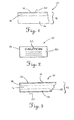
- FIG. 1 is a schematical end elevational representation of the decorative panel of the present invention which may take the form of a partition panel or a ceiling tile;
- FIG. 2 is a schematical top plan view showing the exposed printed face of the facing layer of the decorative panel shown in FIG. 1 ;
- FIG. 3 shows a panel with a central base zone and opposing densified surface zone faces.
- FIG. 1 showing the decorative panel 10 of the present invention.
- decorative panel 10 takes the form of a partition panel or ceiling tile. It should be appreciated, however, that these are just two possible applications for the decorative panel 10 of the present invention and that they should be considered as being merely illustrative in nature rather than limiting in scope.
- Exemplary of other possible products of the present invention are hood liners, head liners, trim panels, vehicle sun visors, building panels, basement finishing systems, bulletin boards, business cards, display boards, picture frames and storage boxes.
- the decorative panel 10 is constructed from a single layer 12 of polymer based blanket material having fibers exhibiting desirable acoustical and/or thermal insulating properties as well as moisture wicking. Those fibers may be selected from a group consisting of polyester, polyolefin, polypropylene, polyethylene, fiberglass, acrylic, natural fibers such as kenaf and cotton, nylon, rayon and blends thereof.
- the layer 12 of polymer based blanket material includes a surface zone 14 , a base zone 16 and an intermediate zone 18 .
- the exposed face 20 of the surface zone 14 bears printing 22 .
- the surface zone 14 may be densified relative to the base zone 16 and intermediate zone 18 if desired so as to make the face 20 particularly smooth thereby allowing high definition printing/coloring.
- the face 20 may also be water and stain resistant.
- the printing 22 on the exposed face 20 may take substantially any form such as a landscape graphic, a natural wood or stone image, a design, a pattern or indicia.
- the printing may even take the form of a product warning such as commonly found in automobiles or around other machinery. In essence, substantially any image that may be printed can be used.
- the polymer based blanket material may be selected from a group of materials consisting of polyester, polyolefin, polypropylene, polyethylene, fiberglass, acrylic, natural fibers, nylon, rayon and blends thereof.
- One example of a commonly used polymer based blanket material includes both polyester staple fibers and polyester bicomponent fibers.
- the polyester staple fibers and polyester bicomponent fibers may have diameters of between about 8.0 to about 50.0 microns and lengths between about 1.25 and 8.0 cm.
- the polymer based blanket material may include meltblown microfibers if desired.
- the polymer based blanket material may also include a targeted amount of fire retardant fibers.
- the densified surface zone 14 has a first density A
- the base zone 16 has a second density B
- the intermediate zone 18 has a third density C where A>C>B. More specifically, the densified surface zone 14 has a density of between about 1.5 pcf and about 15.0 pcf.
- the base zone 16 has a density of between about 0.5 pcf and about 10.0 pcf.
- the intermediate zone 18 has a density of between about 0.5 pcf and about 10.0 pcf.
- the densified surface zone 14 has a thickness of between about 0.038 and about 0.38 cm.
- the base zone 16 has a thickness of between about 0.38 and about 5.08 cm.
- the intermediate zone 18 has a thickness of between about 0.127 and about 1.27 cm.
- the densified surface zone 14 includes fibers having a diameter D.
- the base layer 16 includes fibers having a diameter E and the intermediate zone 18 includes fibers having a diameter F where F>E>D. More specifically, the densified surface zone 14 includes fibers having a diameter of between about 5.0 to about 25.0 microns and a length of between about 1.27 to about 6.35 cm.
- the base zone 16 includes fibers having a diameter of between about 10.0 and about 50.0 microns and a length of between about 2.54 and about 7.62 cm.
- the intermediate zone 18 includes fibers having a diameter of between about 10.0 and about 50.0 microns and a length of between about 2.54 and about 7.62 cm.
- the present invention represents a significant advance in the art.
- the performance characteristics of the panel 10 may be tuned in order to obtain the tackability, NRC and printability properties required for a multitude of different applications.
- the layer 12 of polymer based blanket material may be subjected to differential densification as taught in copending U.S. patent application Ser. No. 10/040,697, filed Nov. 9, 2001 and entitled “Multidensity Liner/Insulator” (OC Case No. 24981).
- This allows the panel 10 of the present invention to meet various acoustical, rigidity, tackability and printability requirements.
- the density, thickness, fiber diameter and fiber chemical composition of the zones may be altered in order to meet this end.
- the base zone 16 could be of low density and include medium fiber diameters to economically provide good acoustical properties.
- the intermediate zone 18 could be of medium density and incorporate coarse fibers to economically provide desired stiffness and tackability.
- the surface zone 14 could be very thin and incorporate a high density of fine fibers to provide a superior printing surface. Any or all of the zones could have a targeted amount of fire retardant fibers if desired.
- the surface zone 14 when the surface zone 14 is constructed from polyester fibers having an average fiber diameter of between about 10 and about 50 microns and, more typically, about 10 and about 30 microns that are densified to a density of between about 1.5 pcf and about 15.0 pcf, the surface zone advantageously provides an airflow resistance of between about 10,000 and about 1,000,000 mks rayls/meter.
- the surface zone 14 has many advantages over paper and other film facing layers commonly utilized in the art since it retains some degree of air porosity. This provides an acoustic benefit over solid, non-porous films.
- the acoustical properties of the panel 10 may be tuned to absorb and/or reflect various frequency ranges by changing the porosity properties of the surface zone 14 .
- Thickness, density and fiber formulation can all be utilized to tune the acoustics to provide better overall sound attenuating properties for any particular application.
- Papers, fabrics and films generally utilized as decorative facings in office panels, basement finishing systems and ceiling tiles known in the art lack the ability to significantly enhance the acoustics of the finished product. Further, these prior art facings and fabrics are expensive and time consuming to install onto board products thereby significantly increasing production costs.
- the panel 10 may be prepared by differential heating and uniform compression.
- the panel 10 shown in FIG. 1 is prepared by heating one side of the blanket layer 12 , i.e., the side to include the heat-seared, densified surface zone 14 , while the other side remains relatively cool.
- a pressure is then applied for sufficient time to allow the polymer binding fiber to soften near the hot surface but not near the cold surface.
- the hot side is reshaped into a higher density surface layer 14 .
- the cool side of the polymer binding fiber does not soften and, therefore, when the pressure is removed, the base zone 16 retains most of its original thickness and density characteristics.
- the intermediate zone 18 undergoes only moderate densification. This technique may be performed in a standard molding press where one platen runs hot and the other runs cool. In this manner, it is possible to provide the surface zone 14 of the polymer based blanket layer 12 with a density of between about 1.5 pcf and about 15.0 pcf. This is followed by the printing of a selected face of the facing layer with desired graphics, patterns, designs or indicia.
- printing 22 may be provided with virtually any color or pattern and in a high level of detail.
- patterns representing fabric, stone, marble, granite, wood as well as abstract color patterns and fictional or actual photographs may be printed on the exposed face 20 of the surface zone 14 .
- the subject matter capable of being printed on the exposed face 20 is only limited by one's imagination.
- the printing may be completed by substantially any known printing process suitable for printing on the exposed face 20 of the densified polyester surface zone 14 . Exemplary of these techniques, without being limiting, are laser printing, lithography, wallpaper printing processes and heat transfer processes.
- the decorative panel 10 of the present invention has enhanced acoustical insulating properties which may be successfully tuned for particular applications. Further, the material will not delaminate thereby enhancing the service life of the final product.
- the densified surface zone 14 adds rigidity to the panel 10 so as to make the panel easier to handle thereby aiding trouble-free installation.
- the densified surface zone 14 also is relatively water-resistant and as such is also stain resistant.
- the densified surface zone 14 also provides the decorative panel 10 with good tackability so that it will not only receive but also hold fasteners and maintain its position following mounting to a wall stud, vehicle body panel or other support.
- the opposite side of the panel could also include a densified surface zone and an intermediate zone between that second densified surface zone and the base zone (see FIG. 3 ).
- This could be accomplished by passing the layer 12 of polymer based blanket material through the nip of two opposing heated pressure rolls. Those rolls provide sufficient pressure to compress the blanket material and sufficient heat to cause melting of the low temperature component of the bicomponent fibers at least in the surface zone. Of course, the melted component would need to set before releasing the pressure rolls in order to densify the surface zones 14 to the desired level. Under these circumstances, some densification would also take place in the two intermediate zones 18 while the base zone 16 would essentially return to its original density. Either or both of the exposed faces 20 of the densified surface zones 14 could include printing 22 .
Abstract
Description
Claims (27)
Priority Applications (4)
| Application Number | Priority Date | Filing Date | Title |
|---|---|---|---|
| US10/421,565 US8039091B2 (en) | 2003-04-23 | 2003-04-23 | Decorative panel with surface printing |
| EP20040749627 EP1615762A2 (en) | 2003-04-23 | 2004-04-01 | Decorative panel with surface printing |
| PCT/US2004/010053 WO2004094164A2 (en) | 2003-04-23 | 2004-04-01 | Decorative panel with surface printing |
| CA 2522375 CA2522375A1 (en) | 2003-04-23 | 2004-04-01 | Decorative panel with surface printing |
Applications Claiming Priority (1)
| Application Number | Priority Date | Filing Date | Title |
|---|---|---|---|
| US10/421,565 US8039091B2 (en) | 2003-04-23 | 2003-04-23 | Decorative panel with surface printing |
Publications (2)
| Publication Number | Publication Date |
|---|---|
| US20040213964A1 US20040213964A1 (en) | 2004-10-28 |
| US8039091B2 true US8039091B2 (en) | 2011-10-18 |
Family
ID=33298707
Family Applications (1)
| Application Number | Title | Priority Date | Filing Date |
|---|---|---|---|
| US10/421,565 Expired - Fee Related US8039091B2 (en) | 2003-04-23 | 2003-04-23 | Decorative panel with surface printing |
Country Status (4)
| Country | Link |
|---|---|
| US (1) | US8039091B2 (en) |
| EP (1) | EP1615762A2 (en) |
| CA (1) | CA2522375A1 (en) |
| WO (1) | WO2004094164A2 (en) |
Cited By (2)
| Publication number | Priority date | Publication date | Assignee | Title |
|---|---|---|---|---|
| US20030008592A1 (en) * | 2000-06-30 | 2003-01-09 | Block Thomas L. | Hood, dash, firewall or engine cover liner |
| US8678458B2 (en) * | 2012-08-09 | 2014-03-25 | Faurecia Interior Systems, Inc. | Vehicle interior components with decorative stitching |
Families Citing this family (9)
| Publication number | Priority date | Publication date | Assignee | Title |
|---|---|---|---|---|
| US20040219853A1 (en) * | 2003-03-31 | 2004-11-04 | Weir Charles R. | Room finishing system |
| US8039091B2 (en) | 2003-04-23 | 2011-10-18 | Owens Corning Intellectual Capital, Llc | Decorative panel with surface printing |
| US7537818B2 (en) * | 2003-07-01 | 2009-05-26 | International Automotive Components Group North America, Inc. | Sound absorptive multilayer articles and methods of producing same |
| US20060123723A1 (en) * | 2004-12-09 | 2006-06-15 | Weir Charles R | Wall finishing panel system |
| US20060234016A1 (en) * | 2005-02-24 | 2006-10-19 | Neill John M | Customizable ceiling or wall panels and method of construction |
| US20080003907A1 (en) * | 2006-06-28 | 2008-01-03 | Samuel Keith Black | Facing Product for Vehicular Trim |
| DE102006051567A1 (en) * | 2006-11-02 | 2008-05-08 | Illbruck Acoustic Gmbh | A decorative wall element forming acoustic absorber |
| US11207863B2 (en) | 2018-12-12 | 2021-12-28 | Owens Corning Intellectual Capital, Llc | Acoustic insulator |
| US11666199B2 (en) | 2018-12-12 | 2023-06-06 | Owens Corning Intellectual Capital, Llc | Appliance with cellulose-based insulator |
Citations (84)
| Publication number | Priority date | Publication date | Assignee | Title |
|---|---|---|---|---|
| US2612462A (en) | 1947-11-20 | 1952-09-30 | Johns Manville | Laminated insulating block and method of making the same |
| US2851730A (en) | 1952-10-17 | 1958-09-16 | Holzwerke H Wilhelmi O H G Fa | Production of multi-layer boards |
| US3096879A (en) | 1957-12-12 | 1963-07-09 | Stanley P Schumacher | Packaging material and package |
| US3344973A (en) | 1966-04-21 | 1967-10-03 | Charles E Studen | Lined container |
| US3404748A (en) | 1967-12-06 | 1968-10-08 | Griffolyn Company Inc | Insulation laminate with reinforcing fibers and corrugated layer |
| US3581453A (en) | 1969-01-02 | 1971-06-01 | Owens Corning Fiberglass Corp | Fibrous ceiling surfacing system |
| US3835604A (en) | 1971-01-13 | 1974-09-17 | Certain Teed Prod Corp | Building insulation with decorative facing |
| US3882216A (en) | 1973-08-09 | 1975-05-06 | Int Paper Co | Disposable diaper |
| US3907193A (en) | 1974-04-08 | 1975-09-23 | Autoplex Corp | Plastic folding containers and process and apparatus for making same |
| US4103062A (en) * | 1976-06-14 | 1978-07-25 | Johnson & Johnson | Absorbent panel having densified portion with hydrocolloid material fixed therein |
| US4131664A (en) | 1977-09-28 | 1978-12-26 | Allen Industries, Inc. | Method of making a multiple-density fibrous acoustical panel |
| US4135024A (en) * | 1976-08-16 | 1979-01-16 | Scott Paper Company | Method of treating a low integrity dry-formed nonwoven web and product made therefrom |
| US4175148A (en) | 1976-11-05 | 1979-11-20 | Masonite Corporation | Product containing high density skins on a low density core and method of manufacturing same |
| US4213516A (en) | 1978-11-29 | 1980-07-22 | American Seating Company | Acoustical wall panel |
| US4230753A (en) | 1978-07-07 | 1980-10-28 | Stauffer Chemical Company | Pressure sensitive composite article |
| US4283445A (en) * | 1979-06-25 | 1981-08-11 | Klaus Bartholl | Non-woven organic mulch blanket with polyvinylacetate copolymer binder |
| US4377615A (en) | 1980-09-20 | 1983-03-22 | Uni-Charm Corporation | Nonwoven fabrics and method of producing the same |
| US4428454A (en) | 1981-09-24 | 1984-01-31 | Capaul Raymond W | Acoustical panel construction |
| US4430286A (en) | 1980-07-14 | 1984-02-07 | Celotex Corporation | Variable density board having improved thermal and acoustical properties and method and apparatus for producing same |
| US4539252A (en) | 1980-07-14 | 1985-09-03 | Celotex Corporation | Variable density board having improved thermal and acoustical properties and method and apparatus for producing same |
| US4588457A (en) * | 1983-03-11 | 1986-05-13 | The Procter & Gamble Company | Two-ply nonwoven fabric laminate |
| US4624083A (en) | 1983-12-05 | 1986-11-25 | Hauserman, Inc. | Screen system for offices and method of making and installing same |
| US4627199A (en) | 1984-09-24 | 1986-12-09 | Capaul Raymond W | Tackable acoustical structure |
| US4711685A (en) | 1982-07-06 | 1987-12-08 | Usg Acoustical Products Company | Soft textured reveal edge ceiling board and process for its manufacture |
| US4914767A (en) * | 1989-09-05 | 1990-04-10 | Walnel Corporation | Sun dial beach blanket with pillow |
| US4946738A (en) | 1987-05-22 | 1990-08-07 | Guardian Industries Corp. | Non-woven fibrous product |
| US5149920A (en) | 1989-11-09 | 1992-09-22 | Fiber-Lite Corporation | Acoustical panel and method of making same |
| US5221573A (en) * | 1991-12-30 | 1993-06-22 | Kem-Wove, Inc. | Adsorbent textile product |
| US5298319A (en) | 1992-03-13 | 1994-03-29 | Phillips Petroleum Company | Moldable automotive trunk liner |
| US5339730A (en) * | 1991-06-28 | 1994-08-23 | Kaysersberg | Method for printing-embossing paper sheets |
| US5372885A (en) * | 1984-08-15 | 1994-12-13 | The Dow Chemical Company | Method for making bicomponent fibers |
| US5421133A (en) | 1993-05-20 | 1995-06-06 | Berdan, Ii; Clarke | Insulation batt with extended flange |
| US5436046A (en) * | 1993-06-30 | 1995-07-25 | Ikeda Bussan Co., Ltd. | Interior finishing web and method of producing the same |
| US5451437A (en) | 1993-06-21 | 1995-09-19 | Minnesota Mining And Manufacturing Company | Method and article for protecting a container that holds a fluid |
| US5458590A (en) * | 1993-12-20 | 1995-10-17 | Kimberly-Clark Corporation | Ink-printed, low basis weight nonwoven fibrous webs and method |
| US5492662A (en) | 1994-10-17 | 1996-02-20 | Kargol; James A. | Process for forming multiple density body from fibrous polymeric material and vehicle seat component formed thereby |
| US5501898A (en) | 1992-08-26 | 1996-03-26 | Firma Carl Freudenberg | Interior equipment part for vehicles |
| US5503076A (en) * | 1993-12-01 | 1996-04-02 | Kimberly-Clark Corporation | Multi-color printed nonwoven laminates |
| WO1997006320A1 (en) | 1995-08-03 | 1997-02-20 | Hermanson Lars S | Self-supporting interior surface panel |
| US5616418A (en) * | 1990-06-01 | 1997-04-01 | Atochem | Thermoplastic elastomer polyblends comprising polyamides/modified polyolefins and shaped articles produced therefrom |
| US5629005A (en) * | 1992-05-01 | 1997-05-13 | British United Shoe Machinery Limited | Absorbent material and a method of making same |
| US5674591A (en) * | 1994-09-16 | 1997-10-07 | James; William A. | Nonwoven fabrics having raised portions |
| DE19616672A1 (en) | 1996-04-26 | 1997-10-30 | Audi Ag | Composite sheets useful for forming impact resistant automobile components |
| US5804512A (en) * | 1995-06-07 | 1998-09-08 | Bba Nonwovens Simpsonville, Inc. | Nonwoven laminate fabrics and processes of making same |
| US5817408A (en) | 1996-09-25 | 1998-10-06 | Nissan Motor Co., Ltd. | Sound insulation structure |
| US5823611A (en) | 1995-09-18 | 1998-10-20 | Prince Corporation | Headliner with integral impact absorption panels |
| US5841081A (en) * | 1995-06-23 | 1998-11-24 | Minnesota Mining And Manufacturing Company | Method of attenuating sound, and acoustical insulation therefor |
| US5886306A (en) | 1997-07-22 | 1999-03-23 | Kg Fibers, Inc. | Layered acoustical insulating web |
| EP0909680A1 (en) | 1997-10-16 | 1999-04-21 | Nissan Motor Company, Limited | Noise insulating structure for automotive vehicle passenger compartment |
| USRE36323E (en) | 1993-01-21 | 1999-10-05 | Minnesota Mining And Manufacturing Company | Acoustical insulating web |
| US6066388A (en) * | 1993-01-26 | 2000-05-23 | Van Kerrebrouck; Jozef | Process for the production of a nonwoven and nonwoven obtained by this process |
| US6123171A (en) | 1999-02-24 | 2000-09-26 | Mcnett; Christopher P. | Acoustic panels having plural damping layers |
| US6217691B1 (en) | 1998-12-24 | 2001-04-17 | Johns Manville International, Inc. | Method of making a meltblown fibrous insulation |
| US6321871B1 (en) | 1999-03-19 | 2001-11-27 | Robert Lindsay Russell | Acoustic panels and the like |
| US6345688B1 (en) | 1999-11-23 | 2002-02-12 | Johnson Controls Technology Company | Method and apparatus for absorbing sound |
| US6372870B1 (en) * | 1997-06-23 | 2002-04-16 | Daikin Industries Ltd. | Tetrafluoroethylene copolymer and use thereof |
| US6420013B1 (en) * | 1996-06-14 | 2002-07-16 | The Procter & Gamble Company | Multiply tissue paper |
| US20020099347A1 (en) * | 1997-03-21 | 2002-07-25 | Fung-Jou Chen | Dual-zoned absorbent webs |
| US6436512B1 (en) * | 1999-08-13 | 2002-08-20 | First Quality Nonwovens, Inc. | Nonwoven fabric with high CD elongation and method of making same |
| US6443256B1 (en) | 2000-12-27 | 2002-09-03 | Usg Interiors, Inc. | Dual layer acoustical ceiling tile having an improved sound absorption value |
| US20020123289A1 (en) | 1999-05-28 | 2002-09-05 | Deangelis Alfred R. | Felt having conductivity gradient |
| US6459016B1 (en) * | 1999-12-23 | 2002-10-01 | Mcneil-Ppc, Inc. | Absorbent article with multiple high absorbency zones |
| US20030008093A1 (en) | 2000-05-16 | 2003-01-09 | Johns Manville International, Inc. | Fire resistant polymeric film and insulation assembly |
| US20030008581A1 (en) | 2000-06-30 | 2003-01-09 | Tilton Jeffrey A. | Multidensity liner/insulator |
| US20030066708A1 (en) | 2001-10-05 | 2003-04-10 | Allison T. J. | Sound attenuating material for use within vehicles and methods of making same |
| US20030068943A1 (en) | 2001-09-28 | 2003-04-10 | Fay Ralph Michael | Equipment and duct liner insulation and method |
| US20030082387A1 (en) | 2001-10-30 | 2003-05-01 | Arndt William R. | Insulation facing material z-fold area coating |
| US6572575B1 (en) | 1999-08-20 | 2003-06-03 | Uni-Charm Corporation | Disposable diaper having pattern sheet, and method for manufacturing the same |
| US6610390B1 (en) * | 1999-08-13 | 2003-08-26 | First Quality Nonwovens, Inc. | Nonwoven with non-symmetrical bonding configuration |
| US20040002274A1 (en) * | 2002-06-27 | 2004-01-01 | Tilton Jeffrey A. | Decorative laminate for fibrous insulation products |
| US6726980B2 (en) | 2001-11-09 | 2004-04-27 | Owens Corning Fiberglass Technology, Inc. | Acoustic doorliner with integral water barrier |
| US6746766B2 (en) * | 2001-05-10 | 2004-06-08 | The Procter & Gamble Company | Multicomponent fibers comprising starch and polymers |
| US6756332B2 (en) | 1998-01-30 | 2004-06-29 | Jason Incorporated | Vehicle headliner and laminate therefor |
| US6770339B2 (en) | 2002-08-08 | 2004-08-03 | Johns Manville International, Inc. | Insulation package |
| WO2004094164A2 (en) | 2003-04-23 | 2004-11-04 | Owens Corning | Decorative panel with surface printing |
| US6875315B2 (en) | 2002-12-19 | 2005-04-05 | Kimberly-Clark Worldwide, Inc. | Non-woven through air dryer and transfer fabrics for tissue making |
| US6878238B2 (en) * | 2002-12-19 | 2005-04-12 | Kimberly-Clark Worldwide, Inc. | Non-woven through air dryer and transfer fabrics for tissue making |
| US6878427B2 (en) | 2002-12-20 | 2005-04-12 | Kimberly Clark Worldwide, Inc. | Encased insulation article |
| US6890622B2 (en) * | 2001-12-20 | 2005-05-10 | Kimberly-Clark Worldwide, Inc. | Composite fluid distribution and fluid retention layer having selective material deposition zones for personal care products |
| US6893711B2 (en) | 2002-08-05 | 2005-05-17 | Kimberly-Clark Worldwide, Inc. | Acoustical insulation material containing fine thermoplastic fibers |
| US6900147B2 (en) | 2001-11-28 | 2005-05-31 | Kimberly-Clark Worldwide, Inc. | Nonwoven webs having improved necking uniformity |
| US6921570B2 (en) * | 2001-12-21 | 2005-07-26 | Kimberly-Clark Worldwide, Inc. | Pattern unbonded nonwoven web and process for making same |
| US6925765B2 (en) | 2002-12-27 | 2005-08-09 | Johns Manville | Facing and faced insulation assembly |
| EP2256020A2 (en) | 2005-01-14 | 2010-12-01 | NSK Ltd. | Control apparatus for electric power steering apparatus |
Family Cites Families (7)
| Publication number | Priority date | Publication date | Assignee | Title |
|---|---|---|---|---|
| US8581A (en) * | 1851-12-09 | Improvement in feeding logs in saw-mills | ||
| US117352A (en) * | 1871-07-25 | Improvement in machines for cutting cloth | ||
| US50139A (en) * | 1865-09-26 | Machine for finishing the cascabel of guns | ||
| US66708A (en) * | 1867-07-16 | Improved sobghum-evapoeatok | ||
| US2615462A (en) * | 1946-09-13 | 1952-10-28 | James T Crowder | Centrifugal governor having a series of radially shiftable, motion transmitting bell crank levers |
| US6754686B1 (en) * | 2000-10-13 | 2004-06-22 | Xilinx, Inc. | Literal sharing method for fast sum-of-products logic |
| KR100474891B1 (en) * | 2001-12-20 | 2005-03-08 | 엘지전자 주식회사 | organic electroluminescent display device |
-
2003
- 2003-04-23 US US10/421,565 patent/US8039091B2/en not_active Expired - Fee Related
-
2004
- 2004-04-01 EP EP20040749627 patent/EP1615762A2/en not_active Withdrawn
- 2004-04-01 WO PCT/US2004/010053 patent/WO2004094164A2/en active Search and Examination
- 2004-04-01 CA CA 2522375 patent/CA2522375A1/en not_active Abandoned
Patent Citations (91)
| Publication number | Priority date | Publication date | Assignee | Title |
|---|---|---|---|---|
| US2612462A (en) | 1947-11-20 | 1952-09-30 | Johns Manville | Laminated insulating block and method of making the same |
| US2851730A (en) | 1952-10-17 | 1958-09-16 | Holzwerke H Wilhelmi O H G Fa | Production of multi-layer boards |
| US3096879A (en) | 1957-12-12 | 1963-07-09 | Stanley P Schumacher | Packaging material and package |
| US3344973A (en) | 1966-04-21 | 1967-10-03 | Charles E Studen | Lined container |
| US3404748A (en) | 1967-12-06 | 1968-10-08 | Griffolyn Company Inc | Insulation laminate with reinforcing fibers and corrugated layer |
| US3581453A (en) | 1969-01-02 | 1971-06-01 | Owens Corning Fiberglass Corp | Fibrous ceiling surfacing system |
| US3835604A (en) | 1971-01-13 | 1974-09-17 | Certain Teed Prod Corp | Building insulation with decorative facing |
| US3882216A (en) | 1973-08-09 | 1975-05-06 | Int Paper Co | Disposable diaper |
| US3907193A (en) | 1974-04-08 | 1975-09-23 | Autoplex Corp | Plastic folding containers and process and apparatus for making same |
| US4103062A (en) * | 1976-06-14 | 1978-07-25 | Johnson & Johnson | Absorbent panel having densified portion with hydrocolloid material fixed therein |
| US4135024A (en) * | 1976-08-16 | 1979-01-16 | Scott Paper Company | Method of treating a low integrity dry-formed nonwoven web and product made therefrom |
| US4175148A (en) | 1976-11-05 | 1979-11-20 | Masonite Corporation | Product containing high density skins on a low density core and method of manufacturing same |
| US4131664A (en) | 1977-09-28 | 1978-12-26 | Allen Industries, Inc. | Method of making a multiple-density fibrous acoustical panel |
| US4230753A (en) | 1978-07-07 | 1980-10-28 | Stauffer Chemical Company | Pressure sensitive composite article |
| US4213516A (en) | 1978-11-29 | 1980-07-22 | American Seating Company | Acoustical wall panel |
| US4283445A (en) * | 1979-06-25 | 1981-08-11 | Klaus Bartholl | Non-woven organic mulch blanket with polyvinylacetate copolymer binder |
| US4430286A (en) | 1980-07-14 | 1984-02-07 | Celotex Corporation | Variable density board having improved thermal and acoustical properties and method and apparatus for producing same |
| US4539252A (en) | 1980-07-14 | 1985-09-03 | Celotex Corporation | Variable density board having improved thermal and acoustical properties and method and apparatus for producing same |
| US4377615A (en) | 1980-09-20 | 1983-03-22 | Uni-Charm Corporation | Nonwoven fabrics and method of producing the same |
| US4428454A (en) | 1981-09-24 | 1984-01-31 | Capaul Raymond W | Acoustical panel construction |
| US4711685A (en) | 1982-07-06 | 1987-12-08 | Usg Acoustical Products Company | Soft textured reveal edge ceiling board and process for its manufacture |
| US4588457A (en) * | 1983-03-11 | 1986-05-13 | The Procter & Gamble Company | Two-ply nonwoven fabric laminate |
| US4624083A (en) | 1983-12-05 | 1986-11-25 | Hauserman, Inc. | Screen system for offices and method of making and installing same |
| US5372885A (en) * | 1984-08-15 | 1994-12-13 | The Dow Chemical Company | Method for making bicomponent fibers |
| US4627199A (en) | 1984-09-24 | 1986-12-09 | Capaul Raymond W | Tackable acoustical structure |
| US4946738A (en) | 1987-05-22 | 1990-08-07 | Guardian Industries Corp. | Non-woven fibrous product |
| US4914767A (en) * | 1989-09-05 | 1990-04-10 | Walnel Corporation | Sun dial beach blanket with pillow |
| US5149920A (en) | 1989-11-09 | 1992-09-22 | Fiber-Lite Corporation | Acoustical panel and method of making same |
| US5616418A (en) * | 1990-06-01 | 1997-04-01 | Atochem | Thermoplastic elastomer polyblends comprising polyamides/modified polyolefins and shaped articles produced therefrom |
| US5339730A (en) * | 1991-06-28 | 1994-08-23 | Kaysersberg | Method for printing-embossing paper sheets |
| US5221573A (en) * | 1991-12-30 | 1993-06-22 | Kem-Wove, Inc. | Adsorbent textile product |
| US5298319A (en) | 1992-03-13 | 1994-03-29 | Phillips Petroleum Company | Moldable automotive trunk liner |
| US5629005A (en) * | 1992-05-01 | 1997-05-13 | British United Shoe Machinery Limited | Absorbent material and a method of making same |
| US5501898A (en) | 1992-08-26 | 1996-03-26 | Firma Carl Freudenberg | Interior equipment part for vehicles |
| USRE36323E (en) | 1993-01-21 | 1999-10-05 | Minnesota Mining And Manufacturing Company | Acoustical insulating web |
| US6066388A (en) * | 1993-01-26 | 2000-05-23 | Van Kerrebrouck; Jozef | Process for the production of a nonwoven and nonwoven obtained by this process |
| US5421133A (en) | 1993-05-20 | 1995-06-06 | Berdan, Ii; Clarke | Insulation batt with extended flange |
| US5451437A (en) | 1993-06-21 | 1995-09-19 | Minnesota Mining And Manufacturing Company | Method and article for protecting a container that holds a fluid |
| US5436046A (en) * | 1993-06-30 | 1995-07-25 | Ikeda Bussan Co., Ltd. | Interior finishing web and method of producing the same |
| US5503076A (en) * | 1993-12-01 | 1996-04-02 | Kimberly-Clark Corporation | Multi-color printed nonwoven laminates |
| US5458590A (en) * | 1993-12-20 | 1995-10-17 | Kimberly-Clark Corporation | Ink-printed, low basis weight nonwoven fibrous webs and method |
| US5674591A (en) * | 1994-09-16 | 1997-10-07 | James; William A. | Nonwoven fabrics having raised portions |
| US5492662A (en) | 1994-10-17 | 1996-02-20 | Kargol; James A. | Process for forming multiple density body from fibrous polymeric material and vehicle seat component formed thereby |
| US5804512A (en) * | 1995-06-07 | 1998-09-08 | Bba Nonwovens Simpsonville, Inc. | Nonwoven laminate fabrics and processes of making same |
| US5841081A (en) * | 1995-06-23 | 1998-11-24 | Minnesota Mining And Manufacturing Company | Method of attenuating sound, and acoustical insulation therefor |
| WO1997006320A1 (en) | 1995-08-03 | 1997-02-20 | Hermanson Lars S | Self-supporting interior surface panel |
| US5823611A (en) | 1995-09-18 | 1998-10-20 | Prince Corporation | Headliner with integral impact absorption panels |
| US5833304A (en) | 1995-09-18 | 1998-11-10 | Prince Corporation | Headliner with integral impact absorption panels |
| DE19616672A1 (en) | 1996-04-26 | 1997-10-30 | Audi Ag | Composite sheets useful for forming impact resistant automobile components |
| US6420013B1 (en) * | 1996-06-14 | 2002-07-16 | The Procter & Gamble Company | Multiply tissue paper |
| US5817408A (en) | 1996-09-25 | 1998-10-06 | Nissan Motor Co., Ltd. | Sound insulation structure |
| US20020107495A1 (en) * | 1997-03-21 | 2002-08-08 | Fung-Jou Chen | Dual-zoned absorbent webs |
| US20020099347A1 (en) * | 1997-03-21 | 2002-07-25 | Fung-Jou Chen | Dual-zoned absorbent webs |
| US6538084B2 (en) * | 1997-06-23 | 2003-03-25 | Daikin Industries, Ltd. | Tetrafluoroethylene copolymer and use thereof |
| US6372870B1 (en) * | 1997-06-23 | 2002-04-16 | Daikin Industries Ltd. | Tetrafluoroethylene copolymer and use thereof |
| US5886306A (en) | 1997-07-22 | 1999-03-23 | Kg Fibers, Inc. | Layered acoustical insulating web |
| EP0909680A1 (en) | 1997-10-16 | 1999-04-21 | Nissan Motor Company, Limited | Noise insulating structure for automotive vehicle passenger compartment |
| US6756332B2 (en) | 1998-01-30 | 2004-06-29 | Jason Incorporated | Vehicle headliner and laminate therefor |
| US6217691B1 (en) | 1998-12-24 | 2001-04-17 | Johns Manville International, Inc. | Method of making a meltblown fibrous insulation |
| US6358592B2 (en) | 1998-12-24 | 2002-03-19 | Johns Manville International, Inc. | Meltblown fibrous acoustic insulation |
| US20010050139A1 (en) | 1998-12-24 | 2001-12-13 | Johns Manville International, Inc. | Meltblown fibrous acoustic insulation |
| US6123171A (en) | 1999-02-24 | 2000-09-26 | Mcnett; Christopher P. | Acoustic panels having plural damping layers |
| US6321871B1 (en) | 1999-03-19 | 2001-11-27 | Robert Lindsay Russell | Acoustic panels and the like |
| US20020123289A1 (en) | 1999-05-28 | 2002-09-05 | Deangelis Alfred R. | Felt having conductivity gradient |
| US6436512B1 (en) * | 1999-08-13 | 2002-08-20 | First Quality Nonwovens, Inc. | Nonwoven fabric with high CD elongation and method of making same |
| US6610390B1 (en) * | 1999-08-13 | 2003-08-26 | First Quality Nonwovens, Inc. | Nonwoven with non-symmetrical bonding configuration |
| US6572575B1 (en) | 1999-08-20 | 2003-06-03 | Uni-Charm Corporation | Disposable diaper having pattern sheet, and method for manufacturing the same |
| US20020117352A1 (en) | 1999-11-23 | 2002-08-29 | Veen Gerald R. | Apparatus for absorbing sound |
| US6345688B1 (en) | 1999-11-23 | 2002-02-12 | Johnson Controls Technology Company | Method and apparatus for absorbing sound |
| US6459016B1 (en) * | 1999-12-23 | 2002-10-01 | Mcneil-Ppc, Inc. | Absorbent article with multiple high absorbency zones |
| US20030008093A1 (en) | 2000-05-16 | 2003-01-09 | Johns Manville International, Inc. | Fire resistant polymeric film and insulation assembly |
| US20030008581A1 (en) | 2000-06-30 | 2003-01-09 | Tilton Jeffrey A. | Multidensity liner/insulator |
| US6669265B2 (en) | 2000-06-30 | 2003-12-30 | Owens Corning Fiberglas Technology, Inc. | Multidensity liner/insulator |
| US6443256B1 (en) | 2000-12-27 | 2002-09-03 | Usg Interiors, Inc. | Dual layer acoustical ceiling tile having an improved sound absorption value |
| US6746766B2 (en) * | 2001-05-10 | 2004-06-08 | The Procter & Gamble Company | Multicomponent fibers comprising starch and polymers |
| US20030068943A1 (en) | 2001-09-28 | 2003-04-10 | Fay Ralph Michael | Equipment and duct liner insulation and method |
| US20030066708A1 (en) | 2001-10-05 | 2003-04-10 | Allison T. J. | Sound attenuating material for use within vehicles and methods of making same |
| US20030082387A1 (en) | 2001-10-30 | 2003-05-01 | Arndt William R. | Insulation facing material z-fold area coating |
| US6726980B2 (en) | 2001-11-09 | 2004-04-27 | Owens Corning Fiberglass Technology, Inc. | Acoustic doorliner with integral water barrier |
| US6900147B2 (en) | 2001-11-28 | 2005-05-31 | Kimberly-Clark Worldwide, Inc. | Nonwoven webs having improved necking uniformity |
| US6890622B2 (en) * | 2001-12-20 | 2005-05-10 | Kimberly-Clark Worldwide, Inc. | Composite fluid distribution and fluid retention layer having selective material deposition zones for personal care products |
| US6921570B2 (en) * | 2001-12-21 | 2005-07-26 | Kimberly-Clark Worldwide, Inc. | Pattern unbonded nonwoven web and process for making same |
| US20040002274A1 (en) * | 2002-06-27 | 2004-01-01 | Tilton Jeffrey A. | Decorative laminate for fibrous insulation products |
| US6893711B2 (en) | 2002-08-05 | 2005-05-17 | Kimberly-Clark Worldwide, Inc. | Acoustical insulation material containing fine thermoplastic fibers |
| US6770339B2 (en) | 2002-08-08 | 2004-08-03 | Johns Manville International, Inc. | Insulation package |
| US6875315B2 (en) | 2002-12-19 | 2005-04-05 | Kimberly-Clark Worldwide, Inc. | Non-woven through air dryer and transfer fabrics for tissue making |
| US6878238B2 (en) * | 2002-12-19 | 2005-04-12 | Kimberly-Clark Worldwide, Inc. | Non-woven through air dryer and transfer fabrics for tissue making |
| US6878427B2 (en) | 2002-12-20 | 2005-04-12 | Kimberly Clark Worldwide, Inc. | Encased insulation article |
| US6925765B2 (en) | 2002-12-27 | 2005-08-09 | Johns Manville | Facing and faced insulation assembly |
| WO2004094164A2 (en) | 2003-04-23 | 2004-11-04 | Owens Corning | Decorative panel with surface printing |
| EP2256020A2 (en) | 2005-01-14 | 2010-12-01 | NSK Ltd. | Control apparatus for electric power steering apparatus |
Non-Patent Citations (5)
| Title |
|---|
| International Search Report and Written Opinion from PCT/US04/10053 dated Mar. 23, 2005. |
| International Search report PCT/US2004/042517 dated Apr. 1, 2005. |
| Office action from European Application No. 04729627.8 dated Mar. 26, 2009. |
| US 03-0008093 A1 Jan. 2003 Ray et al 428/36.91. * |
| US -03-0068943A1 Apr. 2003 Fay 442/76. * |
Cited By (3)
| Publication number | Priority date | Publication date | Assignee | Title |
|---|---|---|---|---|
| US20030008592A1 (en) * | 2000-06-30 | 2003-01-09 | Block Thomas L. | Hood, dash, firewall or engine cover liner |
| US8361912B2 (en) * | 2000-06-30 | 2013-01-29 | Owens Corning Intellectual Capital, Llc | Hood, dash, firewall or engine cover liner |
| US8678458B2 (en) * | 2012-08-09 | 2014-03-25 | Faurecia Interior Systems, Inc. | Vehicle interior components with decorative stitching |
Also Published As
| Publication number | Publication date |
|---|---|
| CA2522375A1 (en) | 2004-11-04 |
| WO2004094164A2 (en) | 2004-11-04 |
| WO2004094164A3 (en) | 2005-05-19 |
| EP1615762A2 (en) | 2006-01-18 |
| US20040213964A1 (en) | 2004-10-28 |
Similar Documents
| Publication | Publication Date | Title |
|---|---|---|
| US20040002274A1 (en) | Decorative laminate for fibrous insulation products | |
| US7871947B2 (en) | Non-woven composite office panel | |
| US5832685A (en) | Self-supporting interior surface panel | |
| US4695501A (en) | Thermoformable composite articles | |
| US8039091B2 (en) | Decorative panel with surface printing | |
| US5547743A (en) | Thin high density glass fiber panel | |
| KR20060043576A (en) | Polyester staple fiber bases of head liner for vehicle and method of the same | |
| WO2005084934A1 (en) | Layered polymer fiber insulation and method of making thereof | |
| EP0978602A2 (en) | Reinforced ceiling panels | |
| JP2741683B2 (en) | Interior material and method of manufacturing the interior material | |
| JP2001047545A (en) | Soundproof material | |
| JP2800212B2 (en) | Composite panel and manufacturing method thereof | |
| KR100356197B1 (en) | Carpet having a good capability of shaping and its manufacturing method | |
| JP2005028864A (en) | Laminated surface material and laminate for interior triming material using same | |
| JP2699502B2 (en) | Structural material and its manufacturing method | |
| CN218906767U (en) | Fireproof noise-reduction wall decoration picture and installation structure thereof | |
| JPH0129076Y2 (en) | ||
| JPH08311760A (en) | Non-woven fabric for interior material | |
| KR102530117B1 (en) | Semi-noncombustible sound absorbing insulation and its manufacturing method | |
| US20220268029A1 (en) | A sound tuning layer and a panel for acoustic treatment of a space | |
| KR20060065153A (en) | Functional sound absorbing board by ethying process | |
| EP1632398B1 (en) | Headliner and method of manufacturing the same | |
| CN117507669A (en) | Fireproof and noise-reduction wall decoration picture, and mounting structure and production process thereof | |
| JP2573777Y2 (en) | Insulating sound absorbing board and decorative sheet made of inorganic fiber | |
| KR200343818Y1 (en) | Producing method of polyster absorptive material |
Legal Events
| Date | Code | Title | Description |
|---|---|---|---|
| AS | Assignment |
Owner name: OWENS-CORNING FIBERGLAS TECHNOLOGY, INC., ILLINOIS Free format text: ASSIGNMENT OF ASSIGNORS INTEREST;ASSIGNORS:TILTON, JEFFREY A.;BERDAN, CLARKE;PARKS, JERRY M.;REEL/FRAME:014319/0353;SIGNING DATES FROM 20030505 TO 20030507 Owner name: OWENS-CORNING FIBERGLAS TECHNOLOGY, INC., ILLINOIS Free format text: ASSIGNMENT OF ASSIGNORS INTEREST;ASSIGNORS:TILTON, JEFFREY A.;BERDAN, CLARKE;PARKS, JERRY M.;SIGNING DATES FROM 20030505 TO 20030507;REEL/FRAME:014319/0353 |
|
| ZAAA | Notice of allowance and fees due |
Free format text: ORIGINAL CODE: NOA |
|
| ZAAB | Notice of allowance mailed |
Free format text: ORIGINAL CODE: MN/=. |
|
| ZAAA | Notice of allowance and fees due |
Free format text: ORIGINAL CODE: NOA |
|
| ZAAB | Notice of allowance mailed |
Free format text: ORIGINAL CODE: MN/=. |
|
| AS | Assignment |
Owner name: OWENS CORNING INTELLECTUAL CAPITAL, LLC, OHIO Free format text: ASSIGNMENT OF ASSIGNORS INTEREST;ASSIGNOR:OWENS-CORNING FIBERGLASS TECHNOLOGY, INC.;REEL/FRAME:019795/0433 Effective date: 20070803 Owner name: OWENS CORNING INTELLECTUAL CAPITAL, LLC,OHIO Free format text: ASSIGNMENT OF ASSIGNORS INTEREST;ASSIGNOR:OWENS-CORNING FIBERGLASS TECHNOLOGY, INC.;REEL/FRAME:019795/0433 Effective date: 20070803 Owner name: OWENS CORNING INTELLECTUAL CAPITAL, LLC, OHIO Free format text: ASSIGNMENT OF ASSIGNORS INTEREST;ASSIGNOR:OWENS-CORNING FIBERGLAS TECHNOLOGY, INC.;REEL/FRAME:019795/0433 Effective date: 20070803 |
|
| ZAAA | Notice of allowance and fees due |
Free format text: ORIGINAL CODE: NOA |
|
| ZAAB | Notice of allowance mailed |
Free format text: ORIGINAL CODE: MN/=. |
|
| STCF | Information on status: patent grant |
Free format text: PATENTED CASE |
|
| FEPP | Fee payment procedure |
Free format text: PAYOR NUMBER ASSIGNED (ORIGINAL EVENT CODE: ASPN); ENTITY STATUS OF PATENT OWNER: LARGE ENTITY |
|
| FEPP | Fee payment procedure |
Free format text: PAYER NUMBER DE-ASSIGNED (ORIGINAL EVENT CODE: RMPN); ENTITY STATUS OF PATENT OWNER: LARGE ENTITY Free format text: PAYOR NUMBER ASSIGNED (ORIGINAL EVENT CODE: ASPN); ENTITY STATUS OF PATENT OWNER: LARGE ENTITY |
|
| FPAY | Fee payment |
Year of fee payment: 4 |
|
| MAFP | Maintenance fee payment |
Free format text: PAYMENT OF MAINTENANCE FEE, 8TH YEAR, LARGE ENTITY (ORIGINAL EVENT CODE: M1552); ENTITY STATUS OF PATENT OWNER: LARGE ENTITY Year of fee payment: 8 |
|
| FEPP | Fee payment procedure |
Free format text: MAINTENANCE FEE REMINDER MAILED (ORIGINAL EVENT CODE: REM.); ENTITY STATUS OF PATENT OWNER: LARGE ENTITY |
|
| LAPS | Lapse for failure to pay maintenance fees |
Free format text: PATENT EXPIRED FOR FAILURE TO PAY MAINTENANCE FEES (ORIGINAL EVENT CODE: EXP.); ENTITY STATUS OF PATENT OWNER: LARGE ENTITY |
|
| STCH | Information on status: patent discontinuation |
Free format text: PATENT EXPIRED DUE TO NONPAYMENT OF MAINTENANCE FEES UNDER 37 CFR 1.362 |
|
| FP | Lapsed due to failure to pay maintenance fee |
Effective date: 20231018 |